Bard President for 51 years, Leon Botstein, will step down after Jeffrey Epstein investigation!

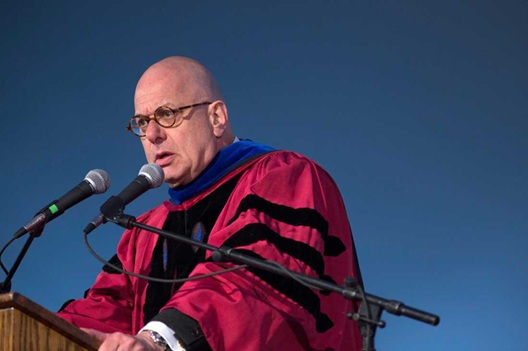
Leon Botstein. Philip Kamrass/AP.

Dear Commons Community,

Leon Botstein, president of Bard College, will retire in June, capping a 51-year stint at the helm of the institution and a tumultuous final year in which his ties to the convicted sex offender Jeffrey Epstein came under intense scrutiny.

The Friday announcement came as Bard’s Board of Trustees released the results of a law firm’s investigation into those ties. In a three-page summary, the firm, WilmerHale, concluded that Botstein “minimized and was not fully accurate in describing his relationship with Epstein.”  As reported by The Chronicle of Higher Education and The Associated Press.

The board’s executive committee wrote in a message that it would appoint an interim leader soon and that the college is “committed to strengthening its policies on donor vetting, fund raising, and conflicts of interest.”

In his own message to campus, Botstein said he had “previously” told the board of his intent to step aside, saying: “I knew I could not retire” until the completion of a $1-billion fund-raising campaign, which wrapped up in January. He added that “it was prudent and in the best interest of Bard to wait until the WilmerHale review was complete to make this announcement.”

Emails found in the tranche of documents released by the Justice Department earlier this year show that Botstein sent Epstein friendly messages even after some of the most damning allegations of sex trafficking were reported about him in the Miami Herald in 2018. Some of the emails even seemed meant to console Epstein in the face of the reporting about him.

“Given the support you have shown and the help given (despite vociferous obje=tions) I want you to know that I hope you are holding up as well as can be expected,” Botstein wrote to Epstein, according to the Times Union, just three weeks after the Miami Herald expose.

“Press brutality. Not serious,” Epstein responded. The Miami Herald had tracked down more than 60 women who said they were victims of Epstein. The following year he was arrested again and died in prison of an apparent suicide.

Botstein sent a similar message to Epstein in 2015, the Times Union reported, after The Guardian published a story about Epstein’s connection to a lawsuit filed by Virginia Giuffre against Prince Andrew. Giuffre was one of the many women to accuse Epstein of sex trafficking; the prince was stripped of his royal status because of the allegations.

That the longtime Bard president courted Epstein for donations came to light several years ago. In 2023, The Wall Street Journal reported that meetings between the two appeared in Epstein’s calendar about two dozen times over the course of four years. At the time, Botstein said he‘d stopped contacting Epstein once he realized Epstein was just stringing him along.

Earlier this year, it became clear that was not the whole story. The New York Times reported that Botstein signed a 2013 email to Epstein, “Miss you.” Epstein also apparently connected Woody Allen and Soon-Yi Previn to Botstein when the couple’s daughter was applying to Bard. An email from Allen’s account that appears to have been written by Previn thanked Botstein for getting their daughter into the college. A Bard spokesperson told the Times then that the applicant had got in on her own merits.

Botstein’s resignation ends one of the longest college presidencies in modern memory. He became the youngest college president in the county in 1975, when he took over at Bard, a small liberal-arts college in New York’s Hudson Valley. He is known as a prodigious fund raiser who has kept the college and its many ambitious outposts afloat through the force of his own personality. His fund-raising skills allowed Bard to open early college programs for high-school students around the country and to offer college degrees in prisons.

Though Botstein is the only college president to resign from the top job because of his connection to Epstein, he is far from the only academic to face consequences for having a relationship with the accused sex offender. Lawrence H. Summers, Harvard University’s former president, also maintained a yearslong relationship with Epstein, one that was close enough that he asked Epstein for romantic advice. High-profile researchers and trustees have also been among the long list of people who cozied up to the disgraced financier, according to the documents.

Botstein cited his fund-raising achievements prominently in his Friday message. “I am proud to have marshalled, during my tenure, nearly 3 billion dollars of philanthropy from numerous sources on account of the college’s unique and vital purpose,” he wrote. “I am deeply grateful to all the institutions and individuals who have stepped up to support Bard and the people it serves.”

An unfortunate end to an illustrious career. 

Tony
 

Rudy Giuliani hospitalized in ‘critical’ condition in hospital.

Rudy Giuliani, seated with a chest brace on under a blue suit coat. (Seth Wenig / AP file)

(Seth Wenig / AP file).

Dear Commons Community,

Rudy Giuliani has been hospitalized and is in critical condition, according to his spokesperson, Ted Goodman.  AS reported by NBC News.

“Mayor Rudy Giuliani is currently in the hospital, where he remains in critical but stable condition. Mayor Giuliani is a fighter who has faced every challenge in his life with unwavering strength, and he’s fighting with that same level of strength as we speak,” Goodman wrote on X Sunday.

“We do ask that you join us in prayer for America’s Mayor Rudy Giuliani,” Goodman added.

The spokesman did not specify why the former New York City mayor, who is 81, had been hospitalized, or which hospital admitted him.

Giuliani hosted his show “America’s Mayor Live” on Friday night from Palm Beach, Florida. As he kicked off the show, he noted his voice was “a little bit under the weather” after coughing.

Giuliani, who served as Trump’s personal lawyer, represented Trump in lawsuits attempting to overturn the 2020 election results. He was disbarred in New York and Washington, D.C. over his involvement in those efforts.

In November, Trump pardoned Giuliani and dozens of others accused of having some involvement in attempting to overturn the 2020 election. The pardon was largely symbolic, as none of the people pardoned were convicted of federal crimes.

Giuliani also faced state charges in Georgia and Arizona for his actions following the 2020 election, and was named as an unindicted co-conspirator in special counsel Jack Smith’s federal election interference case against Trump. The former mayor denied the allegations.

I wish Giuliani well, but he never should have involved himself with Trump!  

Tony

Maureen Dowd: His Majesty King Charles and Our Travesty Trump!

Credit…Alex Brandon/Associated Press.

Dear Commons Community,

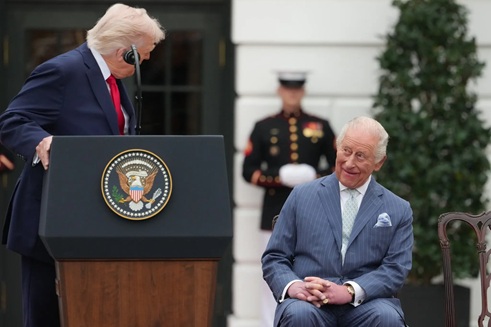
Maureen Dowd in her column yesterday entitled, His Majesty and Our Travesty, reflects on the recent visit by King Charles and compares him to Trump. Here is an excerpt.

“…in Washington this past week, Charles came into his own. ..

In a country rife with No Kings protests, this king was a tonic. He presented himself with elegance, intelligence and wit — everything that has been wanting in Washington during the Trump era.

He arrived at a propitious moment to remind the autocrat in the White House why Britain’s rebellious colony ran away: to escape the tyranny of an oppressive king.

“Out of the fires of a bitter and bloody Revolutionary War, the triumph of the father of this country, George Washington, and his fellow founders was to forge a democracy founded upon the rights to liberty and the rule of law,” Charles said at the state dinner.

In his pointed speech to Congress, he reminded the lawmakers that our Constitution, based on Magna Carta, provides checks on a tyrant’s power.

The king deftly schooled Donald, and Donald took it because he has always been awed by the British royal family. “

Dowd’s conclusion:

“It was lovely to hear the King’s English, devoid of the vengeance, blasphemy and vulgarity common in our leader’s language…

…The king put a salve on a blistered partnership. Trump has trashed Prime Minister Keir Starmer as “cowardly” and a “loser” for not helping with Iran, Charles radiated an élan of his own — a class act, shining next to the boorish Trump. At long last, Charles was in no one’s shadow. At 77, he has done what he always yearned to do: make his mark on the world.”

Amen!

Dowd’s entire column is below

Tony

———————————————————————–

The New York Times

His Majesty and Our Travesty

May 2, 2026

By Maureen Dowd

Opinion Columnist, reporting from Washington

The last time Charles came here for a state visit, nobody seemed to notice.

I saw him up close during his trip in the autumn of 1985, from his stop at JCPenney in a suburban mall to promote British clothing to a starry state dinner. I was impressed.

The Prince of Wales had a reputation back then as a bit of a wimp, always chafing in the shadow of his towering mother, resentful about being relegated to cutting ribbons.

In a flashy decade full of bling kings like the New York developer Donald Trump, Charles seemed like a man from another time. He yearned to be taken seriously and to have an impact on global issues. As the charming British actor Peter Ustinov, who attended the state dinner, told me: “He has a clear sense of what he would do if allowed to. One regrets that he didn’t live in 1400.”

Touring the sights in Washington, Prince Charles impressed salesclerks and senators alike with his genuine interest in culture and politics and his playful and self-deprecating small talk.

As I wrote in The Times back then, “He went out of his way to move past protocol, and was equally at home discussing the architecture of Baltimore, the actresses on the television show ‘Dynasty,’ the opera roles that Beverly Sills made famous and the tenuous state of international relations.”

It didn’t matter. Nobody was paying attention. He was simply the man who accompanied Princess Diana to Washington.

Even without talking much, just tucking her chin in shyly and looking up out of those luminous blue eyes, Diana outshone her prince. It was pretty much a total eclipse of the son. I don’t remember seeing a single picture of Charles from the state dinner. His remarks are lost to history.

All eyes were on the Sloane Square Cinderella. The state dinner was Diana’s fairy tale turn, conjured by her fairy godmother, Nancy Reagan. The first lady invited Clint Eastwood, Mikhail Baryshnikov and John Travolta to dance with the princess who loved dancing. Mrs. Reagan directed the Marine Band to put aside the society two-step sheet music and get up to speed on the “Saturday Night Fever” soundtrack.

“She’s a great little mover,” Travolta said of Diana, who wore a gorgeous midnight blue velvet gown and a diamond tiara.

The total effect of the visit was “Charles who?” Being overshadowed by his young wife, after decades of being overshadowed by his mother, did not boost his ego.

The ensuing decades would not be kind to Charles. He was mired in scandal and pain.

He blew up his marriage in spectacular fashion, returning to his old girlfriend, Camilla. After spilling her guts on the BBC, Diana died in a nightmarish car crash in Paris with her new boyfriend and ascended to a saintly status in Britain. Netflix’s “The Crown” had an unflattering depiction of Charles maneuvering to get his mother to give up the throne to spur generational change. The queen decided not to move aside, and Charles entered his 70s still hanging about.

Harry and Meghan executed “Megxit” and moved over 5,000 miles away. Then Harry aimed a trans-Atlantic missile at the family with his royal tell-all, “Spare,” painting his father and brother as emotionally distant and insensitive. Harry cast his stepmother, Camilla, as a manipulative villainess. After Charles gave Harry and Meghan an elaborate wedding with a Black minister and gospel choir, Meghan Markle told Oprah that she had encountered racism within the royal family.

Charles underwent treatment for cancer, as did his daughter-in-law Kate Middleton. Then Charles had to strip his brother Andrew of his title when public outrage grew over his seamy friendship with Jeffrey Epstein.

But in Washington this past week, Charles came into his own. Forty years after Diana’s Cinderella turn, Charles got to be Cinderfella.

In a country rife with No Kings protests, this king was a tonic. He presented himself with elegance, intelligence and wit — everything that has been wanting in Washington during the Trump era.

He arrived at a propitious moment to remind the autocrat in the White House why Britain’s rebellious colony ran away: to escape the tyranny of an oppressive king.

“Out of the fires of a bitter and bloody Revolutionary War, the triumph of the father of this country, George Washington, and his fellow founders was to forge a democracy founded upon the rights to liberty and the rule of law,” Charles said at the state dinner.

In his pointed speech to Congress, he reminded the lawmakers that our Constitution, based on Magna Carta, provides checks on a tyrant’s power.

The king deftly schooled Donald, and Donald took it because he has always been awed by the British royal family. The president was thrilled when a British newspaper did a genealogy that found he may be a distant cousin of Charles. (Then again, so are the Bushes.) Trump even dropped the tariffs on Scottish whisky to please the king.

Charles gently reminded the president, who has been blasting NATO for not helping bail him out of the Iran quicksand, that America’s allies stepped up after 9/11. Britain battled in Afghanistan beside us, and tried to rebuild it with us, for 20 years.

“Our people have fought and fallen together in defense of the values we cherish,” Charles said.

The message to Trump was obvious: Don’t berate us for not backing your misadventure in Iran, after we went all in on America’s misbegotten occupation of Afghanistan and war in Iraq.

Gently mocking the territorial Trump at the state dinner, Charles noted that he is already the king of Canada — no need for another. He also teased: “Now I know you have big plans for the moon, Mr. President, but I’ve checked the papers and I rather suspect it is already part of the Commonwealth, I’m afraid!”

He quoted Shakespeare’s “Henry V” to prompt the bellicose president to seek peace: “my speech entreats, that I may know … why gentle Peace should not … bless us with her former qualities.”

It was lovely to hear the King’s English, devoid of the vengeance, blasphemy and vulgarity common in our leader’s language.

The king put a salve on a blistered partnership. Trump has trashed Prime Minister Keir Starmer as “cowardly” and a “loser” for not helping with Iran. Britain’s ambassador, Christian Turner, didn’t help with his leaked comment that the “special relationship” America has now is with Israel.

On his last state visit, Charles was in the shade of Diana’s radiance. On this one, he radiated an élan of his own — a class act, shining next to the boorish Trump. At long last, Charles was in no one’s shadow. At 77, he has done what he always yearned to do: make his mark on the world.

PGA Cadillac Golf Championship at Trump’s National Doral Golf Course is a Flop!

PGA Tour officially brings back Cadillac for Doral tournament

Dear Commons Community,

The PGA Tour is back at Trump National Doral’s iconic Blue Monster course for the first time since 2016, and yet, it doesn’t seem like there’s a ton of excitement in the air.  As reported by The Spun.

Before the Cadillac Championship even started on Thursday, fans were informed that Masters champion Rory McIlroy, Ludvig Aberg, Wyndham Clark, Xander Schauffele and several others wouldn’t be competing at Trump National Doral. They’re most likely getting ready for the Truist Championship, which is scheduled for May 7.

It’s unclear if all those withdrawals derailed the hype surrounding the Cadillac Championship. All we can say for certain is the course looks pretty empty yesterday.

“There are virtually no fans at the Cadillac Championship at Doral. Is this a Trump boycott? Tickets too high? Who sets the prices? Single day ticket is $88. Tickets too high next weeks Truist at Quail Hollow are $84. Not much different,” one fan said.

“The scheduling on this is terrible. F1 is this weekend in Miami, which has all sorts of big ancillary events and creates tons of traffic,” a second fan wrote. “This is also the first week of summer temperatures we’ve started to have so it’s hot. Kentucky Derby this weekend is also big at the race tracks in South FL. Just a really bad spot on the schedule.”

“The fact that nobody at the PGAT office expected this with an F1 race two miles up the road AND on Kentucky Derby weekend just shows that nobody at the PGAT office knows how to schedule at all,” another fan said.

“The Cadillac Championship feels flat, from the atmosphere, energy and crowd size. The golf course set also appears uninspiring. It does not feel like a signature event at all,” a social media user added.

Cadillac Championship announces new security measures.

Earlier this Saturday, the PGA Tour revealed fans will be subjected to TSA-style screening for the final two rounds of the Cadillac Championship.

“Travel times to access the course and Trump National Doral property could significantly increase, so ticketed attendees are strongly encouraged to arrive to the course earlier than planned. Enhanced security screenings will be conducted prior to entry by the Secret Service Uniformed Division,” the press release stated.

“Upon entering Trump National Doral, spectators will be subjected to TSA-style screening at the Main Entry, Downtown Doral Entry, and in select areas on course. Attendees are encouraged to minimize personal items and review the list of prohibited items prior to arrival. Due to the U.S. Secret Service protectee, there may be additional restricted or prohibited items for the weekend.”

Is it possible those enhanced security measures impacted the turnout on Saturday? Maybe, but that seems unlikely.

The real issue for the PGA Tour is that Formula 1 has its Miami Grand Prix this Sunday. That race is going to undoubtedly soak up the spotlight this weekend.

It would be interesting to see what is the television viewership for this event!

Tony

Book:  “The Marriage Portrait” by Maggie O’Farrell

Dear Commons Community,

I have just finished reading, The Marriage Portrait by Maggie O’Farrell.  My wife recommended it to me because she knows that I enjoy reading about the Renaissance and the Medici family of Florence.  This novel presents the story of Lucretia Medici, the fifteen-year old daughter of Cosimo de’Medici, and takes place in the mid-1500s.  She ends up in a marriage that she never wanted.  It was an arranged marriage to Alfonso II d’Este of Ferrara. The story immediately captures your attention because Lucretia is sure her husband means to kill her. It also focuses on the assumption that her only duty is to provide an heir for Alphonso. 

I found O’Farrell’s book a good read not a great read! I won’t say anything else because I risk giving clues to the plot twists and ending.

Below is a review of The Marriage Portrait as published in The New York Times.

Tony


Sex and Murder in Maggie O’Farrell’s Overwrought Historical Drama

“The Marriage Portrait” is the fictionalized story of the 16th-century Italian noblewoman Lucrezia di Cosimo de’Medici.


Does great sex yield great children? Norman Mailer thought so (of course), but other writers have circled this topic, too. If you have a blah night in bed when you and your partner conceive, maybe it’s a karma thing — maybe you’ll have a blah kid.

Early in Maggie O’Farrell’s new novel, “The Marriage Portrait,” the Duchess Eleanora finishes making love with her husband, the Grand Duke of Tuscany. The year is 1544. The setting: a palace in Florence.

The grand duke wraps up happily, and mightily, with “his habitual howling gasp,” but Eleanora knows something is amiss. She’d been inattentive, staring at troubling images on the walls — maps filled with “strange and wild seas, filled with dragons and monsters” — instead of keeping her mind on her own storied fecundity.

Her previous children are well mannered. But Lucrezia, who emerges nine months later? She is “squalling,” “intractable,” “unbiddable,” “inconsolable” and “savage.” Like an animal, she prefers to eat her food off the floor. She screams for days; she’s banished to the basement kitchen.

We get it: Lucrezia is a pint-size hell-raiser. By Page 15 of “The Marriage Portrait,” we also get that this historical novel is verging on the steamy and operatic. Then we’re introduced to the tiger, and we should talk about the tiger.

The grand duke wants the animal to complete his menagerie, because tigers are (cue the hammy Vincent Price vocals) “vicious, singular beasts.” This is about where “The Marriage Portrait” begins to boil over and the C.G.I. effects kick into motion.

“The tigress didn’t so much pace as pour herself,” O’Farrell writes, “as if her very essence was molten, simmering, like the ooze from a volcano.” Ooze is the right word.

She continues: “The animal was orange, burnished gold, fire made flesh; she was power and anger, she was vicious and exquisite.” The tiger’s cry is a “yearning, desperate rasp.”

O’Farrell is most notably the author of “Hamnet,” a largely fictional account of the life and early death of Shakespeare’s son; it won a National Book Critic’s Circle prize in 2021. Some of the prickliest and most committed readers I know take “Hamnet” seriously.

“Hamnet” wasn’t ridiculous in the way that “The Marriage Portrait” is ridiculous; at its best it was an affecting portrait of grief. But it too went in for lush atmospherics, for a lot of rustling leaves, for creating scenes that longed to be bowers of enchantment.

It, too, had few sharp perceptions, little wit and little humble sense of life as it is lived down near the ground. Reading each I pined instead for — the reason one goes to a good restaurant — something simple and unpretending.

A.S. Byatt once told The Paris Review that to read Tolkien, you need to do so primitively. “If you start thinking,” Byatt said, “you’ve got to stop reading.” Maybe that’s the trick with “Hamnet” and “The Marriage Portrait,” too.

(My favorite O’Farrell novel is the earthier “Instructions for a Heatwave,” from 2013, in which a young woman arriving in New York does so “like someone who trips when they enter a room.”)

“The Marriage Portrait” tells the somewhat true story of Lucrezia di Cosimo de’Medici, who at 15 was forced by her parents to marry the older Alfonso II d’Este, Duke of Ferrara, thus merging two dynasties.

Alfonso spirits her away to a different palace, where she suffers. She is subject to totalitarian surveillance. She is kept largely to herself, but like Van Gogh she has a great ear. She can hear intrigue through walls and around the corners of passageways.

Outside, nature is, like the tiger, vicious and exquisite. The Po River laps at its banks with “lassitudinous ochre tongues.” Inside, Lucrezia’s heart is fearsome and full: “Flames, vibrant and consoling, lick at her insides, a fire kindles, cracks and smolders.”

When she speaks, others lean in, “as if every syllable Lucrezia spoke was a fragile airborne filament of gold.”

In the first chapter we learn that Alfonso probably intends to kill Lucrezia, in part because she has been unable, though the fault is his, to conceive an heir. As with “Hamnet,” scenes jump artily back and forth in time, postponing this reckoning.

A second sort of reckoning looms. Lucrezia will have to sleep with Alfonso at some point, and the moment is delayed for as long as possible. Things build to a crescendo Bernard Herrmann would envy. The sex is as awful as we know it will be: “burning, invading, unwelcome.”

But a dynasty is at stake, and Lucrezia must be ruthlessly pollinated. The novel’s later sex scenes have overtones of “The Shape of Water,” the Guillermo del Toro movie.

Alfonso becomes like “a river god, a water monster” with “the hidden gills in his neck pulsing and pulsing.” His face is a “grotesque mask above her: a face of fury, of intent, of unslakable need.”

You hope Lucrezia might be fertilized by a shower of light, the way Zeus impregnated Danae, and thus spared. You also hold out hope that this victim will ultimately become a destroyer.

Murder and unwanted sex are primal drivers of narrative. In this novel the characters are so one-dimensional and overwrought that the force of neither driver lands. The novelist begins to resemble a conjurer forcing cards.

Archdiocese of New York offers $800 million sex abuse settlement.

Dear Commons Community,

The Archdiocese of New York has offered to pay $800 million in a settlement to 1,300 people who say they were sexually abused as minors.

The case stemmed from claims under the Child Victims Act. The legislation passed in 2019 gave a one-year window for sexual abuse survivors to file civil lawsuits barred by the statute of limitations.  

The proposed settlement comes months after the church sold off valuable properties, laid off staff and cut its operating budget to come up with the funds.  As reported by CBS News.

“For nearly six years, the Archdiocese and its insurers, including Chubb Insurance, have been fighting the survivors. The proposed framework of a settlement is a transcendent triumph of courage by the survivors who have endured so much for so long,” attorney Jeff Anderson said. “It is far from full accountability, but it is a measure of responsibility and required transparency by the Archdiocese that also requires the release of documents pertaining to sexual offenders.”  

Details of the proposed settlement

The archdiocese will have to pay $615 million in the first installment, and the other $185 million will be distributed within 15 months, attorneys said.

The settlement includes an opportunity for victims to pursue money from the archdiocese’s insurance companies. Those funds would go into a trust if recovered.

Additionally, the church will have to keep maintaining its list of accused clergy on its website. They must update it with any new claims. 

Anderson is urging his clients to accept the settlement deal.   

“To the survivors the credit is due – for having spoken their voice, having stood up, revealed the truth, and exposed the offenders and top officials of the Archdiocese who’ve allowed these heinous crimes to have occurred – past and present,” he said.

N.Y. Archbishop Ronald Hicks speaks out

Archbishop of New York Ronald Hicks, who was just installed in February, said he is “cautiously optimistic” about the proposed settlement. 

“If a truly global settlement can be achieved, compensation will become available to victim-survivors in the fastest, most comprehensive manner possible, without the need for lengthy, painful litigation for victim-survivors or bankruptcy proceedings for the Archdiocese,” he said in a statement. 

“The Archdiocese of New York continues our prayerful work to recognize and affirm the pain these individuals have experienced, and do all that we can to promote healing and reconciliation,” he wrote. 

Archdiocese previously negotiates $300 million settlement

In December, the church said it was raising $300 million and named a mediator to help reach a settlement with accusers.

Cardinal Timothy Dolan previously said the church sold the archdiocese’s headquarters on First Avenue in Manhattan, laid off staff and reduced the operating budget by 10%.  

Churches across New York have filed for bankruptcy due to lawsuits under the Child Victims Act. 

The Immaculate Heart of Mary parish in Scarsdale filed in December. Dolan said it was their only financial option, as the parish was frequently named as a defendant in abuse cases.    

In 2021, the headquarters of the Diocese of Rockville Centre was sold after it faced more than 200 lawsuits under the legislation. It is the largest Roman Catholic diocese in the country to declare bankruptcy. 

It is unfortunate that New York’s new cardinal, Ronald Hicks, had to inherit this travesty.

Tony


Pope Leo appoints three new bishops who have been critical of Trump

Bishop Evelio Menjivar-Ayala. The Washington Post via Getty Images.

Dear Commons Community,

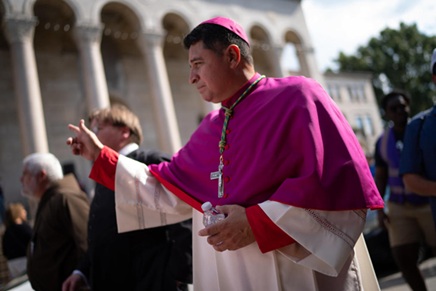
Pope Leo XIV has promoted a former undocumented immigrant to lead West Virginia Catholics in a sign he won’t be intimidated by Trump.

Evelio Menjivar-Ayala came to the U.S. in 1990 as an undocumented immigrant, having been smuggled into the country in the trunk of a car.  As reported by The Daily Beast.

On Friday, Pope Leo, who has criticized Trump’s hardline stance on immigration, tapped Menjivar-Ayala to be West Virginia’s new bishop. He will replace retiring West Virginia Bishop Mark Brennan, a man who, incidentally, helped Menjivar-Ayala secure a green card years ago.

Menjivar-Ayala, 55, has told the Washington Post how he fled violence in his home country of El Salvador three times when he was a teenager before finally arriving in Los Angeles, where his sister was living. He worked as a janitor, painter, and in construction before entering religious life.

In 2023, Pope Francis named Menjivar-Ayala an auxiliary bishop for the Archdiocese of Washington. Now, Menjivar-Ayala will lead the Diocese of Wheeling-Charleston, which covers West Virginia’s 91 parishes and its more than 100,000 Catholics.

In addition to his personal history, Menjivar-Ayala’s public comments have put him at odds with Trump. Just a few weeks ago, he wrote a column in the National Catholic Reporter urging fellow Catholics to oppose how Trump has been treating immigrants.

“We must stand with those at risk… and we cannot let the dark side of anti-immigrant animus take hold,” he wrote.

“Tragically, this onslaught is instead being met with silence by many—or even approval,” he continued. “To those of you who are silent or think this does not involve you, to those of you who are not troubled by this—or worse, who applaud it—particularly those who are Catholic, I ask you: Do you not see the suffering of your neighbors? Do you not realize the pain and misery and very real fear and anxiety these unjust government operations and policies are causing? Is your conscience not disturbed? How can you stay quiet?”

Pope Leo’s personnel moves on Friday weren’t limited to Menjivar-Ayala. He elevated to auxiliary bishop of Washington, Rev. Robert Boxie III, the chaplain of Howard University. Boxie has criticized the Trump administration’s “un-American” and “un-Christian” efforts to chip away at diversity, equity and inclusion (DEI).

“In a lot of ways we have made great progress, but in so many ways, I feel like we’re regressing,” Boxie told OSV News in 2025. “It’s really frustrating—especially this moment that we’re living in. The attacks on ‘DEI’—I don’t even know what that means anymore. It’s a term that’s been hijacked. It means a lot of things to a lot of different people.”QA

Also named auxiliary bishop in Washington was Gary Studniewski, who told The Catholic Standard that the January 6 insurrection was “sickening.”

The White House did not immediately respond to a request for comment from the Daily Beast about the three appointments.

Trump has taken issue with the pope’s pushback on his Iran war and immigration actions, and has said on Truth Social that he should “focus on being a Great Pope, not a Politician.” Trump has also been falsely attributing statements to the pope.

Leo responded that he has “no fear of the Trump administration.”

I like Pope Leo more and more!

Tony

May Day 2026

Maypole

Dear Commons Community,

Today is May Day,  a dual-purpose holiday combining ancient spring festivals with International Workers’ Day. It signifies labor rights, honoring the 1886 Chicago Haymarket Affair, and acts as a global day of protests for workers’ rights, higher wages, and political change. Traditional celebrations include dancing around a Maypole and crowning a May Queen to welcome spring.

There are demonstrations planned throughout our country today supporting workers.

Tony

New York Times Editorial: The U.S. Military Was Losing Its Edge. After Iran, Everyone Knows It.

Credit…Tierney L. Cross/The New York Times

Dear Commons Community,

The New York Times main editorial yesterday was entitled,The U.S. Military Was Losing Its Edge. After Iran, Everyone Knows It.”  The title says it all. 

Read it in its entirety below.

Tony

———————————————————————————-

The New York Times

The U.S. Military Was Losing Its Edge. After Iran, Everyone Knows It.

By The Editorial Board

The editorial board is a group of opinion journalists whose views are informed by expertise, research, debate and certain longstanding values. It is separate from the newsroom.

On paper, the war in Iran should not be much of a contest. The United States spends around $1 trillion a year on its military, more than 100 times as much as Iran. That money buys a vastly larger Air Force and Navy, as well as advanced weapons technologies that Iranian generals can only dream about.

In the war’s early days, the mismatch played out as one might expect. American forces destroyed much of the Iranian military. Now, however, the contest looks less one-sided. Iran has taken control of the Strait of Hormuz, and its missiles and drones still threaten America’s allies in the region. While President Trump seems eager for a negotiated truce, Iran’s leaders do not. Somehow, the weaker nation is in the stronger negotiating position.

That reality exposes the vulnerabilities in the American way of war. Tactical success has not yielded victory. Mr. Trump’s recklessness in conducting the war is one reason. But the problem is bigger than any single commander in chief. The United States has left itself unprepared for modern war.

America has spent hundreds of billions of dollars on ships and planes that are good at defeating competitors’ ships and planes but ineffective against cheaper, mass-produced weapons. The American economy does not have the industrial capacity to produce enough of the weapons and equipment it does need. And the country has struggled to fix these problems because of a sclerotic government and a consolidated defense industry that resists change.

Three months before Mr. Trump attacked Iran, we warned that the United States was at risk of being overmatched in the wars of the future. The last two months have shown that alarm was justified. The war in Iran, unwise as it is, should serve as a warning about the rising threats to American security and an incentive to fix them.

Sign up for the Opinion Today newsletter  Get expert analysis of the news and a guide to the big ideas shaping the world every weekday morning. Get it sent to your inbox.

“Never in recorded history has a nation’s military been so quickly and effectively neutralized,” Secretary of Defense Pete Hegseth claimed on March 26. The next day, Iran launched a drone and missile attack on an American base in Saudi Arabia that wounded more than a dozen service members, destroyed a radar surveillance plane and damaged at least two refueling tankers.

The immediate debunking of Mr. Hegseth’s bombast points to the reform agenda that America’s military needs. There are four main priorities.

First, the United States needs to invest in counter-drone technologies, like those that Ukraine has developed in its war against Russia. The lack of such defenses is one reason that the vaunted U.S. Navy has been unable to prevent the closure of a vital waterway, the Strait of Hormuz.

Second, the United States needs more of its own cheap, disposable weapons like one-way attack drones and unmanned ships. Although much of the war in Ukraine has been fought by mass-produced drones, the Pentagon is pouring money into much more complex equipment, including pilotless “wingmen” that can fly alongside a piloted plane.

Third, the country needs larger and more flexible industrial capacity. Until recently, a single factory made all of America’s Tomahawk cruise missiles, and there is a constant shortage of Patriot missile interceptors. Congress should pass laws that help the private sector build up its manufacturing capacity. The Pentagon, for its part, needs to stop buying so many of its weapons from just five big weapons makers and start betting on dynamic tech companies that can quickly adapt.

Lastly, the United States needs to collaborate with other industrialized democracies. Mr. Trump’s pleas for help in reopening the Strait of Hormuz from the very allies he spurned at the start of the war is just the latest proof that America can’t go it alone. In the years ahead, keeping pace with China’s economic and military expansion will require collaborating with like-minded democracies.

All of these steps are not merely about winning the next war. They also can help prevent it — by making our enemies believe they would lose any war they start.

Instead, the war in Iran has provided a road map for any country that wants to resist the United States in the future, including Russia and North Korea. For China, the country with the greatest potential to challenge American military might, the war validates its focus on new forms of warfare such as drones and cyber and space power.

The picture for the American military is not entirely grim. The Iran war has shown that it has an astonishing ability to find and destroy enemy targets. In the conflict’s first six weeks, the U.S. military hit over 13,000 military and industrial targets. American losses in the war, while tragic, have been limited, considering the scale of the attack and Iran’s resources: at least 13 service members killed and more than 300 wounded.

Mr. Trump has made some positive moves toward military reform. His administration has taken several steps to break the hold of major contractors on the supply of weapons to the Pentagon and has pressured some of them to increase production of much-needed missiles. The Army secretary, Daniel P. Driscoll, has moved to cancel outdated and failing programs.

But Mr. Trump’s chaotic, destructive approach to governance has undercut much of this progress. He ordered an expensive new fleet, the “Trump class” battleships, even though they are vulnerable to air attack. Mr. Hegseth has fired a cadre of reformers and is feuding with Mr. Driscoll. In April, the administration proposed a $1.5 trillion budget that is likely to amplify our shortcomings rather than building on our strengths.

The good news is that Congress, the administration and the Pentagon can all now see our military shortcomings. The bad news is that our adversaries can see them too. Washington can no longer just talk about reforming the military. It has to do it, or risk making the disappointments in the Iran war become a preview of far worse.

Humanoid robots to become baggage handlers in Japan’s Haneda Airport.

Photograph courtesy of ABC News.

Dear Commons Community,

Japan Airlines is introducing robots for a trial run at Tokyo Haneda Airport amid the country’s surge in inbound tourism and worsening labor shortages

The Chinese-made humanoids will move travelers’ luggage and cargo on the tarmac at Haneda, which handles more than 60 million passengers a year.

JAL and its partner in the initiative, Japan Airlines GMO Internet Group, hope the experiment – which ends in 2028 – will lessen the burden on human employees amid a surge in inbound tourism and forecasts of more severe labor shortages.

In a demonstration for the media this week, a 130cm-tall (about 4 ft. 2 in.) robot manufactured by Hangzhou-based Unitree was seen tentatively “pushing” cargo on to a conveyer belt next to a JAL passenger plane and waving to an unseen colleague.

The president of JAL Ground Service, Yoshiteru Suzuki, said using robots to perform physically demanding work would “inevitably reduce the burden on workers and provide significant benefits to employees”, according to the Kyodo news agency.

Suzuki added, however, that certain key tasks – such as safety management – would continue to be performed by humans.

Japan is struggling to cope with a simultaneous surge in tourists from overseas and an ageing, declining population.

More than 7 million people visited the country in the first two months of 2026, according to the Japan National Tourism Organization, after a record 42.7 million last year, despite a drop in the number of visitors from China triggered by a diplomatic row between Tokyo and Beijing.

According to one estimate, Japan will need more than 6.5 million foreign workers in 2040 to reach its growth targets as the indigenous workforce continues to shrink. The country’s foreign population has risen dramatically in recent years, but the government is now under political pressure to rein in immigration.

The president of GMO AI and Robotics, Tomohiro Uchida, said: “While airports appear highly automated and standardized, their back-end operations still rely heavily on human labour and face serious labor shortages.”

Robots can operate continuously for two to three hours and the firms are planning to use them to perform other tasks, such as cleaning aircraft cabins.

Tony

Skip to toolbar