


Illustration: Mina De Lao/Getty Images
Dear Commons Community,
Major scientific journals and conferences ban crediting an artificial intelligence (AI) program, such as ChatGPT, as an author or reviewer of a study. Computers can’t be held accountable, the thinking goes. But last week, a norm-breaking meeting turned that taboo on its head: All 48 papers presented, covering topics ranging from designer proteins to mental health, were required to list an AI as the lead author and be scrutinized by AIs acting as reviewers. Here is a description of the meeting courtesy of Science.
“The virtual meeting, Agents4-Science, was billed as the first to explore a theme that only a year ago might have seemed like science fiction: Can AIs take the lead in developing useful hypotheses, designing and running computations to test them, and writing a paper summarizing the results? And can large language models, the type of AI that powers ChatGPT, then effectively vet the work?
“There’s still some stigma about using AI, and people are incentivized to hide or to minimize it,” a lead conference organizer, AI researcher James Zou of Stanford University, tells Science. The conference aimed “to have this study in the open so that we can start to collect real data, to start to answer these important questions.” Ultimately, the organizers hope a fuller embrace of AI could accelerate science—and ease the burden on peer reviewers facing a ballooning number of manuscripts submitted to journals and conferences.
But some researchers reject the conference’s very premise. “No human should mistake this for scholarship,” said Raffaele Ciriello of the University of Sydney, who studies digital innovation, in a statement released by the Science Media Centre before the meeting. “Science is not a factory that converts data into conclusions. It is a collective human enterprise grounded in interpretation, judgment, and critique. Treating research as a mechanistic pipeline … presumes that the process of inquiry is irrelevant so long as the outputs appear statistically valid.”
Most of the 315 manuscripts submitted to the conference, which attracted 1800 registrants, were reviewed and scored on a sixpoint scale by three popular large language models—GPT-5, Gemini 2.5 Pro, and Claude Sonnet 4. The results were averaged for each paper and humans were asked to review 80 papers that passed a threshold score. Organizers accepted 48 covering multiple disciplines, based on both the AI and human reviews.
One accepted paper that organizers highlighted was submitted by Sergey Ovchinnikov, a biologist at the Massachusetts Institute of Technology. His team asked advanced versions of ChatGPT to generate amino acid sequences that code for biologically active proteins with a structure called a four-helix bundle. Scientists typically use specialized software to design proteins. But to Ovchinnikov’s surprise, ChatGPT produced sequences without further refinement of his team’s query. He and his human colleagues tested two of the sequences in the lab, confirming that a protein derived from one had a four-helix bundle. Still, Ovchinnikov found ChatGPT’s performance wasn’t flawless. Most of the sequences did not garner “high confidence” on a score predicting whether they would form the desired protein structure.
Data presented at the conference also probed how researchers collaborate with AIs. The organizers asked human authors to report how much work AI contributed in several key areas, including generating hypotheses, analyzing data, and writing the paper. AI did more than half of the hypothesis-generation labor in just 57% of submissions and 52% of accepted papers. But in about 90% of papers, AI played a big role in writing the manuscripts, perhaps because that task is less computationally challenging.
Some human authors who presented at the meeting said their AI partners enabled them to complete in just a few days tasks that usually take much longer, and eased interdisciplinary collaborations with scholars outside their fields. But they also pointed to AI’s drawbacks, including a tendency to misinterpret complex methods, write code that humans needed to debug, and fabricate irrelevant or nonexistent references in papers.
Scientists should remain skeptical about applying AI for tasks that require deep, conceptual reasoning and scientific judgment, according to Stanford computational astrophysicist Risa Wechsler, who reviewed some of the submitted papers.
“I’m genuinely excited about the use of AI for research, but I think that this conference usefully also demonstrates a lot of limitations,” she said during a panel discussion at the meeting. “I am not at all convinced that AI agents right now have the capability to design robust scientific questions that are actually pushing forward the forefront of the field.” One paper she reviewed “may have been technically correct but was neither interesting nor important,” she said. “One of the most important things we teach human scientists is how to have good scientific taste. And I don’t know how we will teach AI that.”
The conference organizers plan to analyze and compare the AI- and human-written reviews. But the remarks garnered by Ovchinnikov’s protein-design paper hinted that people and machines may often diverge. An AI reviewer called it “profound.” But a human deemed it “an interesting proof-of-concept study with some lingering questions.”
Tony
Dear Commons Community,
Maddalena Alvi, who has a Ph.D. in history from the University of Cambridge and is the author of The European Art Market and the First World War (Cambridge University Press), had an opinion piece in yesterday’s The Chronicle of Higher Education. She reviews the current state of PhD degrees in the humanities and comments on universities that are pausing admissions in these programs. Hers is a sober treatment. Below is the entire article.
Tony
———————————————————-
The Chronicle of Higher Education
Pauses in Ph.D. Programs
The overproduction of doctorates in the humanities has ruined the job market.
By Maddalena Alvi
In August, the University of Chicago announced it was pausing admissions to most of its arts and humanities Ph.D. programs. Chicago’s decision prompted The Atlantic’s Tyler Austin Harper to ask: “If even Chicago is not willing to support and protect American arts and letters, who will?” The question has only gained urgency. Brown University recently announced Ph.D. admissions pauses across six departments, including classics, anthropology, and French. And last week Harvard University slashed Ph.D. admissions spots in the arts and humanities by around 60 percent.
As a young historian, I believe that these institutions are taking a pragmatic approach to the current crisis of the humanities.
Only 57 percent of humanities doctorate recipients in the United States reported definite commitments in 2024, and less than a third secured an academic-related position, according to the National Science Foundation’s Survey of Earned Doctorates. As the Princeton University historian David A. Bell wrote in 2023: “Of my 10 Ph.D. students who defended their dissertations before 2016, all but one got a tenure-track job. … Of the eight who have defended since then, only one has so far gotten a tenure-track job.”
Data from the Ohio State University English department sums up the issue:
It is not just the numbers that paint a grim picture: In recent weeks, my social-media feed has been inundated with complaints from American academics and researchers about funding cuts and the elimination of university positions. “Workforce reductions” are striking near and far at both academic and staff positions, and nontenured positions in particular are falling victim to the funding cuts of the Trump administration.
This isn’t all new — or confined to the United States. The academic jobs crisis is a long-festering problem, culminating in recent strikes around Europe. Apart from cuts to funding, systemic issues like precarity, exploitation, and abuse are being vocally addressed by a generation of young academics asking for change.
At this time of mounting crisis, compounded by current political volatility, pausing admissions is a painful but necessary decision.
At this time of mounting crisis, compounded by current political volatility, pausing admissions is a painful but necessary decision.
Why? A humanities Ph.D. is a job in which graduates invest money. Forty percent of humanities graduates in 2020 relied mainly on teaching for support, 20 percent on their resources, while 37 percent depended primarily on a grant or fellowship, according to the American Academy of Arts and Sciences. Yet, even the best scholarships cannot free doctoral researchers from the need to secure further financial support for activities that range from traveling abroad to conducting archival research or attending and organizing academic conferences. It is additional funding that enables young researchers to be competitive in a job market flooded with excellent competitors. Given the current and proposed cuts to arts and humanities funding in the United States, the question evolves from which members of an incoming Ph.D. cohort will find a job to which of them will be able to complete their doctorate.
Some years ago, anthropologist Emma Quilty posted on Twitter: “Doing a PhD is like putting 100,000 piece puzzle together without a box. And the pieces keep changing shape and colour. And the room is on fire.” Studies have described the impact of the doctoral environment as “hazardous” for mental health. The prospect of retrenchments, economic and political crises, and a steady rise in living costs, is not going to improve work conditions.
Of course, obtaining a Ph.D. is supposed to be challenging, but there is a major difference between tackling an adventure with adequate tools and embarking on a journey in which your map (funding) and destination (jobs) are in the process of vanishing just as you start walking.
I do not regret my doctorate. As an EU citizen, I started my Ph.D. in post-Brexit Britain, wrote and defended my dissertation during quarantine, and witnessed firsthand the funding and job crisis in the humanities. That said, I would not start a doctorate in the United States under what look like even harsher conditions — and I would certainly not advise anyone hoping to find work to do so either.
In “There Has Never Been a Better Time to Start a Ph.D.,” a Chronicle Review essay published earlier this week, the historian Ada Palmer argues that deep skills will always be needed. At the cost of sounding cynical, I don’t see why anyone would voluntarily embark on a highly specialized and restrictive training — one designed as a vocational prerequisite — just to develop deep skills. Palmer is right when she says that there will always be some demand to employ the holders of doctorates, but she neglects the real question: How high will that demand actually be? There is already have an oversupply of Ph.D.s in many fields, and the positions that are available often come with low pay and lack of job security. In the United States, 73 percent of all faculty positions in 2016 were off the tenure track. The situation has not improved. While hard work once led to a permanent position, it now fast-tracks doctoral students into un- or underemployment. With career safety gone and sacrifice left unrewarded, recent doctorate recipients are left at the whims of a system whose hiring practices are beset by preference, patronage, and bandwagon thinking.
Some proponents of retaining large Ph.D. cohorts despite the lack of jobs will argue that it can still lead to jobs outside of academe. The Ph.D. can, of course, lead to such positive outcomes, but this doesn’t make sense as a general strategy. Joining a highly specialized work force after a yearslong delay in a market where — sadly — the knowledge of something like philosophy provides no competitive advantage, can be fiendishly difficult.
The rise of artificial intelligence is poised to make this even harder. Recent research from Microsoft suggests the 40 occupations most at risk from AI include historians, political scientists, mathematicians, economists, geographers, and postsecondary teachers of library science. Also on the list are interpreters, translators, writers, journalists, editors, and archivists — exactly the kinds of positions that used to be prime non-academic destinations for fresh Ph.D. holders. This isn’t to say that creative and original thinkers won’t be needed in the future, and humanities students tend to be just that. Yet right now we seem to be in an adjustment phase where AI is likely to produce redundancies rather than create new opportunities.
Research in the humanities should be supported and protected, but not at the cost of graduates spending years in pursuit of a path that cannot offer them professional and financial dignity. In an ideal world, barring someone from entering their dream program might seem unfair; in the real world, it’s a blessing in disguise for a generation that deserves serious and tangible perspectives.
The decisions made at Chicago, Brown, and Harvard are a much-needed confession about the state of the academic humanities. Things have not worked in academe for a long time — and they aren’t getting better. Assessing where the humanities stand with honesty and pragmatism is the first step toward change and reform, both of which are sorely needed for the future of the humanities.
Dear Commons Community,
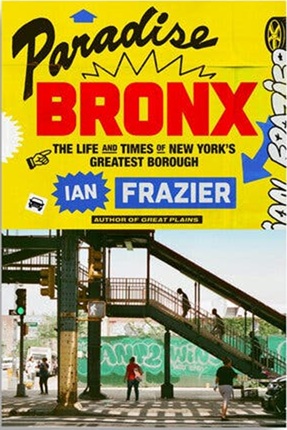
I have just finished reading Paradise Bronx: The Life and Times of New York’s Greatest Borough by Ian Frazier. Having been born and raised in the Bronx, I was curious as to how Frazier would present its story. I also had read an earlier Frazier book, Great Plains, which I thought was quite good. I found Paradise Bronx.. okay but not great. Frazier spends a good deal of time on its history and devotes chapters to Gouverneur Morris, a major figure in the birth of our country and a large landowner in the Bronx. It takes a while for Frazier to get to the latter part of the 20th century when a lot of what the Bronx is today was developed. He has a feel for some of the borough’s populations especially the Jewish and Latino residents but less so for other ethnic groups such as the Irish, Polish, Italians, and African Americans. He covers well how the Cross Bronx Expressway literally destroyed the East-West center of the Bronx. He also accurately comments on how Co-op City caused many white middle class residents to flee other parts of the Bronx such as the Grand Concourse. There are also interesting vignettes about the Bronx Zoo and Woodlawn Cemetery. He also devotes space to Justice Sonia Sotomayor (a Bronx native). She and I went to the same high school – Cardinal Spellman. Readers who know little about the Bronx and its history will find Paradise Bronx… a good read. For those of us who spent decades there – less so!
Below is a review that appeared in The New York Times Review of Books.
Tony
———————————————————————–
The New York Times
Review of Books
“Brooklyn? Bah. Manhattan? Meh. A New Book Calls the Bronx the City’s Best Borough.”
Ian Frazier’s history roams far and wide, on foot and in the archives, celebrating (if not romanticizing) a perennially “in between” part of New York.
Published Aug. 18, 2024Updated Sept. 7, 2024
PARADISE BRONX: The Life and Times of New York’s Greatest Borough, by Ian Frazier
“The Bronx? No thonx,” wrote the poet Ogden Nash for The New Yorker in 1931.
It’s surprising that Ian Frazier’s latest book, a fat and occasionally even phat history of the borough, omits this memorable epigram, later recanted. First, like Nash, he’s a New Yorker man known as a humorist, though a mostly prose-y one (a hundred bloggers toddled so that his Cursing Mommy could run).
Second, “Paradise Bronx” aspires to great comprehension, stretching from before the glacier that 14,000 years ago covered the New York Botanical Garden — and indeed most of the city — to the fires that infamously punctuated Howard Cosell’s commentary on the Yankees during the 1977 World Series, and what has since risen from the ashes: hip-hop, murals, shiny new high rises.
“The Bronx? It honks!” is Frazier’s basic riposte.
His sentiment for the place isn’t entirely explained; certainly he’s not Ianny From the Block. A previous chronicler of Siberia and the Great Plains, Frazier writes about how in young adulthood, when New York was at its “Ford to City: Drop Dead” economic nadir, he was a self-identified “gentrifier” in Manhattan, living in a former candy factory in SoHo for a dozen years until he was priced out. He watched the underwhelming bicentennial fireworks from the West Side Highway and was dining with “my friend Jamaica” (Kincaid) in Chelsea during the ’77 blackout, seeing news of the subsequent riots uptown later that week on television from his home state of Ohio.
He now resides in Montclair, N.J., and when he compares complicated urban housing policy to “the details the contractor is telling you about why you are going to need a new basement” those of youse without ownership of a basement might wonder for whom exactly this book is intended.
As Bill Bryson did on the Appalachian Trail, though, Frazier has logged many, many steps in the Bronx, setting out, he writes, to walk a thousand miles there, sometimes 10 at a time. It is just as much of a hike, with steep hilly terrain that “registers in your calves,” and arguably more treacherous, given the interstate highways, like the one Justice Sonia Sotomayor had to cross to get from Co-Op City, the massive housing development built in the 1960s, to Cardinal Spellman High School.
With some glee he notes more than once that Robert Moses, head honcho of a highway system that ruined wide swaths of the city, is interred in a columbarium right near a particularly loud traffic intersection.
In his wanderings, Frazier finds significance in signage (hypnotically repeating the auto-shop phrase “FLAT FIX” over the course of one chapter) and encounters various neighborhood sages. Some gamely explain local phenomena, like the cheery decals temporarily applied to windows of abandoned buildings; others brush him off. Like Ricky Fitts in “American Beauty,” he romanticizes swirling plastic bags.
Source-wise the book is a melting pot (or perhaps an act of “dynamic compaction,” as the onetime borough president Fernando Ferrer refers ruefully to a toxic-rubble disposal process). Frazier mines memoirs, like Grandmaster Flash’s, previously conducted interviews from Fordham’s Bronx African American History Project (BAAHP) and his own articles. He is keenly sensitive to the pain of various populations and individuals, and to the twin scourges of drugs and gang violence.
But “Paradise Bronx” is a ramble in every way: physical, chronological, pedagogical. (There are charmingly hand-drawn maps, but a few photographs would have helped further orient out-of-towners.) Frazier lingers on the biography of Gouverneur Morris, the native “proto-Bronxite” whose name is all over the area: a founding father who gave the preamble to the U.S. Constitution its lyricism and perished after an infection caused by trying to unblock his urinary tract with a piece of whalebone. (Add that to Tangerine Kitty’s list of “dumb ways to die.”)
As Frazier sees it, both the man and his birthplace were terminally “in between.” The Bronx is smaller than both Queens and Brooklyn but has the moxie of Manhattan, unsoftened by hipster arrivistes, “a hand reaching down” to barely tethered Staten Island. It’s the only borough attached to the mainland, making it a site of cyclical conflictand neglect: a place many people go through to get somewhere else.
Frazier plunges deep into the area’s ugly racist history, which included so-called slave markets for domestic workers on Prospect Avenue, and tidally changing demographics. It is currently majority Hispanic; the multitude of ethnicities and nationalities flowing in and out over the years makes for a dazzling pageant. “We have residents from every continent, if you count the penguins from the zoo,” the history professor Lloyd Ultan tells him.
Periodically, Frazier makes plain, the Bronx has been Arcadia, if not nirvana. Before it became the Bronx, it was like the Hamptons, with rich families taking trains and stagecoaches up to their mansions. For a time it was the “piano-making capital of America,” back when pianos were essential living-room furniture, not consigned to the dump. Stella D’Oro cookies and the hilariously faux-Scandi Häagen-Dazs ice cream were once both manufactured there. Harold Bloom and E.L. Doctorow sprang from the Bronx. James Baldwin went to high school there. W.E.B. Du Bois, Edgar Allan Poe and Leon Trotsky flickered through. Irving Berlin is buried at Woodlawn.
At least half a dozen times, our nouveau Baudelaire of the borough retraces on foot the trail that an aghast President Jimmy Carter took in his motorcade when it looked like a war zone, marveling at the change. Frazier smells marijuana, overhears a sermon, admires recent rowhouses eclipsed by a willow’s “bouffant foliage.” Bucko, we get it: A tree does not just grow in Brooklyn.
Dear Commons Community,
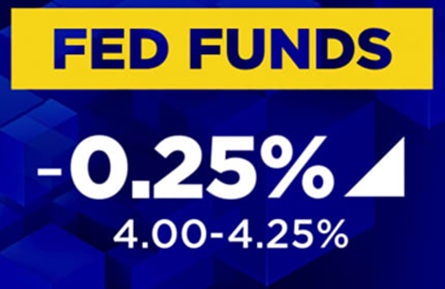
The Federal Reserve cut its benchmark interest rate by a quarter point yesterday for the second time since September. Before that, it had gone nine months without a cut.
The federal funds rate is the rate at which banks borrow and lend to one another. While the rates consumers pay to borrow money aren’t directly linked to this rate, shifts affect what you pay for credit cards, auto loans, mortgages, and other financial products. As reported by The Associated Press.
“While the full economic impact of such a move will unfold over time, early indicators suggest that even modest rate cuts can have meaningful consequences for consumer behavior and financial health,” said Michele Raneri, vice president and head of U.S. research at credit reporting agency TransUnion.
The Fed has two goals when it sets the rate: one, to manage prices for goods and services, and two, to encourage full employment. Typically, the Fed might increase the rate to try to bring down inflation and decrease it to encourage faster economic growth and increase hiring. The challenge now is that inflation is higher than the Fed’s 2% target but the job market has been weak. The government shutdown has also prevented the collection and release of data the Fed relies on to monitor the health of the economy.
Still, the Fed has projected it will cut rates once more before the end of the year.
Here’s what we need to know.
Stock investors
When borrowing money becomes cheaper, companies can expand operations, upgrade equipment and hire workers more affordably, typically leading to higher profits and stock prices over time.
Growth stocks and tech companies usually see the biggest bumps because their stock prices depend on future profits. When interest rates drop, those future earnings become more valuable, making tomorrow’s money worth more today.
When your savings account starts paying out less after a cut, people tend to start moving their money into the stock market to hunt for better returns. All that cash flowing into the market lifts stock prices across the board.
Interest on savings accounts won’t be as appealing
For savers, falling interest rates will slowly erode attractive yields currently on offer with certificates of deposit (CDs) and high-yield savings accounts.
Three of the top five high yield savings accounts had rate cuts after the last Fed rate cut in September, according to Ken Tumin, founder of DepositAccounts.com, while two of the big five banks (Ally and Discover/Capital One) cut their savings account rates. The top rates for high yield savings account right now remain around 4.46% to 4.6%.
Those are still better than the trends of recent years, and a good option for consumers who want to earn a return on money they may want to access in the near-term. A high yield savings account generally has a much higher annual percentage yield than a traditional savings account. The national average for traditional savings accounts is currently 0.63%, according to Bankrate.
There may be a few accounts with returns of about 4% through the end of 2025, according to Tumin, but the Fed cuts will filter down to these offerings, lowering the average yields as they do.
A cut will impact mortgages gradually
For prospective homebuyers, the market has already priced in the rate cut.
“Mortgage rates, in particular, have responded swiftly,” said Raneri. “Just in the past week, they fell to their lowest level in over a year. While mortgage rates don’t always move in lockstep with the Fed’s target rate — often pricing in anticipated future cuts, the continued easing of monetary policy may well push rates even lower.”
Bankrate financial analyst Stephen Kates said a declining interest rate environment will provide some relief for borrowers over time.
“Whether it’s a homeowner with a 7% mortgage or a recent graduate hoping to refinance student loans and credit card debt, lower rates can ease the burden on many indebted households by opening opportunities to refinance or consolidate,” he said.
Auto loans are not expected to decline soon
Americans have faced steeper auto loan rates over the last three years after the Fed raised its benchmark interest rate starting in early 2022. Those are not expected to decline anytime soon. While a cut will contribute to eventual relief, it might be slow in arriving, analysts say.
“If the auto market starts to freeze up and people aren’t buying cars, then we may see lending margins start to shrink, but auto loan rates don’t move in lockstep with the Fed rate,” Kates said.
Prices for new cars remain at historically high levels, not adjusting for inflation.
Generally speaking, an auto loan annual percentage rate can run from about 4% to 30%. Bankrate’s most recent weekly survey found that average auto loan interest rates are currently at 7.10% on a 60-month new car loan.
Credit card rate relief could be slow
Interest rates for credit cards are currently at an average of 20.01%, and the Fed’s rate cut may be slow to be felt by anyone carrying a large amount of credit card debt. That said, any reduction is positive news.
“While inflation continues to exert pressure on household budgets, rate cuts offer a potential counterbalance by lowering debt servicing costs,” Raneri said.
Still, the best thing for anyone carrying a large credit card balance is to prioritize paying down high-interest-rate debt, and to seek to transfer any amounts possible to lower APR cards or negotiate directly with credit card companies for accommodation.
Tony
The Chronicle of Higher Education
Dear Commons Community,
Michael D. Smith, professor of information technology and marketing at Carnegie Mellon University, had an opinion piece in The Chronicle of Higher Education yesterday focusing on whether Americans are losing confidence in higher education. He presents data from recent polling that concludes higher education is indeed losing the confidence of American public. He proposed that to reverse this trend higher education needs to take greater advantage of digital technology. Here is an excerpt.
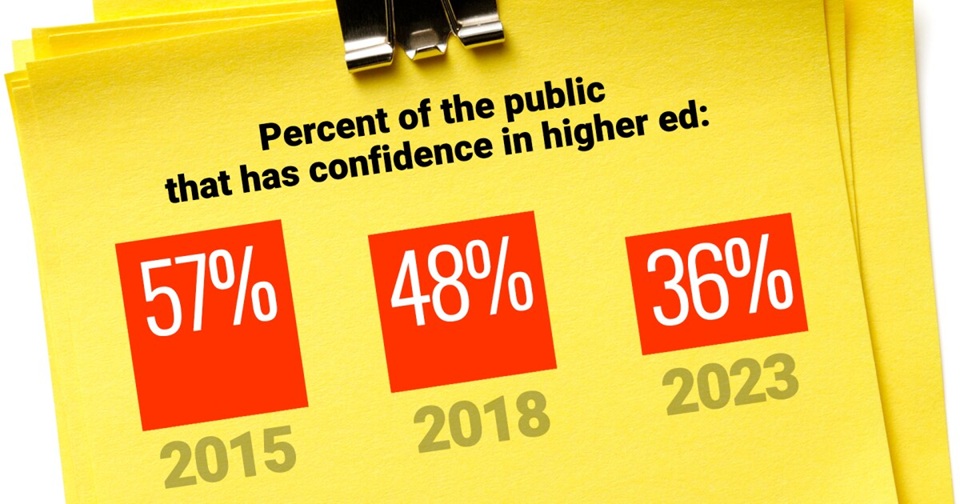
“It’s common knowledge that Americans are losing confidence in higher education. Even so, the numbers that Gallup reported this summer were sobering. Only 36 percent of Americans, Gallup found, have “a great deal” or “quite a lot” of confidence in higher ed. That’s down from 57 percent in 2015 — a drop of more than 20 percentage points in just eight years.
These findings are no anomaly. Last month The Chronicle released the results of a national survey in which fewer than a third of respondents reported believing that “colleges are doing an excellent or very good job of leveling the playing field for success in society.” An astounding 86 percent of respondents reported believing that trade school is “about the same” as or “better” than college. The journalist Paul Tough recently summed up some of the dispiriting trends in The New York Times Magazine. The percentage of young adults who believe a college degree is very important fell from 74 percent in 2013 to 41 percent in 2019. The number of students enrolled in college has fallen from more than 18 million in 2010 to less than 15.5 million as of 2021. And roughly half of American parents today, Tough noted, would prefer that their children not enroll in a traditional four-year college.
These should be terrifying data points for those of us who work in higher education — our compact with the public has been broken. But many of us have shrugged off the looming threat. Deep down, many of us think the numbers are skewed — whether by Republicans (they’re biased against us!), people without college degrees (they’re ignorant!), or an increasingly polarized population (the other side is nuts!). In short, it’s not our fault.
This is wishful thinking. Yes, the 2015-2023 drop in trust among Republicans in the Gallup poll was large (37 percent), but it was significant among Democrats too (9 percent). And yes, the drop in confidence among respondents without a college degree was large (25 percent), but it wasn’t much larger than the drop among those with postgraduate degrees (17 percent). As for the idea that political polarization is to blame, the data doesn’t bear this out. Gallup surveys trust in over a dozen different American institutions. While trust in higher education fell 21 percent, the others fell, on average, by around just 5 percent. As far as the public is concerned, there’s something uniquely wrong with higher education.”
Smith goes on to implore higher education to work hard to reverse this trend and recommends it make greater use of digital technology in all aspects of its operations and services.
Tony
 US companies that have recently cut jobs (AP Photo)
Dear Commons Community,
Thousands of workers are falling victim to job cuts at Amazon, UPS, Target, and other large companies, in an economy defined by uncertainty, AI, and global tensions.
Amazon said in a message to employees Tuesday that it would reduce its “corporate workforce” by approximately 14,000 roles, with impacted employees being offered time to look for new roles internally or receive “severance pay, outplacement services, health insurance benefits, and more” if they were unable or unwilling to continue working for the company.
Meanwhile, UPS said in its third quarter earnings results on Tuesday that it had cut its “operational workforce by approximately 34,000 positions” in the first nine months of the year as it looked to be more efficient, while about 14,000 positions, primarily in management, had also been eliminated.
Target is similarly planning to axe 1,800 corporate roles, while Paramount Skydance is reportedly set to slash more than 1,000 positions Wednesday.
Even perceived winners in the AI-fueled economy, like Meta , have recently announced layoffs — in its AI unit, no less. Rivian is also reportedly implementing workforce reductions.
Though layoffs remain relatively stable and the labor market showed some possible signs of a slight recovery in October, this year’s no-hire, no-fire job environment has left young workers reeling, and the share of long-term unemployed people is at its highest in more than three years. That the pool of out-of-work Americans submitting applications is about to get larger will certainly be unwelcome news.
The reasons for the layoffs vary from mergers to complaints of too much bureaucracy and more.
Still, some companies have been transparent about facing other realities feared by workers: Chegg, an education technology company, said this week it would cut about 45% of its workforce as AI dents its revenue, and Salesforce’s CEO has said efficiencies from AI mean the company now needs fewer people.
Tariffs are also biting into some companies’ bottom lines, triggering layoffs.
It’s the economy stupid!
Tony
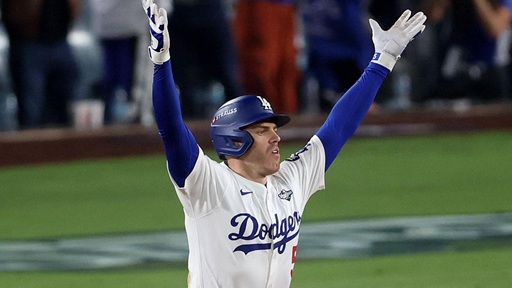
Freddie Freeman
Dear Commons Community,
Freddie Freeman homered leading off the bottom of the 18th, Shohei Ohtani went deep twice during another record-setting performance and the Los Angeles Dodgers outlasted the Toronto Blue Jays 6-5 in an instant classic Monday night.
The defending champion Dodgers took a 2-1 lead in the best-of-seven matchup and still have a chance to win the title at home — something they haven’t done since 1963.
“That could go down as one of the greatest games of all time,” manager Dave Roberts said.
Freeman drove left-hander Brendon Little’s full-count sinker 406 feet to straightaway center field, finally ending a baseball marathon that lasted 6 hours, 39 minutes, and matched the longest by innings in postseason history.
“Oh gosh, just pure excitement,” he said. “That’s as good as it gets.”
The only other World Series contest to go 18 innings was Game 3 at Dodger Stadium seven years ago. Freeman’s current teammate, Max Muncy, won that one for Los Angeles with an 18th-inning homer against the Boston Red Sox in a game that took 7 hours, 20 minutes.
It was Freeman’s second World Series walk-off homer in two years. The star first baseman hit the first game-ending grand slam in Series history to win Game 1 in 10 innings last season against the New York Yankees.
“This one took a little longer,” Freeman said. “But this game was incredible. Our bullpen was absolutely incredible.”
Will Klein, the last reliever left for the Dodgers, got the biggest win of his career. He allowed one hit over four shutout innings and threw 72 pitches — twice as many as his previous high in the majors.
“We weren’t losing that game,” Klein said, “and so I had to keep going back out there.”
Yoshinobu Yamamoto, who threw 105 pitches Saturday at Toronto in his second consecutive complete game, was warming up in the bullpen as Klein worked out of trouble in the top of the 18th.
“I don’t know how I kept going, but I just knew every inning that I went out there, it was going to be another zero. If I had to keep going out, there were going to be more zeros,” Klein said. “I was sitting at home in Arizona last month, you know? This is crazy.”
A total of 19 pitchers — 10 for the Dodgers — combined to throw 609 pitches in a game that ended at 11:50 p.m. on the West Coast. Three-time Cy Young Award winner Clayton Kershaw came out of the LA bullpen to escape a bases-loaded jam in the 12th, pitching in extra innings for the first time in his illustrious career.
“The Dodgers didn’t win a World Series today,” Blue Jays manager John Schneider cautioned. “They won a game.”
The Dodgers felt like they won the Series!
Tony
P.S. I confess – I watched the game but went to bed around 11:30 pm (EDT) while the game was still tied!
Dear Commons Community,
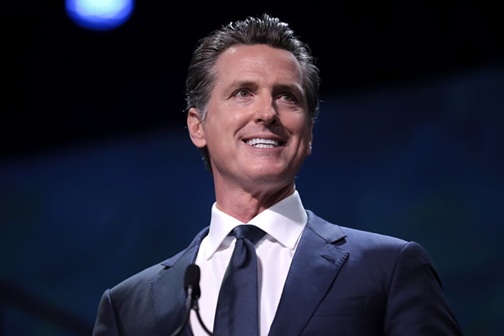
California Gov. Gavin Newsom (D) said on Sunday that he’d “be lying” if he said he wasn’t thinking about running for president in 2028.
In an interview on CBS News, Robert Costa asked Newsom about the prospect of running for president and whether it’s “fair to say, after the 2026 midterms, you’re going to give it serious thought.”
“Yeah, I’d be lying otherwise. I’d just be lying. And I’m not — I can’t do that,” Newsom said in response.
Costa told Newsom that, when he saw the California governor speaking with potential voters in South Carolina this summer, “I thought, ‘This guy might run for president.’”
Newsom laughed and said, ”The idea that a guy who got 960 on his SAT, that still struggles to read scripts, that was always in the back of the classroom — the idea that you even throw that out is, in and of itself, extraordinary,” Newsom continued.
“Who the hell knows,” he added. “I’m looking forward to who presents themselves in 2028 and who meets that moment. And that’s the question for the American people.”
Newsom has emerged as one of the most high-profile opponents of President Trump since he returned to the White House in January.
In the interview, which aired on “CBS News Sunday Morning,” Newsom called the president an “invasive species” and a “wrecking ball,” nodding to the demolition of the White House’s East Wing and some of the president’s global policies.
“He’s a wrecking ball, not just the symbolism and substance of the East Wing. He’s wrecking alliances, truth, trust, tradition, institutions.”
So true!
Tony
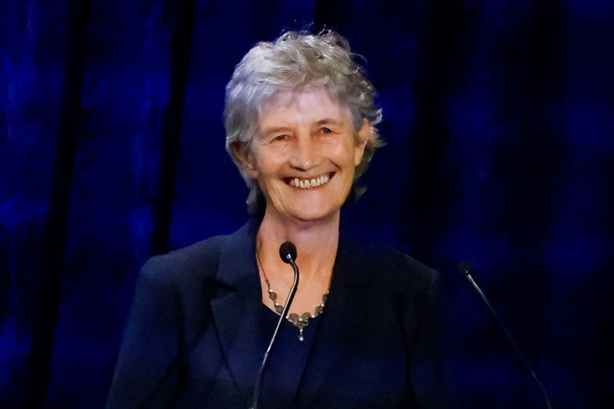
Catherine Connolly
Dear Commons Community
Left-wing independent Catherine Connolly, who secured the backing of Ireland’s left-leaning parties, has won the country’s presidential election in a landslide victory against her center-right rival.
Official results showed strong voter support for Connolly as president, a largely ceremonial role in Ireland. She won 63% of first-preference votes once spoiled votes were excluded, compared to 29% of her rival, Heather Humphreys, of the center-right party Fine Gael. As reported by CBS and the BBC.
Connolly, 68, said Saturday evening at Dublin Castle that she would champion diversity and be a voice for peace and one that “builds on our policy of neutrality.”
“I would be an inclusive president for all of you, and I regard it as an absolute honor,” she said.
Humphreys conceded she had lost earlier Saturday, before vote counting had finished.
The video player is currently playing an ad.
“Catherine will be a president for all of us and she will be my president, and I really would like to wish her all the very, very best,” she said.
Last month, she told BBC’s Talkback programme: ‘I come from a background that put a very high value on integrity and honesty.
‘My mother died when I was young and I watched my father – the most honest man – work every single week on our behalf to bring us up.’
Polls have suggested consistent and strong voter support for Connolly over rival Humphreys for president, a largely ceremonial role in Ireland.
Connolly, a former barrister and an independent lawmaker since 2016, has been outspoken in criticizing Israel over the war in Gaza.
She has garnered the backing of a range of left-leaning parties, including Féin, the Labour Party and the Social Democrats.
She and Humphreys were the only contenders after Jim Gavin, the candidate for Prime Minister Micheál Fianna Fail party, quit the race three weeks before the election over a long-ago financial dispute.
Martin, who heads Ireland’s government, had personally backed Gavin as a presidential candidate. Though Gavin had stopped campaigning, his name remained on the ballot paper because of his late withdrawal from the race.
While Irish presidents represent the country on the world stage, host visiting heads of state and play an important constitutional role, they do not have the power to shape laws or policies.
The leader of the Irish Labour Party said Connolly has united parties “with an alternative vision.”
Ivana Bacik said left-wing parties could now look at how they can “combine together” and “offer a real alternative” in the next general election.
Humphreys, a former cabinet minister, had stressed that she is a center-ground, pro-business, pro-EU candidate who will strive for unity.
Connolly will succeed Michael D. Higgins, who has been president since 2011, having served the maximum two seven-year terms. She will be Ireland’s 10th president and the third woman to hold the post.
Congratulations, Ms. Connolly!
Tony

