George Will: Trump’s Treatment of Ukraine’s President Zelensky ‘will live in infamy’

Conservative Washington Post columnist George Will in Scottsdale, Arizona on December 1, 2022 (Gage Skidmore/Flickr)

George Will. Courtesy of Alternet.

Dear Commons Community,

George Will, columnist for The Washington Post, commented yesterday that U.S. President Donald Trump’s return to the White House on January 20, 2025 marked a major departure from the Biden Administration on foreign policy, including American relations with Ukraine during its war with Russia and the United States’ role in the North Atlantic Treaty Organization (NATO). Trump and Vice President JD Vance had some harsh words for Ukrainian President Volodymyr Zelensky when he visited the White House in late February 2025, which, according to Will, will be remembered as one of Trump’s worst foreign policy blunders.

“Fifteen months ago, in an Oval Office tantrum that will live in infamy, President Donald Trump ordered Ukraine to surrender,” Will argues in a late May Washington Post column. “He told President Volodymyr Zelensky, ‘You don’t have the cards.’ He saw an incurable mismatch with Russia.”

Trump and Vance angrily berated Zelensky in the White House, accusing the Ukrainian president of being ungrateful to the U.S. And quite a few Trump critics, from Democrats to Never Trumpers, accused him of being Russian President Vladimir Putin’s “useful idiot.”

Trump, Will emphasizes, badly underestimated Zelensky during that February 2025 meeting.

“Was Ukraine a tulip confronting a bulldozer?” Will writes. “Some tulip. Overrated bulldozer. Russia’s subsequent stumble was dramatized this month by precautions Ukraine forced Vladimir Putin to take regarding Russia’s annual Victory Day. Usually, the May 9 parade of military formations and hardware lasts much longer than this year’s 45 minutes. There were fewer men and machines because Moscow now lives with the threat of Ukrainian drones.”

The Never Trump conservative continues, “Staging areas for the parade would have been inviting targets. In a splendid taunt, Zelensky announced that Ukraine would ‘permit’ the parade by not targeting Red Square that day.

Zelensky, according to Will, is making it clear that surrender is the last thing on his mind.

“Putin’s limp recent assessment of the war was, ‘I believe the matter is coming to a close,'” Will notes. “‘The matter,’ his ‘special military operation’ to extinguish Ukrainian nationhood, began 51 months ago. He assumed it would require at most a few weeks. So far this year, Russia has captured about 0.04 percent of Ukraine — and in April, Putin’s forces experienced a net loss of territory. By this month, The Economist estimates, the human cost of 4¼ years of aggression has been about 3 percent of Russia’s pre-war population of fighting-age men killed or wounded…. A former senior Russian government official, writing anonymously for The Economist, says the war Russia started has reached a situation known in chess as ‘zugzwang,’ when every move worsens the position.”

Will continues, “By the end of this year, two current unknowns might be known: how Putin might lash out in response to the pain of Ukraine’s military revival. And how Trump might lash out in response to the painful (to him) fact that, refuting his clairvoyance, Ukraine holds good and improving cards.”

Will is a long-time critic of Trump.  In 2012, he described Trump as a “bloviating ignoramus”.

Tony

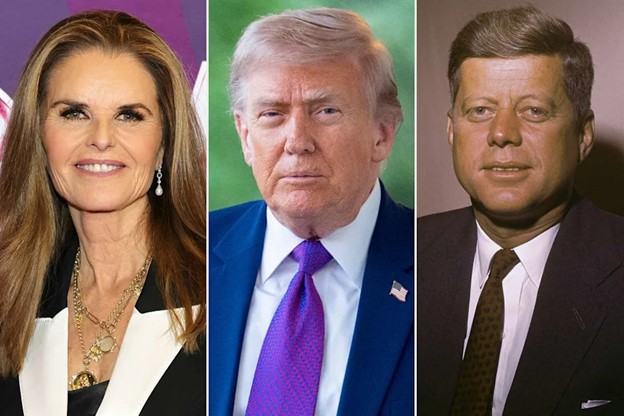
Maria Shriver Calls Judge’s Decision to Reverse the Trump-Kennedy Center Rebrand a ‘Great Birthday Gift’ to Her Uncle JFK

Credit: Ethan Miller/Getty; Aaron Schwartz/Sipa/Bloomberg via Getty; Bettmann Archive

Dear Commons Community,

Maria Shriver celebrated a judge’s ruling to remove President Donald Trump’s name from the Kennedy Center on what would have been her uncle John F. Kennedy’s, 109th birthday.  As reported by People.

Shriver, the daughter of Kennedy’s younger sister, Eunice Kennedy Shriver, called the decision from U.S. District Judge Christopher Cooper “a great birthday gift” for her uncle

Cooper, an appointee of former President Barack Obama, ordered that Trump’s name be removed from the cultural institution within 14 days and halted plans to close the building for renovations expected to take two years

“An appropriate birthday present on my uncle’s birthday today,” Shriver, the daughter of Kennedy’s younger sister, Eunice Kennedy Shriver, wrote Friday on social media in response to the decision from U.S. District Judge Christopher Cooper, an appointee of former President Barack Obama.

“I know they’ll probably appeal and the story isn’t over,” she added, “but for today let’s celebrate a great birthday gift.”

In a 94-page ruling, Cooper wrote that the Kennedy Center’s board of trustees violated the original law that named the cultural institution for Kennedy in 1964, shortly after Kennedy’s assassination in November 1963. He ordered that Trump’s name, installed on the building’s exterior in December, be removed within two weeks, and halted plans announced by the president in February to close the center for a “complete rebuilding.”

“The Kennedy Center’s organic statute makes crystal clear that the Center is to be named for President Kennedy, and it cannot bear any other formal name or public memorial based on the Board’s unilateral say-so,” Cooper wrote on Friday.

“Congress gave the Kennedy Center its name, and only Congress can change it,” he added.

Trump raged against Cooper’s decision in a lengthy Truth Social post on Friday, but appeared willing to acquiesce.

“Based on the fact that the Radical Left Democrats care more about opposing your favorite President, ME, than saving a dying Performing Arts Center, almost all of which lose large amounts of money throughout the Country, we are going to be working with Congress to transfer this failing Institution back to them so they can make a determination as to what to do with it,” he wrote.

“Unless I am free to do what I do better than anyone else, bring this Institution back, physically, financially, and artistically, I have no interest in continuing what could only be a hopeless journey into ‘NEVER NEVER LAND,’” Trump added.

Shriver, a frequent and outspoken critic of the president, has been highly critical of the effort to add his name to the Kennedy Center, a living memorial to the 35th president, since its board of trustees took a unanimous vote to do so late last year.

“It is beyond comprehension that this sitting president has sought to rename this great memorial dedicated to President Kennedy,” Shriver wrote on Instagram after White House press secretary Karoline Leavitt had announced the vote in December 2025. “It is beyond wild that he would think adding his name in front of President Kennedy’s name is acceptable. It is not.”

 John F. Kennedy was all class!  Trump is all crass!

Tony

Florida Set to Stop Funding ‘Preeminence,’ Just as U. of Central Florida Qualifies!

A spending deal approved by the Florida state legislature, is headed to the desk of Florida Gov. Ron DeSantis, that eliminates extra funding for the state’s “preeminent” public universities, The Miami Herald reports. That’s especially bad news for the University of Central Florida (UCF), which is expected to qualify for the designation for the first time this year.

The Preeminence Program emerged in 2013 as an elite designation system to encourage the state’s universities to climb nationwide rankings by meeting a certain number of statistical benchmarks. To achieve this status, institutions must meet or exceed 11 of 12 strict benchmark metrics, including graduation rates, student retention, research expenditures, and patents.  The University of Florida, Florida State University, the University of South Florida, and Florida International University currently have the distinction and last year split $40 million in extra state funding.

If the Preeminence Program is eliminated, it would show a disdain for quality at the Florida state universities.  I feel sorry for colleagues at UCF and the other state universities.

Tony

More on Peer Review in Trouble: Trump Hijacks American Science and Scholarship

A photo of the flags of the People's Republic of China and the Soviet Union waving in the wind against a blue-sky background.

Hung Chin Liu/iStock/Getty Images Plus

Dear Commons Community,

Yesterday I posted on “Peer Review in Trouble in Australia.” One of my colleagues, Bob Ubell, sent me an email alerting me to an article he wrote for Inside Higher Education entitled, “Trump Hijacks American Science and Scholarship.”  Bob ably brings the issue home to the United States.  Below is his entire article.

Important reading!

Tony

———————————————————————-

Inside Higher Education  

Trump Hijacks American Science and Scholarship

Robert Ubell writes that an executive order giving political appointees authority over grant approvals amounts to a Communist-style takeover.

By  Robert Ubell

In a nearly daily barrage, President Trump and his MAGA forces heave fireballs at science and higher education. In the last weeks alone, the administration has been busy hurling a demand for a billion dollars from the University of California, Los Angeles; axing proven mRNA vaccine research; and demanding colleges submit expanded sex and race data from student applications, among other startling detonations. Amid the onslaught of these unsettling developments, it would be easy to miss the decisive change in conventional scientific and scholarly practice, one so vast that it threatens to overturn our revered American research achievements.

On Aug. 7, Trump issued an executive order that uproots more than a half century of peer review, the standard practice for funding federal scientific grants. Taking approval out of the hands of experts, the new rule makes grant approval contingent upon the assent of political puppets who will approve only those awards the president finds acceptable.

When I first came upon the order, I was immediately struck by how closely it resembles the unquestioned authority granted to senior political appointees in Soviet Russia and Communist China. As if dictated by commissars, the new rule requires officials to fund only those proposals that advance presidential priorities. Cast aside, peer review is now merely advisory.

It took my breath away, suddenly realizing how completely threatening the new order is to the very foundations of the democratic practice of research and scholarship. As Victor Ambros, Nobel laureate and co-discoverer of microRNA, aptly put it, the order constitutes a “a shameless, full-bore Soviet-style politicization of American science that will smother what until now has been the world’s pre-eminent scientific enterprise.”

Decades ago, long before I entered higher ed, I worked at a small publishing company in New York that translated Russian scientific and technical books and journals into English. As head of translations, I’d travel once or twice a year over many years to Moscow and Leningrad (now, once again, St. Petersburg) to negotiate with Soviet publishers to obtain rights to our English translations.

One evening in the late ’60s, I invited a distinguished physicist to join me for dinner at a Ukrainian restaurant not far from my hotel in Moscow. We talked for some time openly over a bottle of vodka about new trends in physics, among other themes. As dinner drew to a close, he let his guard down and whispered a confidence. Mournfully, he told me he’d just received an invitation to deliver the keynote address at a scientific conference in England, but the Party official at his institution wouldn’t permit him to travel. I still remember the sense of being privy to a deep and troubling secret, reflected in the silence that followed and the palpable unease at the table. Shame enveloped him.

Over a couple of dozen years of frequent trips to the Soviet Union and Communist China, I never met a single Party official. My day-to-day interactions were with administrators, editors, researchers and faculty who managed scientific publishing or were involved in teaching, research or other routine matters. The Party secretary remained hidden behind a curtain of power as in The Wizard of Oz.

On one rare occasion in the 2010s, at a graduation ceremony at a local technical university in Beijing where I ran a couple of online master’s degrees in partnership with Stevens Institute of Technology, a student seated next to me in the audience drew near and identified a well-dressed official several rows ahead of us up front. “The Party secretary,” he revealed in hushed tones. I saw the officer later at the reception, standing by himself with a dour expression, as faculty, students and family members bustled about at a distance.

One afternoon at that university in Beijing, I came upon a huddle of faculty in a corner office. As they chatted quietly among themselves in Mandarin, I took a seat at the far end of the room to give them privacy. But I could make out that a man in the group was disturbed, his face flushed and his eyes close to tears. Later, I approached one of the faculty members in the group with whom I’d grown close and asked what had troubled his colleague

“Oh,” he replied. “He often gets upset when the Party secretary objects to something we’re doing. He worries that our joint program is in jeopardy.”

These personal reflections, based on my limited encounters with scientists and faculty, do not reveal the full extent of the control over scientific research exerted by Party functionaries. But if you compare the president’s new order with that of the Party’s authority in Soviet Russia and Communist China, you’ll find they’re all out of the same playbook.

The order’s demand for political appointee approval takes decisions out of the hands of apolitical, merit-based peer-review panels. In the Soviet Union and China, adherence to the Party line and loyalty to the regime was (or is) paramount, with grant funds being used to advance ideological or state power. Similarly, the president’s order establishes a party line, stating that federal money cannot be used to support racial preferences, “denial … of the sex binary in humans,” illegal immigration or initiatives deemed “anti-American.”


Peer Review in Trouble in Australia

Dear Commons Community,

This is the second posting I will be making in as many months on concerns with peer review.  In this morning’s Science, an editorial entitled, “Australia’s erosion of peer review” rings alarm about the state of peer review down under. Here is an excerpt:

“Between 1992 and 2018, government support for fundamental research decreased by 17%, according to the Australian Academy of Science. Despite frustration in the gross underinvestment in biomedical research, Australian scientists were comforted by a trusted peer review system. For generations, Australia’s National Health and Medical Research Council (NHMRC), the major funding body for medical research, aspired to fund excellence through a careful process involving peer review grant panels. However, in 2020 the COVID-19 pandemic led to the necessary cancellation of the grant review panels that buttressed Australian science. Unfortunately, since then, there has been a systematic dismantling of high-quality review panels by the NHMRC in the name of efficiency, reduced administrative costs, and peer review flexibility. This has raised concerns across Australia’s scientific community that the peer review system is no longer reliable and thus poses an imminent threat to the future direction of Australian science.

These problems are best highlighted by detailing the farcical process through which the NHMRC has eroded the pillars that should support every credible peer review process. This includes the involvement of qualified experts. Previous grant review panels were carefully considered and assembled. Typically, about 80% of the panel (usually 12 members) were independent laboratory heads with prior grant panel experience. Remaining members were either new laboratory heads or, rarely, senior postdoctoral fellows. For training purposes, some senior postdocs were invited to serve as confidential observers, preparing them for future panels. This formative educational process for emerging leaders has now been scrapped and replaced with a YouTube-style video for junior scientists to educate themselves on peer review. In this new system, each grant is assigned to four or five anonymous reviewers whose qualifications are unknown.

…there has been a systematic dismantling of high-quality review panels… in the name of efficiency…”

Below is the entire editorial.

Tony

———————————————————-

Science

Australia’s erosion of peer review

In Section Editorial

Mark A. Dawson and Massimo A. Hilliard

Throughout the world, peer review serves as the cornerstone of the scientific enterprise, providing rigorous quality control and building the confidence that underpins progress for both science and society. Without such a robust process, scientists and the general public would rapidly lose the ability to distinguish groundbreaking advances from noise, which undermines policy decisions, research translation, and most importantly, public trust in science. Sadly, that is exactly what has been happening in Australia.

Between 1992 and 2018, government support for fundamental research decreased by 17%, according to the Australian Academy of Science. Despite frustration in the gross underinvestment in biomedical research, Australian scientists were comforted by a trusted peer review system. For generations, Australia’s National Health and Medical Research Council (NHMRC), the major funding body for medical research, aspired to fund excellence through a careful process involving peer review grant panels. However, in 2020 the COVID-19 pandemic led to the necessary cancellation of the grant review panels that buttressed Australian science. Unfortunately, since then, there has been a systematic dismantling of high-quality review panels by the NHMRC in the name of efficiency, reduced administrative costs, and peer review flexibility. This has raised concerns across Australia’s scientific community that the peer review system is no longer reliable and thus poses an imminent threat to the future direction of Australian science.

These problems are best highlighted by detailing the farcical process through which the NHMRC has eroded the pillars that should support every credible peer review process. This includes the involvement of qualified experts. Previous grant review panels were carefully considered and assembled. Typically, about 80% of the panel (usually 12 members) were independent laboratory heads with prior grant panel experience. Remaining members were either new laboratory heads or, rarely, senior postdoctoral fellows. For training purposes, some senior postdocs were invited to serve as confidential observers, preparing them for future panels. This formative educational process for emerging leaders has now been scrapped and replaced with a YouTube-style video for junior scientists to educate themselves on peer review. In this new system, each grant is assigned to four or five anonymous reviewers whose qualifications are unknown.

…there has been a systematic dismantling of high-quality review panels… in the name of efficiency…

Also gone is a stringent process that ensured fairness and accountability. Bias and conflicts of interest were frequently laid bare in prior grant review panels. Furthermore, to account for variation in raw scores, benchmarking and normalization was performed to guarantee that only the top grants from each panel were prioritized for funding. All of these measures have now been abandoned for a process that favors convenience over diligence. Reviewers do not interact, remain anonymous, and are not accountable. Consequently, variations in opinions and scores are simply mathematically averaged rather than scientifically debated, resulting in a 10% increase in funding cut-off scores and a decline of funding from 17.3% (2018) for grants reviewed at panel to 8.1% (2025).

The previous NHMRC mechanism also provided applicants with detailed reviewer comments and the opportunity to submit a two-page response before adjudication. This process has been replaced by one that provides applicants with little feedback—initially with just raw scores, and more recently with an assessment summary of as few as 100 characters. Because there are often no distinguishing features to the reviews, it is often unclear whether a grant has even been read. When scientists receive these reviews, there is no pride or sense of meritocratic achievement for a successful grant and no solace or guidance for improvement if an application was unsuccessful. On the annual occasion when NHMRC grant outcomes are released, there is only one unifying sensation felt: Australian scientists are left with the stain of embarrassment of belonging to a system that lacks the credibility of rigorous scholarly review.

The prospect of reducing or discarding grant review panels has recently been raised in other countries, including the United States, as a measure to reduce administrative costs. Australia provides a stark example of the consequences of such an action. If left unchecked, Australia will soon have a generation of scientists that has never been adequately trained, supervised, or mentored in upholding the pillars of peer review to provide an equitable adjudication on the scientific merit and value of a grant proposal. The NHMRC needs to reinstate grant review panels to ensure research excellence, restore faith in Australian science, and prevent an exodus of talent to overseas.

———————-

Mark A. Dawson is a professor at the Peter MacCallum Cancer Centre and Sir Peter MacCallum Department of Oncology, University of Melbourne, and a professor at the Collaborative Centre for Genomic Cancer Medicine, University of Melbourne, Melbourne, Australia. [email protected] Massimo A. Hilliard is a professor at the Clem Jones Centre for Aging Dementia Research, Queensland Brain Institute, Faculty of Health, Medicine and Behavioural Sciences, The University of Queensland, Brisbane, Australia. [email protected]

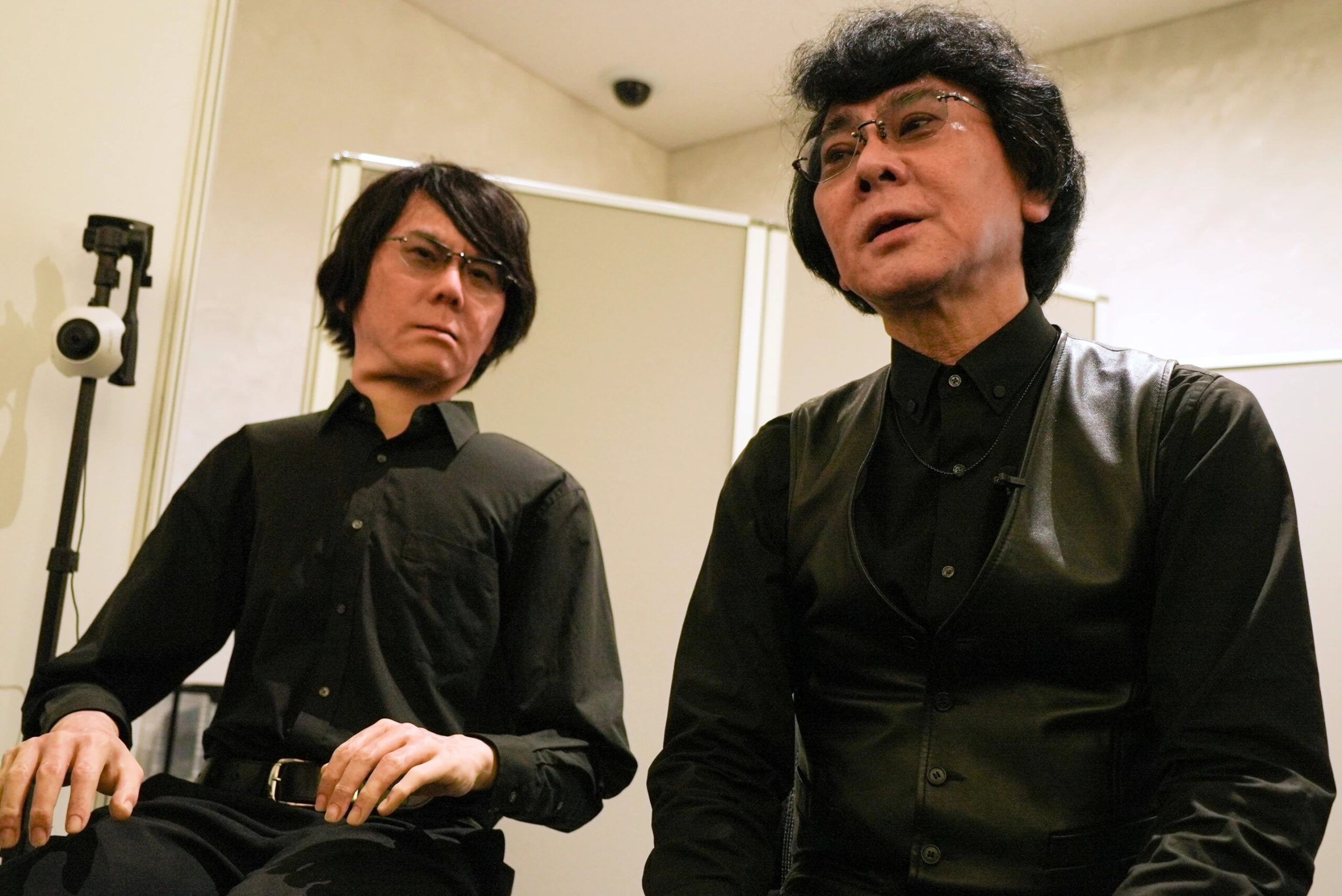
Humanoids Summit: Robots on display including one cloned to look like its developer.

Professor Hiroschi Ishiguro, on the right, talks to his android counterpart, Geminoid on the left. Photograph. Associated Press.

Dear Commons Community,

Mechanical hands dexterous enough to thread a needle, childlike dancing robots and adult-sized ones to help with deliveries were on display yesterday at the Humanoids Summit that opened in Tokyo. Among the demonstrations was Geminoid (above) who was designed to look just like his developer, Professor Hiroschi Ishiguro.  As reported by The Associated Press.

Among the dozens of companies taking part, including well-known players like Boston Dynamics and Toyota Motor Corp., the big stars now were clearly the Chinese.

Chinese newcomers, like Booster Robotics and LimX Dynamics, took the technology initially developed in Japan and the U.S. and fine-tuned it, often for cheaper mass production. It’s a repeat of what happened in other Japanese industries, from consumer electronics to cellphones and electric vehicles. In humanoids, Japan was initially ahead but then failed to produce major commercial solutions.

Tim Hornyuk, author of “Loving the Machine: The Art and Science of Japanese Robots,” who was at the event, categorized it as the so-called “Galapagos syndrome,” referring to how innovative Japanese products evolve in isolation and end up not translating for the international market.

“I really hope that Japan can come up with a Ford Model T-version of humanoid roots. But I think China has already stolen their lunch. It’s a bit too little too late,” he said.

The dancing and wiggling Mini Pi Plus robot from High Torque of China, for instance, still can’t help at an auto plant or do your dishes. But it’s cute. And it doesn’t come with an eye-popping price tag, starting at $5,500.

Chinese robots are dominating

One telling example of Chinese robotics use in Japan was GMO, a Tokyo-based AI and robotics company working on a humanoid with camera eyes that will help with Japan Airlines cargo and other chores at an airport.

The key is to have the robot do the work in the same way as people so they would be interchangeable, an initiative meant to tackle the labor shortage problem that is increasingly serious in Japan.

The inner robotics workings were all courtesy of Unitree, a Chinese outfit, which is also working on a four-legged dog-like “stellar explorer.”

Experts say Japan, with its finesse in manufacturing, proved a good breeding ground for robotics development. The sociological backdrop of a public receptive to robotics also helped.

A recent Pew global survey showed that people in Japan are highly aware of AI but are less anxious about it, at about 28%, than people in the U.S. at 50%.

Japanese automaker Honda Motor Co., a leader in robotics with its walking humanoid Asimo, first shown in 2000, was demonstrating a motorized four-fingered robotic hand that could screw on and off tiny bolts, or thread a needle.

It didn’t seem to bother Keisuke Tsuta, assistant chief engineer, that similar mechanical hands were on display galore near his booth, many of them from Chinese makers.

Japanese robotics show their prowess

The technology Honda had developed is more durable and powerful than rival offerings, and the Japanese have historically shown they can excel at quality mass production, according to Tsuta.

The looming threat of a Chinese robotics domination didn’t seem to phase Osaka University Professor Hiroshi Ishiguro, who has worked on humanoids for decades, including one that’s his clone.

“What’s significant is that Japan has a culture that’s receptive to robotics. If we’re going to really start using robots in society, Japan is the ideal place,” he said, stressing that Japanese don’t discriminate against robots.

His robotic counterpart, dressed all in black like the professor, did as good a job, if not better, of answering a key existentialist question on the meaning of robots.

“I think robots will coexist with people. Robots are the mirror of human beings,” the robot replied in a slightly monotonous but human-like voice.

Earlier, the professor had answered a similar question, but a bit differently.

“No one is interested in me. All everyone cares about is my robot,” he said, sitting next to his twin-like humanoid.

“As long as people identify with what I have produced, I am a success,” he added.

Impressive!

Tony


Jill Biden says she thought Joe Biden was having a stroke during 2024 debate

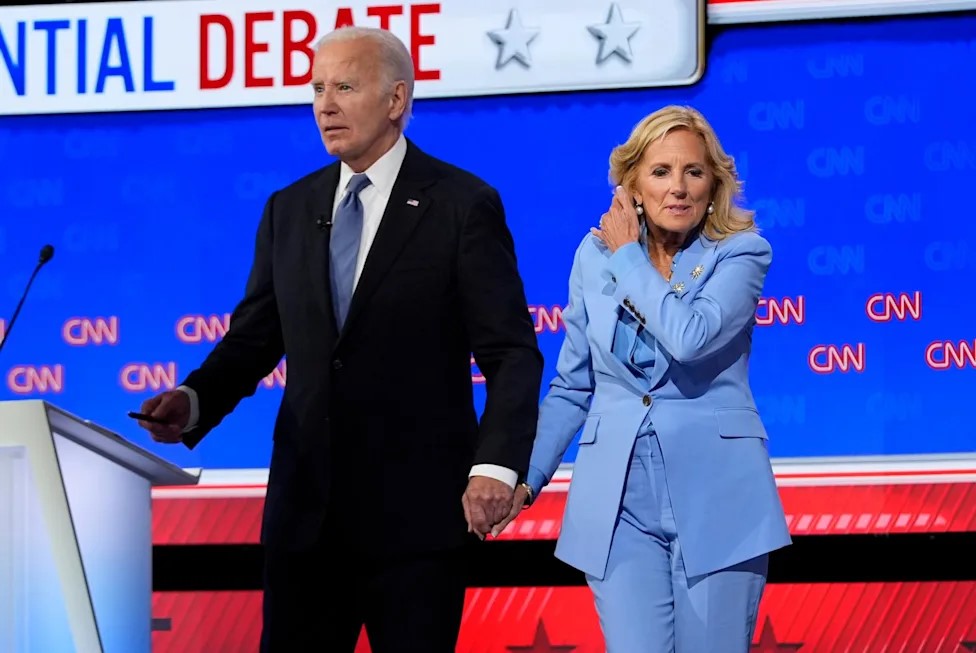
The Bidens at the conclusion of his debate with Trump on 27 June 2024.Photograph: Gerald Herbert/AP

Dear Commons Community,

Jill Biden said she had been “frightened” as she watched Joe Biden’s faltering performance during his 2024 presidential debate, and thought her husband might have suffered a stroke.  As reported by The Guardian.

“I was frightened, because I had never, ever seen Joe like that before or since. Never,” the former first lady said in an interview with CBS set to air on Sunday.

“As I watched it, I thought: ‘Oh, my God, he’s having a stroke,’” she said. “And it scared me to death.”

Biden’s poor debate performance against Donald Trump in June 2024 sparked widespread alarm among Democrats, prompting calls for his withdrawal from the race.

Under immense pressure, Biden ended his re-election bid and endorsed his vice-president, Kamala Harris, leaving her just 107 days to campaign before the November 2024 general election against Trump.

Throughout the 90-minute showdown in Atlanta, a raspy Biden, then 81 years old, repeatedly stumbled over his words, took long pauses and mumbled inaudibly and occasionally incoherently.

At one point, his rambling response prompted Trump to quip: “I really don’t know what he said at the end of that sentence. I don’t think he knows what he said either.”

Biden memorably tried to land a blow on Trump’s policies on tax cuts and the national debt, but tangled the line and instead declared: “We finally beat Medicare.” His team later clarified that he had meant to say his administration had “beat big pharma”, but the misspeak crystalized longstanding concerns about the mental acuity and physical condition of the US’s oldest president.

Biden also veered away from a question on reproductive rights, shifting instead to references about women killed by immigrants – a pivot into one of his weaker areas and a point frequently emphasized in Republican talking points.

Jill Biden has remained a stalwart supporter of her husband throughout his decades-long political career. In a rally shortly after the June 2024 debate, Jill Biden praised her husband’s performance, saying: “Joe, you did such a great job. You answered every question. You knew all the facts.”

The former first lady will soon publish a memoir, titled View from the East Wing, about her experience in the White House. In it, she is expected to share her account of her husband’s fraught re-election campaign and his monumental – and historic –decision to withdraw.

I am sorry Jill but you and his political handlers never should have allowed your husband to run for a second term. He should have left after one term and would have been viewed as having a successful presidency.  Instead, his decision to run and then to withdraw late in the game put the Democratic Party at a distinct disadvantage going into the election.

Tony

Trump Blocks $2 Billion Approved for Education: See Programs Affected

Sample of Education Programs Not Being Funded. Click on the table to enlarge.
Dear Commons Community,


The Trump administration is using an obscure and typically routine federal budget procedure to withhold more than $2 billion for education that Congress approved in February.  As reported by Education Week.

Lawmakers belatedly approved a fiscal 2026 budget for the U.S. Department of Education on Feb. 3. Before the agency can actually spend those dollars, the federal Office of Management and Budget by law must “apportion” the correct amounts, or dispense them, into the agency’s accounts.

During past presidencies, the vast majority of apportionments occurred no later than a month and a half after lawmakers approved the federal budget, according to publicly available documents and former OMB staffers.

The second Trump administration has taken a markedly different approach. As of May 21, OMB has apportioned little or no fiscal 2026 funding for 33 of the agency’s competitive grant programs totaling more than $1.8 billion. The office has also apportioned less than one-quarter of the $790 million allocation Congress approved earlier this year for the Institute of Education Sciences, the department’s research arm.

Most of these funds aren’t expected to go out to grant recipients until later this year. And none of the department’s larger formula grants—including for Title programs and special education—is among the programs with missing or incomplete apportionments.

Still, education advocates and federal budget experts have expressed concern that the lack of routine apportionments could foreshadow more funding disruption in the coming months. The department has launched grant competitions in recent months for 11 of the programs without currently apportioned funds—but the agency likely can’t give out new grant awards or replenish ongoing grants using these congressionally appropriated funds until OMB apportions the money for each program.

Education Week is closely tracking OMB apportionment disclosures using the OpenOMB transparency portal operated by the nonprofit Protect Democracy. Below is our list of the 34 programs with missing or incomplete apportionments and the date when unspent funding returns to the U.S. Treasury.

Spokespeople for the Education Department have repeatedly said the agency is reviewing every dollar it spends rather than giving out funds “on autopilot.” OMB hasn’t responded to multiple requests for comment.

Legal fight over White House role in federal spending continues

More than $1 billion of the currently unapportioned Education Department funds will expire and return to the Treasury if OMB doesn’t release the money in the next four months. That would likely constitute a violation of the federal law that prohibits the executive branch from “impounding,” or declining to spend, congressional appropriations.

Russell Vought, the Trump-appointed OMB director who co-wrote the conservative policy document Project 2025, has said he believes the impoundment ban that’s part of federal law is unconstitutional and that the administration has “not impounded a single thing.” He’s also spoken publicly about using the apportionment process to keep federal spending in line with the president’s priorities.

This approach marks a sharp break with past practice. “For the 27 years I worked at OMB, it never occurred to any OMB staff that a president or OMB director would do what Trump and Vought are doing,” said Kathy Stack, who oversaw the office’s education branch from 2000 to 2005 and the broader division that includes education from 2005 to 2013, during the Bush and Obama administrations.

Similar OMB maneuvers since last year have affected grantees for other agencies, including for community development financial institutionsdomestic violence preventiondrought mitigationhealth and science research, and public transit.

OMB last year also removed all of its apportionment documents from its website. Protect Democracy and other transparency advocates sued to reverse the move and secured a court order last fall that requires OMB to continue publishing apportionment documents and the spending plans it’s requiring from agencies before releasing certain funds.

Tony


What are James Talarico’s Chances of Defeating Ken Paxton for the Texas Senate Seat?

James Talarico. Brenda Bazán/Associated Press

Dear Commons Community,

Yesterday, Ken Paxton won the Republican nomination for the U.S. Senate seat in the Texas.  He defeated long-time incumbent John Cornyn.  Democrats are seeing this as an opportunity for their candidate, James Talarico, to win the election in November.  Below is an analysis, courtesy of The New York Times, by Jack Herrera, who regularly covers Texas politics.

Tony


The New York Times

What Ken Paxton’s Win Means for James Talarico

May 26, 2026

By Jack Herrera

Mr. Herrera writes about the changing American West. He has covered Texas politics since 2020.

When James Talarico was born in Round Rock, Texas, in 1989, Democrats controlled both chambers of the Texas statehouse. A reformed frat boy named George W. Bush was still a few years away from becoming governor.

Thirty-seven years later, Texas is solidly red, with Republicans holding both U.S. Senate seats, the governor’s mansion and the State Legislature. But after winning the Democratic Senate primary in March, Mr. Talarico has a chance to become the first Democratic U.S. senator elected in Texas in his lifetime. Not because the state’s Democrats suddenly have their act together, but because the party has a perfect candidate to run against: the right-wing warrior Ken Paxton.

Mr. Paxton — who just defeated the incumbent, John Cornyn, in a G.O.P. runoff — is known as a scoundrel. In 2023, he was impeached by the state’s Republican-controlled House on corruption charges (but was acquitted by the State Senate). Last year, his wife — herself a state senator — filed for divorce, accusing him of having an extramarital affair.

Combine that with a midterm election year in which President Trump’s coattails look shorter than they once did, and Mr. Talarico has the best chance a Democratic Senate candidate has had in years.

Over the past decade, the Texas Republican Party deftly navigated the rise of MAGA. It retained the backing of wealthy business interests in the state while expanding its support with middle- and working-class voters. In particular, it has drawn Mexican American voters from the Rio Grande Valley into the Republican coalition. But the party is weaker than it seems.

Because Republican primaries, not general elections, frequently decide who is in power in Texas, politicians like Mr. Paxton often need only the votes of about 3 percent of the population to ultimately win office. That’s made it a lot easier for Republican politicians to drift to the right of Texas’ broader electorate.

Consider, for example, the issue of abortion: The average Texan is conservative when it comes to reproductive health care, but not as conservative as Mr. Paxton, the state’s attorney general. According to a 2025 poll, 83 percent of Texans think abortions should be legal in cases of rape or incest; 82 percent think abortions should be legal to preserve the mother’s physical health; and 84 percent think abortions should be legal if doctors determine that a fetus will die before or not long after birth. By contrast, in 2023, Mr. Paxton went to great lengths to try to prevent Kate Cox from getting legal approval to terminate her pregnancy after she found out that her fetus had a fatal genetic condition.

This kind of ideological gap exists not only between Mr. Paxton and many Texas voters, but also between him and other Republicans. The bitter primary battle between Mr. Paxton and Mr. Cornyn deepened a divide between Texas’ chamber-of-commerce-style Republicans and the harder-right MAGA faithful. Mr. Paxton got Mr. Trump’s endorsement at the 11th hour. Wealthy donors spent tens of millions trying to help Mr. Cornyn, to no avail.

All this leaves an opening for a candidate like Mr. Talarico — a member of the Texas House of Representatives who blends progressive ideas with an overt embrace of his Christian faith. The question now is whether Texas Democrats can take advantage of it.

Millions of Texans have spent decades in a no man’s land between a Republican Party that caters to its primary voters and a Democratic Party that won’t meet them where they are. Mr. Talarico has a chance to offer them a politics that’s both Democratic and Texan.

His most direct path to victory runs through college-educated voters, who are more likely to vote than those without college degrees. If Democrats can turn out these voters, particularly in places like Dallas and Austin, destinations for many prosperous transplants, they’ll increase the chances that he’ll prove recent polling right and eke out a narrow victory.

But there are limits to appealing to those voters: What plays in some precincts won’t always fly in the rest of Texas. Adopting the priorities — and the language — of college-educated suburban voters has alienated some voters in other key constituencies. It’s one of the reasons Texas’ growing Latino electorate hasn’t saved Democrats, as some people in the party once hoped.

Mr. Talarico, to his credit, has taken pride in campaigning in parts of Texas that Democrats previously all but conceded. He acknowledges that he hasn’t always made headway with skeptical voters, but he and other Democrats will need that willingness to take the fight into Republican territory to gain ground in 2026 and beyond.

A version of this approach has already worked for Republicans. In 2016, Mr. Trump lost by wide margins in several majority-Latino counties along the U.S.-Mexico border. No doubt, following that race, there were political consultants who told Republicans that it wasn’t worth their time trying to win new voters there. But a few forward-looking Republicans noticed something: Evangelical churches, long a core component of their coalition, were gaining popularity among traditionally Catholic Tejanos.

With evangelical voters as a focus, local Latina conservatives began building their party the way a pastor builds a church: They knocked on doors. They offered people a sense of belonging. They said Democrats were taking Latino voters for granted. And in 2020 the South Texas borderlands from Laredo to Brownsville moved sharply to the right.

One key to winning those districts was economic populism. The party tailored its message to focus on inflation and other bread-and-butter issues, and then reaped the rewards in 2024.

Mr. Talarico can use a comparable model to expand the Texas Democratic coalition.

Whatever happens, Texas Democrats will need a message that fits their state. Recall that what brought Beto O’Rourke’s 2018 Senate campaign so close to beating Senator Ted Cruz — he lost by just 2.6 percentage points — was that it was authentically Texan despite his popularity with liberals around the country.

Mr. O’Rourke visited all 254 Texas counties. He worked around liberal interest groups and the dysfunction of the state Democratic Party. He took in plenty of out-of-state money without adopting an out-of-state voice. He talked about gun safety without demonizing gun owners.

It was when he ran for president and started sounding like a standard Democrat, telling gun owners, “Hell yes, we’re going to take your AR-15,” that he began to struggle.


In 2022, Republicans hung that quote around his neck and he got walloped by double digits. Mr. Talarico, take note.


New York Knicks win NBA Eastern Conference Champion and are going to the Finals for first time in 27 years!

OG Anunoby and the Knicks bench celebrate.

OG Anunoby and the New York Knicks are heading to the NBA Finals. David Liam Kyle

Dear Commons Community,

Congratulations to the New York Knicks for being the NBA Eastern Conference Champions and on their way to the NBA finals.   Here is a recap courtesy of The Athletic.

The Knicks are headed to the big dance for the first time since 1999 after they completed a sweep of the Cleveland Cavaliers in the Eastern Conference finals. New York beat the “home” Cavs, 130-93, in Game 4 — and it felt like all five boroughs took over Cleveland’s Rocket Arena.  It was a total team effort from start to finish with all of the Knick players making contributions. 

Jalen Brunson, MVP for the conference finals, scored 15 points with five assists in the blowout. Karl-Anthony Towns added 19 points and 14 boards on 8-of-11 shooting. OG Anunoby, the lone Knick who has already won a finals with the 2019 Raptors, finished with 17 points.

The Knicks have won 11 in a row and swept both the 76ers and Cavs. They were up by 40 on Cleveland through three games and just about doubled that Sunday night. It was total dominance, no matter what Kenny Atkinson said about the analytics.

The “Let’s Go Knicks” chants were startling, borderline deafening. Knick fan celebrities like Timothée Chalamet, Spike Lee, Tracy Morgan and Fat Joe showed up, even if they were kicked to the second row for violating rules cheering against the Cavs in floor seats. 

This is the Knicks’ ninth finals berth — they haven’t won a title since 1973. They’ll once again have ample rest ahead of the next round, getting to put their legs up while the Oklahoma City Thunder and San Antonio Spurs bash each other out West.

One of those teams will host Game 1 of the NBA Finals on June 3.

Donovan Mitchell led the Cavs with 31 points. James Harden had a bad series, and in the finale scored 12 points and missed all six of his 3s. Evan Mobley contributed 15 points and seven boards. Cleveland reserve guard Dennis Schröder missed Game 4 with what the Cavs simply called an “illness.” He likely wouldn’t have made much of a difference.

The Cavs’ Rocket Arena is always loud. Some of it is the fans, but the music is cranked up to higher levels and two adults with microphones are allowed to scream into them at all times. But that combination was no match for the thousands of New York fans who flooded the arena, chanting “Let’s Go Knicks” and booing when Harden scored or a foul was called on the Knicks.

The Knicks shot 50 percent from 3-point range in the first quarter and built a 38-26 lead, but the tone was set just as much by their substantially large traveling fan base. The 20-0 run the Knicks launched near the end of the first quarter that ran into the second and turned this into a total blowout — well, that’s more of a player thing.

All postseason long, Knick Coach Mike Brown has said that the hardest game in the playoffs is the one closing out a series.

Well, he lied.

After closing out the Atlanta Hawks in the first round with a 51-point win and taking down the Philadelphia 76ers with a 30-point victory in a Game 4 sweep, the Knicks guaranteed themselves their first trip to the NBA Finals in 27 years with a victory over the Cavs.

New York’s dominant run has made the franchise feel invincible. The Knicks dropped the first two of three games to the Hawks in the first round and have been on as dominant a postseason run as there has been in NBA history. They go into the NBA Finals having won 11 straight playoff games.

As far as confidence goes, New York has plenty of it going into the sport’s most prestigious stage. The Knicks will need all the confidence they can get. They can beat either Oklahoma City or San Antonio, but it won’t be as easy as their path in the Eastern Conference has made it seem.

Go Knicks!

Tony