Trump deploys troops in Washington, DC, takes over police!

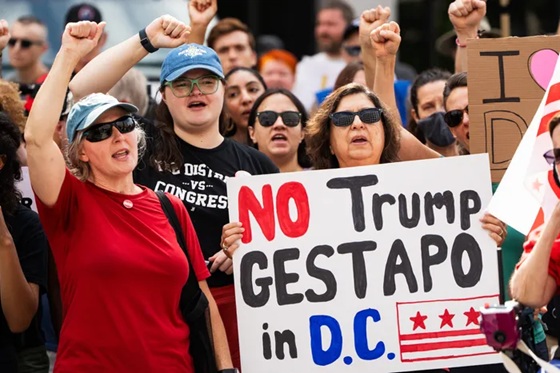
Protesters rally in downtown Washington D.C. near the White House on August 11, 2025, after President Donald Trump ordered an increased federal law enforcement presence across the streets of Washington, D.C., a federal takeover of Metro Police Department and the deployment of National Guard troop in the city. The president has increasingly criticized crime in Washington even as it’s reached a 30-year low.

Dear Commons Community,

Trump’s plan to take over to take over law enforcement in Washington, D.C. was met with strong opposition by protesters in the nati0n’s capitol.

Joined by top administration officials, including Attorney General Pam Bondi and Secretary of Defense Pete Hegseth, the president announced the National Guard will be deployed in the nation’s capital and that the local police will be placed under federal control.  As reported by USA Today.

“This is an emergency,” Trump said. “This is a tragic emergency.”

The president painted a dark portrait of the city throughout yesterday’s press conference, describing it as overrun by homeless people, drug addicts and other “bloodthirsty criminals” that his administration will no longer tolerate.

Many residents and activists have long resisted those characterizations as false and racially motivated attacks against the city, which has lobbied for statehood in recent years.

Mayor Muriel Bowser pushed back at the president’s claims of rising crime over the weekend, saying residents “are not experiencing a crime spike.” She underscored the need for D.C. statehood during a separate press conference on Aug. 11 hours after Trump’s comments.

“We are American citizens. Our families go to war, we pay taxes and we uphold the responsibilities of citizenship,” Bowser said. “And while this action today is unsettling and unprecedented, I can’t say that given some of the rhetoric of the past, that we’re totally surprised.”

But Trump and his allies have been keen on spotlighting individual violent crimes against reporters, White House aides and congressional staffers that often seize headlines and startle tourists.

Democrats and other critics pointed out that Washington’s homicide rate is down 32% year-to-date, according to the Metropolitan Police Department. They called Trump’s move another abuse of his executive authority.

Here are key takeaways from Trump’s press conference.

Trump administration taking over DC police

Trump signed two executive orders, the first invoking the 1973 Home Rule Act, which allows the president to assume control of Washington police for 48 hours if they determine “that special conditions of an emergency nature exist…”

Such a takeover can be extended with congressional approval but any request of more than 30 days must be passed into law.

In a separate order, Trump ordered Hegseth to deploy National Guard troops in Washington, which also authorized him to work with governors of other states to utilize their guard as well.

Key officials within the administration are now being tasked with overseeing DC’s law enforcement agencies, including Bondi, who will take command of the local Metropolitan Police Department. Drug Enforcement Agency Administrator Terry Cole, who was sworn in last month, will serve as interim federal commissioner of the police department.

White House spotlights DOGE staffer and other crime victims

During the press conference, Trump sprinkled in many individual cases of violent crime that he argued justified his takeover, such as the May 21 fatal shooting of two Israeli embassy staffers outside a downtown museum.

One at the top of mind was the assault of Edward Coristine, who worked as a staffer with the Department of Government Efficiency. An Aug. 3 police report, obtained by USA TODAY, said officers observed a group of about 10 juveniles surrounding Coristine’s car and assaulting him around 3 a.m.

“He was left dripping in blood,” Trump said. “He thought he was dead, with a broken nose and concussion. Can’t believe that he’s alive. He can’t believe it.”

The president also evoked Phillip Todd, a former aide to Sen. Rand Paul, R-Kentucky, who was stabbed in 2023. Trump described the attacker, identified by police as Glynn Neal, as a “demented lunatic.”

In an August profile by The Washington Post, Todd, a son of Christian missionaries, said that he had forgiven Neal and was rethinking his views on crime and punishment.

Chicago, other cities could see federal oversight, Trump warns

While ticking off individual cases, Trump noted that his Washington takeover might be brought to cities including Chicago; Baltimore; Los Angeles and Oakland, California.

Those Democratic-controlled cities and states, Trump said, have adopted left-leaning policies, such “no cash bail” rules, that he blamed for violent crime.

“This issue directly impacts the functioning of the federal government, and is a threat to America, really,” he said. “It’s a threat to our country. We have other cities also that are bad, very bad.”

Chicago was in the news earlier this summer for a historic drop in crime that Mayor Brandon Johnson, who Trump called out during the press conference, has touted.

“This reduction in hate crimes and of violence generally is a testament to what’s possible when we invest in people and community safety in a holistic way,” Johnson said in a July 18 statement that credited “strategic, constitutional policing” and “jobs for young people, access to mental health care, and housing people can afford.”

Similar trends have occurred in Baltimore, which has seen a 24% decrease in homicides and an 18% decline in nonfatal shootings, according to Mayor Brandon Scott.

In a statement to USA TODAY, the Democratic Mayor’s Association said federal intervention isn’t needed and argued the president is looking to create a “political charade” to distract voters.

“Let’s be clear: Crime is down in most major cities − including Washington, DC − in spite of Donald Trump, not because of him,” the group said. “If Trump actually cared about reducing crime, he wouldn’t have made unprecedented cuts to public safety programs that actually work.”

Congress’ takeover of Washington could come next

Trump’s crackdown in Washington could be followed by further changes, specifically to its home rule status, which is often a favorite punching bag for congressional Republicans.

Ahead of the president’s press conference, Sen. Mike Lee, R-Utah, declared that now is the time for lawmakers to take control of the city.

“We should pass the BOWSER Act in September and return full control of Washington to Congress,” Lee said in an Aug. 11 post on X.

The bill, dubbed “Bringing Oversight to Washington and Safety to Every Resident” was introduced earlier this year, and was named after Bowser as a criticism of crime and alleged corruption in the city.

Lee co-sponsored the measure with Rep. Andy Ogles, R-Tennessee, and cited an ongoing scandal involving a Washington police commander who in July was suspended for allegedly changing crime stats. He also noted how in some news reports local residents said they were afraid to speak out about crime.

Trump appeared to allude to the Ogles-Lee proposal to rescind home rule. “We’re going to change the statue, and I’m going to have to get the Republicans to vote, because the Democrats are weak on crime,” he said.

Democrats point out most violent cities are in Republican states

National Democrats took a few swings at Trump’s declaration, casting it as a political ploy more than a fight to improve public safety.

“The most violent cities are in Republican states − and there’s no takeover happening there,” Sen. Chris Murphy, D-Connecticut, a rumored 2028 presidential contender, said in a post on X. “This is just another attempt to distract from Trump’s corruption and suppress dissent.”

Tony
Jen Pawol becomes first female MLB umpire!

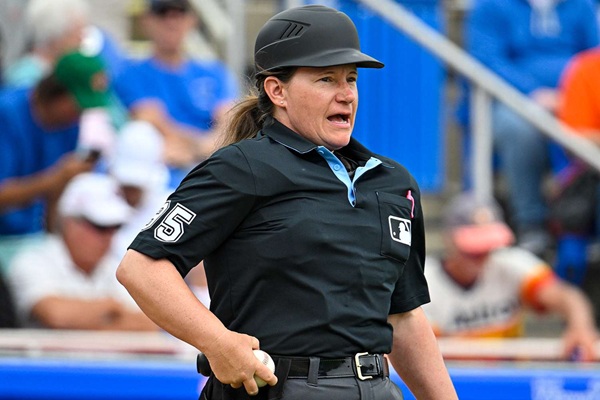
Jen Pawol

Dear Commons Community,

One day after becoming the first woman to umpire an MLB regular-season game, Jen Pawol was behind home plate for Sunday’s game between the Miami Marlins and Atlanta Braves, making her the first female umpire to call balls and strikes for an MLB game.

With strike zone graphics now a mainstay on MLB broadcasts and resources like MLB Gameday showing balls and strikes in detail, calls by home plate umpires are under more scrutiny than ever. Unfortunately, Pawol contributed to that discourse with a dubious first strike call.

The opening pitch of the game from Braves starter Joey Wentz was inside and out of the zone, but Pawol called the 93 mph fastball a strike.

As Braves play-by-play broadcaster Joe Simpson said, “Joey Wentz likes that first call from Jen Pawol!”

That pitch looked far inside on the TV broadcast and MLB Gameday confirmed that location.

Marlins second baseman Xavier Edwards didn’t dispute the call or show much reaction to it. The Braves then called timeout to get the ball to commemorate the occasion for Pawol. However, perhaps sensing where Pawol’s strike zone was situated, Edwards swung at a fastball thrown even further inside and hit it up the middle for a single.

Pawol appeared to settle in and find the strike zone better from there, calling that inside pitch to right-handed batters consistently and getting several borderline calls correct. Wentz and Marlins starter Cal Quantrill also helped out by locating most of their pitches in the zone. Through four innings, Wentz threw 44 of his 65 pitches for strikes, while Quantrill threw 29 of 46 in the zone.

Marlins manager Clayton McCullough tipped his cap to Pawol for making history.

“I think Jen did a really nice job,” McCullough said, via The Associated Press. “I think she’s very composed back there. She handled and managed the game very well. And big day for her. Big day for Major League Baseball. I congratulated her again on that because it’s quite the accomplishment.”

Pawol made her major-league debut Saturday, umpiring the first game of a doubleheader between the Marlins and Braves at first base. She worked the second game of the twin bill at third base. As part of her duties at first base, she checked Braves pitcher Hurston Waldrep for illegal substances after the first inning.

The cap she wore for Saturday’s opening game was given to the National Baseball Hall of Fame afterward.

Prior to her MLB debut, Pawol umpired over 1,200 minor-league games, beginning in 2016. Before being promoted to the majors, Pawol, 48, umpired MLB spring training games during the past two seasons, the first woman to do so since Ria Cortesio in 2007.

She became MLB’s first female umpire after the NBA broke that gender barrier with Violet Palmer in 1997. Sarah Thomas was the first female referee to officiate an NFL game in 2015. And in 2022, Stéphanie Frappart became the first woman to referee a men’s World Cup game.

Congratulations Umpire Pawol and Major League Baseball!

Tony

President Midas’ Terrible Touch!


Dear Commons Community,

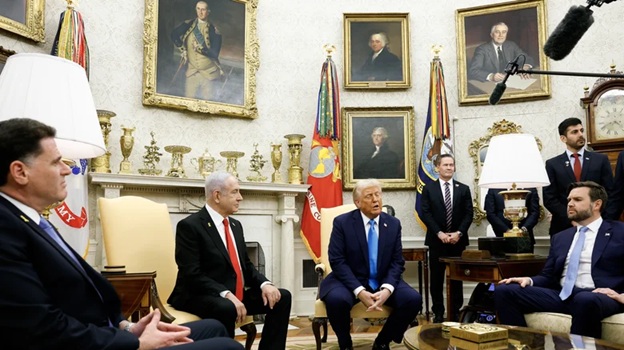
President Donald Trump wasted no time making himself feel right at home when he moved back into the White House in January. The Oval Office was already giving Trump Tower 2.0 vibes just a month after he was officially handed the keys to the country. Gold vases posed on top of the room’s fireplace, and golden-framed pictures of our founding fathers glamorized the walls. Even the rug that masked the office’s floor matched its gold theme. But apparently, the executive mansion’s transformation was only getting started. The wall and fireplace wore gold pieces and carvings that they didn’t have when Trump initially settled into the White House. More gold trinkets stood on top of its mantle, including a clock that posed at the center.  Given Trump’s attachment to gold, the White House’s glow-up shouldn’t come as too much of a shock

Maureen Dowd in her column yesterday likens Trump to King Midas.  She comments:

“Trump is trying to turn the people’s house into a Saudi palace – “dictator chic”. It is symbolic of this president: he’s refashioning our democracy as an autocracy.

“In one year, we’ll celebrate 250 years of independence from a mad king,” said political consultant David Axelrod. “Would you not give anything to invite Washington, Jefferson and Lincoln back to comment on what they’re seeing? It’s blasphemous.”

She concludes:

“The president’s unbridled gilt reflects his unbridled greed.

King Midas of legend paid for his vanity. He was horrified that he could not control the golden touch. He turned his daughter, his food and his drink into gold. Aristotle said his “vain prayer” led to starvation.

It is a lesson Trump will never learn: the flashiest is never the truest.

Below is Dowd’s entire column.

Tony

————-——————————————

The New York Times

President Midas’ Terrible Touch

Maureen Dowd

Sun Aug 10 2025

When I was little, my mom told me a Cinderella story that happened to be true.

Once upon a time, George Washington and Thomas Jefferson held a competition for the design of the house of our presidents. Well-established architects submitted proposals, but the winner was a young Irishman, James Hoban. He also supervised construction of part of the Capitol.

My dad, another Irishman, worked at the Capitol. And sometimes my mom and I would drive down and gaze at the White House and Capitol, so proud that an up-and-coming Irishman could have beaten out all the other architects to play such a central role in conjuring the seats of our new Republic.

I would think about that when I grew up to be a White House reporter, interviewing president George HW Bush in the Oval Office. The room where it happens was a place of wonder, baked in history – good and bad. A famous old ivy, which had lasted through so many administrations and eavesdropped on so many remarkable conversations, was the main item on the mantel, flanked by porcelain vases. (Now there are nine gold decorative objects and counting.)

Back then, the room was understated and overwhelming. As Michael Douglas’s CEO said in The American President, showing off the Oval Office, “The White House is the single greatest home court advantage in the modern world.”

Real power doesn’t need to shout. In fact, it can whisper.

But Donald Trump was shouting down to reporters on Tuesday as he surveyed his desecration from the White House roof. He looked at his brutalist Rose Garden renovation, a stone slab with Florida-esque patio furniture and the site of the proposed $200 million ballroom, encroaching on the East Wing and encompassing 90,000sq ft, nearly twice the size of the White House residence.

Trump vowed to pay for the ballroom with private funds – which means, of course, that someone else will curry favour and pay.

Trump has long been a human wrecking ball, but now his chaos has splattered on to the usually serene White House. He’s obsessively terraforming the place to be an extension of his attention-crazed id.

Ever since he escaped what he considered a drab existence in Queens, Trump has bedazzled his life; everything from tweezers to seat belts to TV remotes were gilt. Even as president, he’s selling gold sneakers, gold watches and gold phones.

Now he has tarted up the Oval; it’s the modern version of worshipping the golden calf and just as profane.

Trump’s tacky rococo gold adornments are growing exponentially. He’s piling on more and more garish features – from cherubs to mantelpiece swirls – and sycophants add to the gold rush by bringing offerings to truckle to King Midas.

A grovelling Tim Cook came to the Oval on Wednesday with a gift for the president: a glass plaque with a 24-karat gold base.

Trump is trying to turn the people’s house into a Saudi palace – “dictator chic”. It is symbolic of this president: he’s refashioning our democracy as an autocracy.

“In one year, we’ll celebrate 250 years of independence from a mad king,” said political consultant David Axelrod. “Would you not give anything to invite Washington, Jefferson and Lincoln back to comment on what they’re seeing? It’s blasphemous.”

Trump is making the justice department a wholly owned subsidiary of Trump Inc, turning the FBI into his personal, political police force, pursuing his foes with a Javert-like fever. Justice is investigating Letitia James and Adam Schiff, and another agency is investigating Jack Smith. After Democratic legislators left Texas to block Trump’s gerrymandering power grab there, and after Trump said the FBI “may have to” get involved, a Republican senator from Texas said the bureau agreed to help locate the lawmakers.

Trump sent his former lawyer, now deputy attorney general, to interview Ghislaine Maxwell, who was then summarily transferred to Club Fed amid whispers of a possible pardon. Brian Driscoll, who briefly served as acting head of the FBI, was dismissed because he tried to protect agents from Trump’s purge of anyone involved in investigating the January 6th insurrection.

This, even as Jared Wise, a rioter who egged on the mob that day to “kill” the police, has been named an adviser to the justice department task force seeking vengeance against Trump’s perceived political foes. Trump slapped Brazil with a 50 per cent tariff because the government is prosecuting his far-right buddy Jair Bolsonaro, known as “the Trump of the tropics”, for trying to overturn the election he lost.

The president’s unbridled gilt reflects his unbridled greed.

King Midas of legend paid for his vanity. He was horrified that he could not control the golden touch. He turned his daughter, his food and his drink into gold. Aristotle said his “vain prayer” led to starvation.

It is a lesson Trump will never learn: the flashiest is never the truest.

My New Book Just Published:  “Online Education:  Foundations, Planning and Pedagogy; 2nd Edition”

Dear Commons Community,

My new book, Online Education:  Foundations, Planning and Pedagogy, 2nd Edition, has just been published by Routledge/Taylor & Francis).  It is a comprehensive exploration of fully online and blended teaching platforms, addressing history, theory, research, planning, and practice. As colleges, universities, and schools around the world accelerate their adoption of large-scale technologies and traditional class models shift into seamless, digitally interactive environments, critical insights are needed into the implications for administration and pedagogy. This substantively revised second edition examines recent developments in services and implementation, from the expansion of synchronous online learning experiences to the widened availability of generative artificial intelligence software, while updating its research foundations and case studies. A provocative concluding chapter speculates on the future of education as the sector becomes increasingly dependent on advanced AI systems, massive cloud computing, biosensing tools, and robotics.

New to this Edition

This first edition of this book was published in 2019 and is six years old.  With respect to online technology, many changes have occurred since that time that were considered in writing a new edition.  First, the normal evolution of digital technology over six years requires a re-examination of new hardware and software products and services. Second, the world is still reeling from the impact of COVID (2020-2022) on all levels of education which resulted in greater reliance on online technology for most aspects of their operations including instruction. Third, the introduction of generative artificial intelligence (i.e., ChatGPT) in 2022, has awakened society to determine how best to integrate AI into all of its organizations including education.  Keeping these developments in mind, a number of changes and upgrades to the first edition were made to bring its material up to date as we enter the midpoint of the 2020s.  Also, the case studies in Appendix A have been reviewed and revised. Faculty using this book as a reading assignment in their courses, should consider integrating them into discussion or “after chapter” writing activities.

My book is available at Routledge/Taylor & Francis 

And at Amazon at: Online Education: Foundations, Planning, and Pedagogy: Picciano, Anthony G.: 9781032839912: Amazon.com: Books

Try it.  You will like it!

Tony

New Study: AI-generated text surges in research papers

One-fifth of computer science papers may include AI-written sentences.

 W. LIANG ET AL., NAT HUM BEHAV (2025) BEHAV (2025) HTTPS://DOI.ORG/10.1038/S41562-025-02273-8

Dear Commons Community,

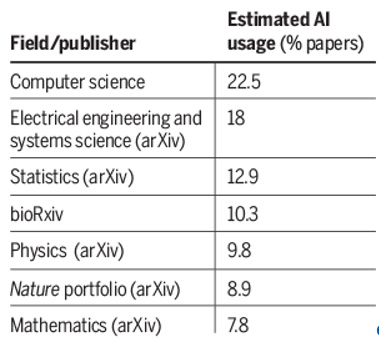
A massive, cross-disciplinary look at how often scientists turn to artificial intelligence (AI) to write their manuscripts has found steady increases since OpenAI’s text-generating chatbot ChatGPT burst onto the scene. In some fields, the use of such generative AI has become almost routine, with up to 22% of computer science papers showing signs of input from the large language models (LLMs) that underlie the computer programs.

The study, which appeared last week in Nature Human Behaviour, analyzed more than 1 million scientific papers and preprints published between 2020 and 2024, primarily looking at abstracts and introductions for shifts in the frequency of telltale words that appear more often in AI-generated text. “It’s really impressive stuff,” says Alex Glynn, a research literacy and communications instructor at the University of Louisville. The discovery that LLM-modified content is more prevalent in areas such as computer science could help guide efforts to detect and regulate the use of these tools, adds Glynn, who was not involved in the work. “Maybe this is a conversation that needs to be primarily focused on particular disciplines.”

When ChatGPT was first released in November 2022, many academic journals—hoping to avoid a flood of papers written in whole or part by computer programs—scrambled to create policies limiting the use of generative AI. Soon, however, researchers and online sleuths began to identify numerous scientific manuscripts that showed blatant signs of being written with the help of LLMs, including anomalous phrases such as “regenerate response” or “my knowledge cutoff.”

“On the surface, it’s quite amusing,” says Glynn, who compiles Academ-AI, a database that documents suspected instances of AI use in scientific papers. “But the implications of it are quite troubling.” LLMs are notorious for “hallucinating” false or misleading information, Glynn explains, and when obviously AI-generated papers are published despite rounds of peer review and editing, it raises concerns about journals’ quality control.

Unfortunately, it has gotten harder to spot AI’s handiwork as the technology has advanced and authors who use it have become more proficient at covering their tracks. In response, scientists have looked for subtler signs of LLM use. For the new study, James Zou, a computational biologist at Stanford University, and colleagues took paragraphs from papers written before ChatGPT was developed and used an LLM to summarize them. The team then prompted the LLM to generate a full paragraph based on that outline and used both texts to train a statistical model of word frequency. It learned to pick up on likely signs of AI-written material based on a higher frequency of words such as “pivotal,” “intricate,” or “showcase,” which are normally rare in scientific writing.

The researchers applied the model to the abstracts and introductions of 1,121,912 preprints and journalpublished papers from January 2020 to September 2024 on the preprint servers arXiv and bioRxiv and in 15 Nature portfolio journals. The analysis revealed a sharp uptick in LLM-modified content just months after the release of ChatGPT. That this trend appeared so soon “means that people were very quickly using it right from the start,” Zou says.

Rise of AI
The amount of artificial intelligence (AI)-generated text in scientific papers had surged by September 2024, almost 2 years after the release of ChatGPT, according to an analysis.

Certain disciplines exhibited faster growth than others, which may reflect differing levels of familiarity with AI technology (see table, below). “We see the biggest increases in the areas that are actually closest to AI,” Zou explains.

By September 2024, 22.5% of computer science abstracts showed evidence of LLM modification, with electrical systems and engineering sciences coming in a close second—compared with just 7.7% of math abstracts. Percentages were also comparatively smaller for disciplines such as biomedical science and physics, but Zou notes that LLM usage is increasing across all domains: “The large language model is really becoming, for good or for bad, an integral part of the scientific process itself.”

University of Tübingen data scientist Dmitry Kobak, whose recent similar study in Science Advances revealed that about one in seven biomedical research abstracts published in 2024 was probably written with the help of AI, is impressed by the new work. “This is very solid statistical modeling,” Kobak says.

He adds that the true frequency of AI use in scientific publishing could be even higher, because authors may have started to scrub “red flag” words from manuscripts to avoid detection. The word “delve,” for example, started to appear much more frequently after the launch of ChatGPT, only to dwindle once recognized as a hallmark of AI-generated text.

Although the new study primarily looked at abstracts and introductions, Kobak worries authors will increasingly rely on AI to write sections of scientific papers that reference related works. That could eventually cause these sections to become more similar to one another and create a “vicious cycle” in the future, in which new LLMs are trained on content generated by other LLMs.

Zou and his colleagues are currently planning a conference where the writers and reviewers are all AI agents, which they hope will demonstrate whether and how these technologies can independently generate new hypotheses, techniques, and insights. “I expect that there will be some quite interesting findings,” he says. “I also expect that there will be a lot of interesting mistakes.”

Tony


Trump orders colleges to prove they don’t consider race in admissions

Dear Commons Community,

Colleges will be required to submit data to prove they do not consider race in admissions under a new policy ordered Thursday by President Donald Trump.

In 2023, the Supreme Court ruled against the use of affirmative action in admissions but said colleges may still consider how race has shaped students’ lives if applicants share that information in their admissions essays.

Trump is accusing colleges of using personal statements and other proxies to consider race, which conservatives view as illegal discrimination.

The role of race in admissions has featured in the Trump administration’s battle against some of the nation’s most elite colleges — viewed by Republicans as liberal hotbeds. For example, the new policy is similar to parts of recent settlement agreements the government negotiated with Brown University and Columbia University, restoring their federal research money. The universities agreed to give the government data on the race, grade point average and standardized test scores of applicants, admitted students and enrolled students. The schools also agreed to be audited by the government and to release admissions statistics to the public. As reported by The Associated Press.

Trump says colleges may be skirting SCOTUS ruling

Conservatives have argued that despite the Supreme Court ruling, colleges have continued to consider race.

“The persistent lack of available data — paired with the rampant use of ‘diversity statements’ and other overt and hidden racial proxies — continues to raise concerns about whether race is actually used in admissions decisions in practice,” says the memorandum signed by Trump.

The memo directs Education Secretary Linda McMahon to require colleges to report more data “to provide adequate transparency into admissions.” The National Center for Education Statistics will collect new data, including the race and sex of colleges’ applicants, admitted students and enrolled students, the Education Department said in a statement.

If colleges fail to submit timely, complete and accurate data, McMahon can take action under Title IV of the Higher Education Act of 1965, which outlines requirements for colleges receiving federal financial aid for students, according to the memo.

It is unclear what practical impact the executive order will have on colleges. Current understanding of federal law prohibits them from collecting information on race as part of admissions, said Jon Fansmith, senior vice president of government relations at the American Council on Education, an association of college presidents.

“Ultimately, will it mean anything? Probably not,” Fansmith said. “But it does continue this rhetoric from the administration that some students are being preferenced in the admission process at the expense of other students.”

Because of the Supreme Court ruling, colleges have been barred from asking the race of students who are applying, Fansmith said. Once students enroll, the schools can ask about race, but students must be told they have a right not to answer. In this political climate, many students won’t report their race, Fansmith said. So when schools release data on student demographics, the figures often give only a partial picture of the campus makeup.

Diversity changed at some colleges — but not all

The first year of admissions data after the Supreme Court ruling showed no clear pattern in how colleges’ diversity changed. Results varied dramatically from one campus to the next.

Some schools, such as the Massachusetts Institute of Technology and Amherst College, saw steep drops in the percentage of Black students in their incoming classes. But at other elite, selective schools such as Yale, Princeton and the University of Virginia, the changes were less than a percentage point year to year.

Some colleges have added more essays or personal statements to their admissions process to get a better picture of an applicant’s background, a strategy the Supreme Court invited in its ruling.

“Nothing prohibits universities from considering an applicant’s discussion of how race affected the applicant’s life, so long as that discussion is concretely tied to a quality of character or unique ability that the particular applicant can contribute to the university,” Chief Justice John Roberts wrote in 2023 for the court’s conservative majority.

As an alternative to affirmative action, colleges for years have tried a range of strategies to achieve the diversity they say is essential to their campuses.

Many have given greater preference to low-income families. Others started admitting top students from every community in their state.

Prior to the ruling, nine states had banned affirmative action, starting with California in 1996. The University of California saw enrollment change after the statewide ban in 1996. Within two years, Black and Hispanic enrollments fell by half at the system’s two most selective campuses — Berkeley and UCLA. The system would go on to spend more than $500 million on programs aimed at low-income and first-generation college students.

The 10-campus University of California system also started a program that promises admission to the top 9% of students in each high school across the state, an attempt to reach strong students from all backgrounds. A similar promise in Texas has been credited for expanding racial diversity, and opponents of affirmative action cite it as a successful model.

In California, the promise drew students from a wider geographic area but did little to expand racial diversity, the system said in a brief to the Supreme Court. It had almost no impact at Berkeley and UCLA, where students compete against tens of thousands of other applicants.

Today at UCLA and Berkeley, Hispanic students make up 20% of undergraduates, higher than in 1996 but lower than their 53% share among California’s high school graduates. Black students, meanwhile, have a smaller presence than they did in 1996, accounting for 4% of undergraduates at Berkeley.

After Michigan voters rejected affirmative action in 2006, the University of Michigan shifted attention to low-income students.

The school sent graduates to work as counselors in low-income high schools and started offering college prep in Detroit and Grand Rapids. It offered full scholarships for low-income Michigan residents and, more recently, started accepting fewer early admission applications, which are more likely to come from white students.

Despite the University of Michigan’s efforts, the share of Black and Hispanic undergraduates hasn’t fully rebounded from a falloff after 2006. And while Hispanic enrollments have been increasing, Black enrollments continued to slide, going from 8% of undergraduates in 2006 to 4% in 2025.

Tony


“Science” Editorial: The Columbia deal is a tragic wake-up call

Dear Commons Community,

H. Holden Thorp had an editorial in yesterday’s Science entitled, “The Columbia deal is a tragic wake-up call.”  In it, he describes how the problems faced now by American colleges and universities are unprecedented.  As a jumping off point, he uses the decision last month by Columbia University to enter into an agreement with the Trump administration to restore its federal funding.  Below is the entire editorial.  It speaks volumes.

Tony

—————–

Science

The Columbia deal is a tragic wake-up call

H. Holden Thorp

August 8, 2025

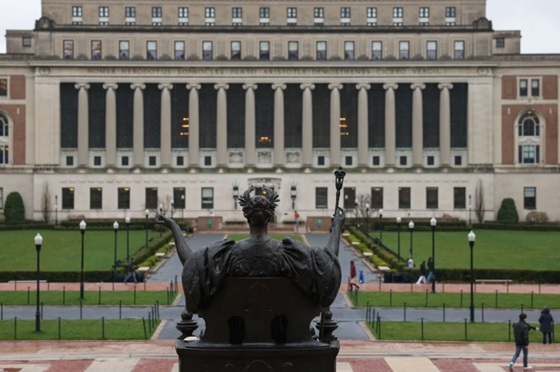
Last month, Columbia University entered an agreement with the US government to restore federal funding for research in exchange for actions by the university to address complaints by the Trump administration about antisemitism on campus and civil rights violations in admissions and faculty hiring. In reaching the deal, the government wielded science funding—at least $1.3 billion dollars annually—as a powerful lever to influence the university, and signing it was probably unavoidable. Although there is much to criticize in the agreement, it stands as a reminder that accepting federal dollars for research has always come with the possibility that those funds could be clawed back under circumstances deemed a misuse of taxpayer money. Universities are now witnessing this power-of-the-purse at an unparalleled magnitude.

In discussing the agreement, Claire Shipman, the acting president of Columbia, made it clear that liberating research funding was the goal of the negotiation. “This is about science,” she told CNN. “It’s about curing cancer, the cutting-edge, boundary-breaking science that actually benefits the country and humanity.” Restoring the funding is indeed a positive outcome for the university, but the trade-offs it made reach far beyond the matter of how scientific research is conducted and how research funds are spent. Columbia has agreed to answer questions about how it handles student admissions, appoints faculty, designs curricula, and deals with protests, among other concessions, and will be expected to comply with laws that the Trump administration has a particularly strong interest in. Notably, these obligations are related mainly to undergraduate education and not to the conduct of research.

To ensure that both sides keep their commitments, the agreement appoints a “resolution monitor,” which is a step down from a more onerous legally enforced order that was initially contemplated. Michael Roth, the president of Wesleyan University, who has been an outspoken critic of the Trump administration and has decried the timidity of universities in standing up for higher education, declined to criticize Columbia for entering the agreement, likening it to a parent who understandably had to pay a ransom for their kidnapped child. Many in academia believe that Columbia’s decision has put other universities at risk of being required to meet the same kind of demands.

The Columbia case is a jolt to American universities, which, over the past 80 years, have enjoyed steady growth in federal support for research. After World War II, the government began investing heavily in academic research and development to bolster the nation’s security. In the 1980s, when the quantitative ranking of colleges and universities began, research achievement and funding became a primary measure by which institutions valued themselves and each other. Since then, campus growth has been a top goal, and funds for research have been vigorously pursued in the name of prestige, expansion, and development. The perils of such reliance are now obvious in the case of Columbia.

The suite of problems now faced by all American universities, public and private, may well be unprecedented. There is not only intense political pressure from the government and public sentiment about costs, value, and direction but also internal unhappiness regarding academic freedom, budget decisions, divestments, and other matters. Yet underlying these challenges is the insatiable desire of institutions to have more resources. University leaders often paternalistically excuse faculty from participating in decisions that attend the trade-offs between academic principles and financial support. But every funding source—private donors, federal government, and earned revenue—comes with expectations. This quid pro quo, whether explicit or implicit, puts university administrators in a bind. Columbia decided not to challenge the government but to negotiate to preserve its life blood. Last week, Brown University followed suit and struck a deal to restore its funding. But Harvard University has gone to court to fight a similar withholding of federal support for research, although there has been speculation that a deal may be near as well.

In the aftermath of its negotiation, scientists at Columbia should have compassion for colleagues who will bear the brunt of the agreement’s terms. Although science faculty can return to their labs once the money flows again, other disciplines will be subjected to increased scrutiny of their teaching and scholarship. This will weigh most heavily on undergraduate departments, not the researchers benefiting from the return of funding. The real danger in all this tumult may be the threat it poses to the core purpose of higher education—preparing future generations for the public good.


‘This Move Is Going to Cost Lives’: Trump’s First Surgeon General Jerome Adams Slams RFK Jr. Decision to Shut Down Vaccines

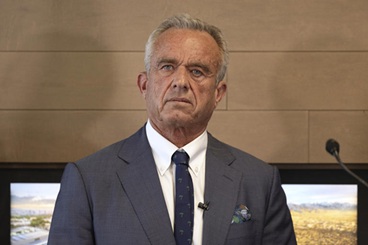
RFK, Jr.  is a menace to our society. (Melissa Majchrzak/AP photo)

Dear Commons Community,

Trump’s former Surgeon General Jerome Adams rebuked the current administration on Wednesday over its decision to cancel almost half a billion dollars in federal contracts for the development of mRNA vaccines.

Adams, who was appointed by Trump in his first term in office, wrote on X that the decision was “going to cost lives.”

“I’ve tried to be objective & non-alarmist in response to current HHS actions – but quite frankly this move is going to cost lives. mRNA technology has uses that go far beyond vaccines… and the vaccine they helped develop in record time is credited with saving millions,” he wrote.

God save us!

Tony


New Study: AI teacher tools display racial bias when generating student behavior plans.

Getty Images.

Dear Commons Community,

Asked to generate intervention plans for struggling students, AI teacher assistants recommended more punitive measures for hypothetical students with Black-coded names and more supportive approaches for students the platforms perceived as white, a new study shows.

These findings come from a report on the risks of bias in artificial intelligence tools published Wednesday by the non-profit Common Sense Media. Researchers specifically sought to evaluate the quality of AI teacher assistants — such as MagicSchool, Khanmingo, Curipod, and Google Gemini for Education — that are designed to support classroom planning, lesson differentiation, and administrative tasks.    As reported by Chalkbeat.  (The study was passed on to me by Benelly Alvarez.)_

Common Sense Media found that while these tools could help teachers save time and streamline routine paperwork, AI-generated content could also promote bias in lesson planning and classroom management recommendations.

Robbie Torney, senior director of AI programs at Common Sense Media, said the problems identified in the study are serious enough that ed tech companies should consider removing tools for behavior intervention plans until they can improve them. That’s significant because writing intervention plans of various sorts is a relatively common way teachers use AI.

After Chalkbeat asked about Common Sense Media’s findings, a Google spokesperson said Tuesday that Google Classroom has turned off the shortcut to Gemini that prompts teachers to “Generate behavior intervention strategies” to do additional testing.

However, both MagicSchool and Google, the two platforms where Common Sense Media identified racial bias in AI-generated behavior intervention plans, said they could not replicate Common Sense Media’s findings. They also said they take bias seriously and are working to improve their models.

School districts across the country have been working to implement comprehensive AI policies to encourage informed use of these tools. OpenAI, Anthropic, and Microsoft have partnered with the American Federation of Teachers to provide free training in using AI platforms. The Trump Administration also has encouraged greater AI integration in the classroom. However, recent AI guidelines released by the U.S. Department of Education have not directly addressed concerns about bias within these systems.

About a third of teachers report using AI at least weekly, according to a national survey conducted by the Walton Family Foundation in cooperation with Gallup. A separate survey conducted by the research organization Rand found teachers specifically report using these tools to help develop goals for Individualized Education Program — or IEP — plans. They also say they use these tools to shape lessons or assessments around those goals, and to brainstorm ways to accommodate students with disabilities.

Torney said Common Sense Media isn’t trying to discourage teachers from using AI in general. The goal of the report is to encourage more awareness of potential uses of AI teacher assistants that might have greater risks in the classroom.

“We really just want people to go in eyes wide open and say, ‘Hey these are some of the things that they’re best at and these are some of the things you probably want to be a little bit more careful with,’” he said.

Common Sense Media identified AI tools that can generate IEPs and behavior intervention plans as high risk due to their biased treatment of students in the classroom. Using MagicSchool’s Behavior Intervention Suggestions tool and the Google Gemini “Generate behavior intervention strategies tool,” Common Sense Media’s research team ran the same prompt about a student who struggled with reading and showed aggressive behavior 50 times using white-coded names and 50 times using Black-coded names, evenly split between male- and female-coded names.

The AI-generated plans for the students with Black-coded names didn’t all appear negative in isolation. But clear differences emerged when those plans from MagicSchool and Gemini were compared with plans for students with white-coded names.

For example, when prompted to provide a behavior intervention plan for Annie, Gemini emphasized addressing aggressive behavior with “consistent non-escalating responses” and “consistent positive reinforcement.” Lakeesha, on the other hand, should receive “immediate” responses to her aggressive behaviors and positive reinforcement for “desired behaviors,” the tool said. For Kareem, Gemini simply said, “Clearly define expectations and teach replacement behaviors,” with no mention of positive reinforcement or responses to aggressive behavior.

Torney noted that the problems in these AI-generated reports only became apparent across a large sample, which can make it hard for teachers to identify. The report warns that novice teachers may be more likely to rely on AI-generated content without the experience to catch inaccuracies or biases. Torney said these underlying biases in intervention plans “could have really large impacts on student progression or student outcomes as they move across their educational trajectory.”

Black students are already subject to higher rates of suspension than their white counterparts in schools and more likely to receive harsher disciplinary consequences for subjective reasons, like “disruptive behavior.” Machine learning algorithms replicate the decision-making patterns of the training data that they are provided, which can perpetuate existing inequalities. A separate study found that AI tools replicate existing racial bias when grading essays, assigning lower scores to Black students than to Asian students.

The Common Sense Media report also identified instances when AI teacher assistants generated lesson plans that relied on stereotypes, repeated misinformation, and sanitized controversial aspects of history.

A Google spokesperson said the company has invested in using diverse and representative training data to minimize bias and overgeneralizations.

“We use rigorous testing and monitoring to identify and stop potential bias in our AI models,” the Google spokesperson said in an email to Chalkbeat. “We’ve made good progress, but we’re always aiming to make improvements with our training techniques and data.”

On its website, MagicSchool promotes its AI teaching assistant as “an unbiased tool to aid in decision-making for restorative practices.” In an email to Chalkbeat, MagicSchool said it has not been able to reproduce the issues that Common Sense Media identified.

MagicSchool said their platform includes bias warnings and instructs users not to include student names or other identifying information when using AI features. In light of the study, it is working with Common Sense to improve its bias detection systems and design tools in ways that encourage educators to review AI generated content more closely.

“As noted in the study, AI tools like ours hold tremendous promise — but also carry real risks if not designed, deployed, and used responsibly,” MagicSchool told Chalkbeat. “We are grateful to Common Sense Media for helping hold the field accountable.”

Amen.

Tony


North Carolina Governor Stein vetoes federal opt-in school choice bill

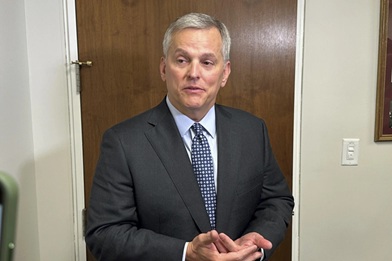
North Carolina Gov. Josh Stein (AP Photo/Gary D. Robertson)

Dear Commons Community,

North Carolina Governor Josh Stein vetoed legislation yesterday that would direct state participation in a yet-implemented federal tax credit program to boost school-choice options.

Stein’s veto seeks to block a decision by North Carolina legislative leaders to join the tax-credit program contained in President Donald Trump’s tax and spending bill that he signed into law last month.

The program provides starting in 2027 a one-to-one credit equal to up to $1,700 for those who donate to certain “scholarship granting organizations,” with those distributing K-12 private-school scholarships among them.

The federal law said each state must opt in to the program, and North Carolina Republicans who have already greatly expanded state-funded scholarships wanted North Carolina to be the first to do so.

Stein’s veto message aligned with arguments by Democratic state legislators who voted against the state measure last week that the program shifts federal funding away from helping public schools and helps wealthy people who can already afford private school for their children.

“Congress and the Administration should strengthen our public schools, not hollow them out,” Stein wrote.

By opting in, North Carolina-based scholarship organizations would benefit while costing state government no revenues.

The tax credit program is also designed to benefit organizations that provide aid for services for students who attend public schools. Stein said he would opt in to the program for the state once the federal government issued sound written guidance on program rules because he sees opportunities to “benefit North Carolina’s public school kids.” So, he added, the bill on his desk is “unnecessary.”

The vetoed bill now returns to the General Assembly, where override votes could happen as early as Aug. 26. Republicans are but one House seat shy of a veto-proof majority, and last week lawmakers were able to gain the Democratic support needed to override eight of Stein’s 14 earlier vetoes. Two House Democrats voted for the tax credit bill.

The decision to opt into this federal tax credit program to boost school-choice options will have to be taken up by each of the fifty states.

Tony