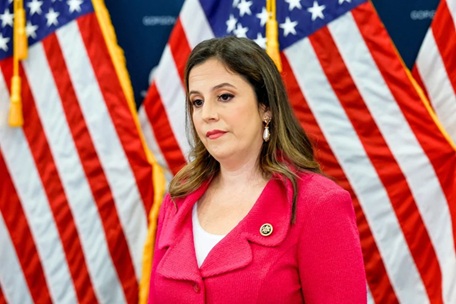
But it was her turn to face intense public scrutiny on Aug. 18, when she was met with a wave of loud boos from the crowd during an event to honor a late local politician in the town of Plattsburgh. The jeering, which went viral, was so bad that she gave up on speaking and passed the microphone back to others on stage. As reported by USA Today.
“Shame!” protesters shouted, along with “Unseal the Epstein files!”
The Democratic National Committee seized on the moment, writing in a post on X: “That’s what happens when you sell out your constituents to Donald Trump.”
The moment comes at a changing political time for Stefanik as she eyes a run for governor of New York state. Trump pulled her nomination to be ambassador to the United Nations earlier this year.
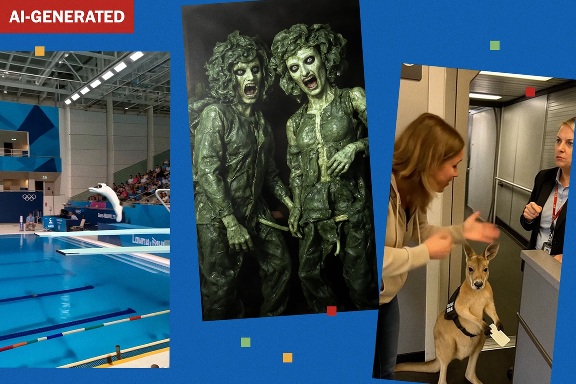
The Washington Post had a featured article yesterday describing a new wave of entertainment called “AI Slop” which uses AI tools that turn text commands into full-color footage that can look uncannily real. In the three years since ChatGPT’s launch, AI videos have come to dominate the social web, copying and sometimes supplanting human artists and videographers whose work helped train the systems in the first place. In sum, AI is creating new alternate video universe on the Web.
Aren’t we lucky!
Below is video explaining AI Slop. The entire Washington Post article follows
Tony
Washington Post
Making cash off ‘AI slop’: The surreal video business taking over the web
A mad rush of creators is using AI video tools to flood the internet — and turn a profit — with videos that can seem remarkably real.
By Drew Harwell
August 18, 2025
Luis Talavera, a 31-year-old loan officer in eastern Idaho, first went viral in June with an AI-generated video on TikTok in which a fake but lifelike old man talked about soiling himself. Within two weeks, he had used AI to pump out 91 more, mostly showing fake street interviews and jokes about fat people to an audience that has surged past 180,000 followers, some of whom comment to ask if the scenes are real.
The low-effort, high-volume nature of AI videos has earned them the nickname “AI slop,” and Talavera knows his videos aren’t high art. But they earn him about $5,000 a month through TikTok’s creator program, he said, so every night and weekend he spends hours churning them out. “I’ve been on my couch holding my 3-month-old daughter, saying, ‘Hey, ChatGPT, we’re gonna create this script,’” he said.
Nothing has transformed or polluted the creative landscape in the past few years quite like AI video, whose tools turn text commands into full-color footage that can look uncannily real. In the three years since ChatGPT’s launch, AI videos have come to dominate the social web, copying and sometimes supplanting the human artists and videographers whose work helped train the systems in the first place.
Their power has spawned a wild cottage industry of AI-video makers, enticed by the possibility of infinite creation for minimal work. Adele, a 20-year-old student in Florida who spoke on the condition that only her first name be used because she fears harassment, told The Washington Post she is taking a break from college to focus on making money from her AI-video accounts. Another creator in Arizona who went viral with an AI airport kangaroo said he made $15,000 in commissions in three months, speaking on the condition of anonymity out of concern over online harassment.
But the flood of financially incentivized “slop” has also given way to a strange new internet, where social media feeds overflow with unsettlingly lifelike imagery and even real videos can appear suspect. Some viral clips now barely rely on humans at all, with AI tools generating not just the imagery but also the ideas.
“I think of it more as a science than an art,” said one 25-year-old creator in Phoenix, who uses the online name Infinite Unreality and spoke on the condition of anonymity because he had received threats online. “In reality, there’s not a whole lot of creativity happening. And whatever creativity is happening is coming from the computer.”
Some of the videos are otherworldly art pieces or cartoonishly goofy satires, carrying labels marking them as AI-made. But many others are deceptively realistic and styled as news reports, influencer posts or mean-spirited jokes, often in hopes they’ll be shocking enough to grab attention — and from there, revenue.
Built on tools from America’s biggest tech giants, offered free or at low cost, the videos have touched off a kind of existential panic among the purveyors of traditional art, fueling anxiety that they could crowd out filmmakers, journalists and other creators for whom every scene takes money and time.
“As AI accelerates the production of content, human creativity will inevitably feel overwhelmed,” said Tony Sampson, a senior academic at the University of Essex who studies digital communication.
AI videos don’t try to compete on “authenticity, aesthetic value or thought-provoking concepts,” he said. Instead, they’re pumped out at industrial speed for maximum engagement, relying on viewers’ shock and fascination to make them spread.
The creators themselves say that AI videos are inevitable, regardless of their impact, and that they enjoy experimenting on AI’s cutting edge. They are also eager to reap the rewards of mass attention: Juan Pablo Jiménez Domínguez, a 29-year-old creator known online as Pablo Prompt who works at a university in the Canary Islands, said he has used AI to create videos for ad campaigns and now makes enough that he “could live entirely from this work.”
“A few months ago, we couldn’t do half the things we can do now,” he said. The technology, he added, will help “bring our ideas to life without the technical or financial blocks that used to hold us back.”
‘A human being, just like you’
The main benchmark for AI video is known as the Will Smith Eating Spaghetti test, and it works exactly how it sounds: A tool’s progress is graded by how well it can make the actor look like he’s chowing down.
In 2023, the best versions looked muddy and deformed: Noodles oozed cartoonishly, eyes bugged out. This year’s top performer, however, is practically undetectable as AI, save for one giveaway: The fake Smith makes crunching sounds, because the AI doesn’t know how real spaghetti gets chewed.
The quirk, in a Google-made tool called Veo 3, actually represents a major breakthrough for AI video: Unlike past tools, Veo 3 generates sound for every scene. And the progress continues rapidly: Google announced last month that the tool can now animate any photo into a lifelike eight-second clip.
Every link of the AI-video supply chain has shown extraordinary progress over the past year, multiplying video makers’ production power. A creator might, for instance, draft video ideas and dialogue with ChatGPT, generate images with Midjourney, compose realistic voices with ElevenLabs, and animate it all together with OpenAI’s Sora, Meta’s Movie Gen or a smaller upstart, such as Hailuo, Luma or Kling.
In the late 2010s, amateurs used early, kludgy AI tools to splice women’s faces into “deepfake” pornography, soliciting money for individual requests. But the newer tools have made the process so simple that basically anyone can use them — as seen on Elon Musk’s social network X, where users have prompted its AI tool Grok to create fake explicit videos of Taylor Swift.
“Five years ago, AI video was nonexistent to complete garbage. One year ago it was okay, not very usable, sort of just beginning,” said Mark Gadala-Maria, a co-founder at the AI tool Post Cheetah who tracks video trends. “And today it’s virtually indistinguishable from reality.”
The shift has unleashed a barrage of AI video onto the web. In May, 4 of the 10 fastest-growing YouTube channels by subscribers trafficked in AI videos, an analysis in Sherwood News found, including Masters of Prophecy (’80s-style synthwave music videos) and Chick of Honor (nonsensical animal skits).
Beyond video, there is AI music; one band, Velvet Sundown, had its AI-generated folk song “Dust on the Wind” climb to the top of Spotify’s Viral 50 charts, despite the fact that the band members don’t actually exist.
To stand out, some creators have built AI-generated influencers with lives a viewer can follow along. “Why does everybody think I’m AI? … I’m a human being, just like you guys,” says the AI woman in one since-removed TikTok video, which was watched more than 1 million times.
The best-performing videos, Gadala-Maria said, have often relied on “shock value,” such as racist and sexist jokes depicting Black women as primates, as first reported by Wired, or joking about what young “AI gals gone wild” would do for cash.
Others have ventured into dreamlike horror. One video showing a dog biting a woman’s face off, revealing a salad, has more than 250 million views.
The major social media platforms, scared of driving viewers away, have tried to crack down on slop accounts, using AI tools of their own to detect and flag videos they believe were synthetically made. YouTube last month said it would demonetize creators for “inauthentic” and “mass-produced” content.
But the systems are imperfect, and the creators can easily spin up new accounts — or just push their AI tools to pump out videos similar to the banned ones, dodging attempts to snuff them out.
“Humans are attracted to things that are over the top,” Gadala-Maria said. “And AI is really good at that.”
‘Slop money’
The typical AI creator’s first dollar comes from the video platforms themselves, through the kinds of incentive programs that TikTok, YouTube and Instagram built to reward viral success.
Adele, the Florida student, shared a screenshot from her TikTok account showing she had made $886 within four days from an AI-made video showing a fake influencer eating glass fruit.
The 20-year-old said she had recently paused her psychology studies to focus on her entrepreneurial goals, including her “AI Viral Club,” which offers video-making guides to roughly 70 subscribers paying $29 a month.
“I’ve seen a lot of my friends have a really hard time getting jobs, even with their degrees,” she said. “This is the future.”
Like Adele, many creators have worked to diversify beyond viral payouts, selling AI-tool courses and templates to aspiring creators eager to make their own. After an AI video showing two women eating a Korean-style “mukbang” went viral, its creator began selling a $15 visual handbook on how others could copy its style.
The creator, Jayla Bennett, who uses the account name “Gigglegrid.ai,” said she is 26, works part-time in North Carolina and just started making AI videos this summer, seeing a chance at easy money. “The trick is to get ahead of the curve and not be a part of the wave,” she said.
Many creators also sell “prompt drops,” listing the commands they gave the AI to make a certain scene, while others charge for custom-commissioned work. One creator said he is able to charge $200 to $300 for a five-second clip.
Even bigger deals are being made. The prediction-gambling company Kalshi paid for a TV commercial during the NBA Finals featuring AI people, including a woman being battered by a hurricane, screaming their bets about current events. Jack Such, a Kalshi spokesman, said the video cost $2,000 in AI-prompting fees and went from idea to live in less than 72 hours, far quicker than a traditional studio could do. The creator, PJ Accetturo, said “high-dopamine” AI videos would be “the ad trend of 2025.”
Angst over AI has roiled the traditional media for years, helping ignite the Hollywood strikes in 2023 and legal battles over artists’ rights. In June, U.S. District Judge Vince Chhabria, ruling narrowly for Meta in a lawsuit brought by authors accusing the company of violating copyright law by training AI on their books, said AI would “dramatically undermine the incentive for human beings to create things the old-fashioned way.”
The technology has steadily inched its way into filmmaking nevertheless. Ted Sarandos, a co-chief of Netflix, said last month that the streamer had recently used AI video tools for the first time to help animate a building collapse for an Argentine sci-fi show, and that the move had been cheaper and “10 times faster” than a traditional special effects crew.
Even for amateurs, AI video’s ease of use has spawned a global business. Jiaru Tang, a researcher at the Queensland University of Technology who recently interviewed creators in China, said AI video has become one of the hottest new income opportunities there for workers in the internet’s underbelly, who previously made money writing fake news articles or running spam accounts.
Many university students, stay-at-home moms and the recently unemployed now see AI video as a kind of gig work, like driving an Uber. The average small creator she interviewed did their day jobs and then, at night, “spent two to three hours making AI-slop money,” she said. A few she spoke with made $2,000 to $3,000 a monthat it.
“They see their business as internet traffic, chasing really short-term trends, some of which are three to four days long,” said Patrik Wikstrom, a professor who oversaw Tang’s research. “They don’t really care about if this is morally sound or if this is creative. They’re chasing the traffic. They’re chasing the next thing.”
‘They just want to be entertained’
For the AI-video creator Daryl Anselmo, this moment recalls a similarly massive shift known as the “Demoscene,” an underground movement in the ’90s built on computer nerds tinkering with real-time 3D graphics before “Toy Story” and the Sony PlayStation made them mainstream. That era, too, stirred up apprehension among animators over the death of art. It also churned out a lot of slop.
But the longtime video game artist has nevertheless gone all in on AI video, believing it offers a revolutionary new kind of artistic freedom. From his home in Vancouver, British Columbia, he describes himself as the creative director for a team of semiautonomous AI machines, each with its own task: visualizing ideas, generating images, animating scenes and stitching them together into experimental videos that are often skin-crawling and avant-garde.
One morning, he takes photos of some leftover spinach and commands the system to make a spinach monster. It creates 10 different takes, and he chooses the leafiest and most menacing, telling the tools to examine the last video in the sequence and create the next most logical scene.
All of the experimentation has cost him in the form of graphics-processing bills, which total thousands of dollars a month. But the videos have won him consulting work from companies eager to emulate what he calls his “grimoire” of AI tools. And they’ve gained him attention on social media, where he often feels he must fight the urge to give people what they want: the creepiest videos, the most over-the-top.
He can now churn out phantasmagoric scenes of hollow-eyed monsters at a speed and quality that would have once required a specialized team, but the pace of advancement slightly freaks him out. The 10 seconds of high-quality video it took him 10 minutes to create last year now takes just two minutes and, he expects, will soon take just a few seconds. At that speed, he said, creators could start really pushing the boundaries, rolling out hyper-personalized commercials and interactive videos a viewer could shape in real time, like a video game come to life.
“I don’t know if we’re prepared for the flood of generative media that’s about to hit us,” he said.
Even for those with less experience than Anselmo, this level of AI power has changed the industry. The creator in Phoenix, Infinite Unreality, started playing around with AI video while working in IT for his dad’s company, hoping to spark a content-creator career with “the most returns off minimal effort.”
He made his first videos by taking viral clips on Instagram Reels and throwing them into Sora, asking the AI to transform them into something new. His first viral hit, which he described as “some fat dude getting a massage,” gained 30 million views, but many more have followed. He now uses AI in every part of his eight-step workflow, from generating ideas to adding his logo in postproduction to discourage video thieves.
His widely shared video of a seemingly real kangaroo at an airport gate, he said, took him 15 minutes, mainly because it was the AI tool’s idea; he had asked it to spit out something that would go viral, and it did. “I don’t want to sit here and act like I’m this genius,” he said. “I’m an entrepreneur.”
But he has been unnerved by some of the responses to his more popular videos, including threats from viewers who say he’s summoning something dark he can’t control. His videos of lizard-headed babies — again, the AI tool’s idea — have been especially unpopular. “People are saying, ‘This is disturbing.’ But this is what you guys want to watch at the end of the day,” he said.
It’s not all easy money because many of the companies charge for individual AI-processing tasks; he budgets himself about $100 a day in AI fees, and a single 10-second rendering costs him about $7.50 to make. But he still expects to be made obsolete in short order, saying he believes that “in a year from now, pretty much everything is going to be very easy for the average person” to make.
His bigger fear, beyond how he’ll pay his mortgage when that time comes, is a more existential one: about what all this limitless creation is doing to our brains. “When you have every single form of media, every possible thing you can think of at your fingerprints at all times,” he said, “is anything exciting anymore?”
Gadala-Maria, in contrast, isn’t worried. He expects AI one day will cement itself as the most powerful medium for human storytelling — not a meme or a novelty but an art form all its own.
“People generally don’t care how their entertainment is created,” he said. “They just want to be entertained.”
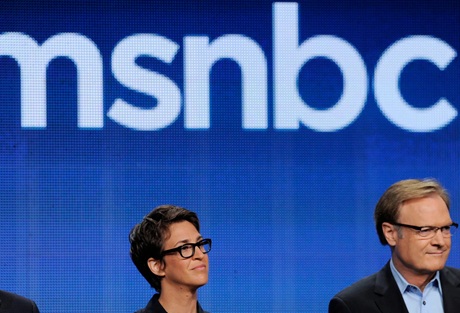
Rachel Maddow and Lawrence O’Donnell. (AP Photo/Chris Pizzello, file) via Associated Press
Dear Commons Community,
Television’s MSNBC news network is changing its name to My Source News Opinion World, or MS NOW for short, as part of its corporate divorce from NBC.
The network, which appeals to liberal audiences with a stable of personalities including Rachel Maddow, Lawrence O’Donnell, Ari Melber and Nicole Wallace, has been building its own separate news division from NBC News. It will also remove NBC’s peacock symbol from its logo as part of the change, which will take effect later this year.
The name change was ordered by NBC Universal, which last November spun off cable networks USA, CNBC, MSNBC, E! Entertainment, Oxygen and the Golf Channel into its own company, called Versant. None of the other networks are changing their name.
MSNBC got its name upon its formation in 1996, as a partnership then between Microsoft and NBC.
Name changes always carry an inherent risk, and MSNBC President Rebecca Kutler said that for employees, it is hard to imagine the network under a different name. “This was not a decision that was made quickly or without significant debate,” she said in a memo to staff.
“During this time of transition, NBC Universal decided that our brand requires a new, separate identity,” she said. “This decision now allows us to set our own course and assert our indepedence as we continue to build our own modern newsgathering organization.”
Still, it’s noteworthy that the business channel CNBC is leaving “NBC” in its name. MSNBC argues that CNBC has always maintained a greater separation and, with its business focus, is less likely to cover many of the same topics.
Still, the affiliation between a news division that tries to play it safe and one that doesn’t hide its liberal bent has long caused tension. Trump refers to the cable network as “MSDNC,” for Democratic National Committee. Even before the corporate change, NBC News has been reducing the use of its personalities on MSNBC.
Some NBC News personalities, like Jacob Soboroff, Vaughn Hillyard, Brandy Zadrozny and Antonia Hylton, have joined MSNBC. The network has also hired Carol Leoning, Catherine Rampell and Jackie Alemany from the Washington Post, and Eugene Daniels from Politico.
Maddow, in a recent episode of Pivot, noted that MSNBC will no longer have to compete with NBC News programs for reporting product from out in the field — meaning it will no longer get the “leftovers.”
“In this case, we can apply our own instincts, our own queries, our own priorities, to getting stuff that we need from reporters and correspondents,” Maddow said. “And so it’s gonna be better.”
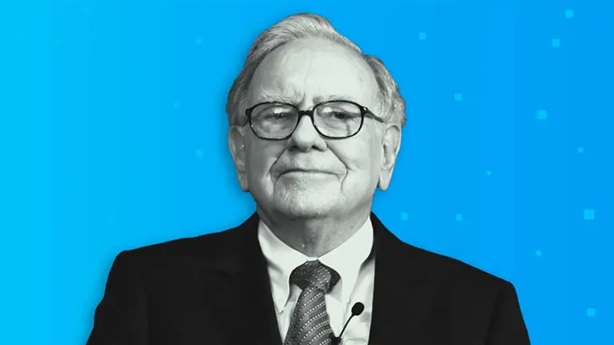
Billionaire Warren Buffett, who will step down as CEO of Berkshire Hathaway at the end of the year, has built one of the most successful companies in history by living out a set of values that are as practical as they are inspiring.
When it comes to hiring, Buffett doesn’t mince words. Skills and experience matter, but if you miss one critical trait, you risk bringing serious damage into your organization.
The Buffett Quote:
“Somebody once said that in looking for people to hire, you look for three qualities: integrity, intelligence, and energy. And if you don’t have the first, the other two will kill you. You think about it; it’s true. If you hire somebody without [integrity], you really want them to be dumb and lazy.”
In a knowledge economy, intelligence is obviously key. And energy fuels passion and productivity. But integrity? It’s the bedrock that holds everything together. Without it, talent becomes dangerous.
In my line of work coaching high-level leaders, integrity is a non-negotiable. I see how employees, colleagues, customers and stakeholders alike respond to their integrity by trusting their decision-making. People working for such leaders know that their actions are transparent, and their judgment sound. In collaborative environments, trustworthy leaders quickly earn a reputation for dependability and accountability—two accelerators of team trust.
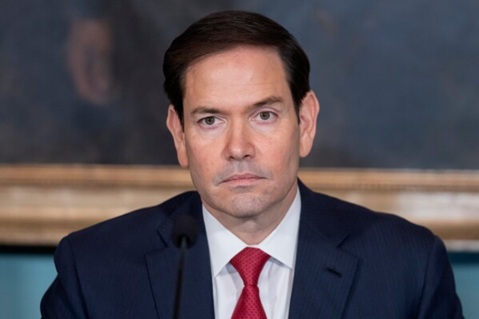
Secretary of State Marco Rubio yesterday acknowledged the Trump administration is far away from reaching any kind of peace deal between Russia and Ukraine after President Trump’s summit on Friday with Russian President Vladimir Putin.
Rubio insisted progress was made at the Alaska summit, which the president declared a “10 out of 10” because of how well he got along with Putin.
At the same time, Rubio in a Sunday morning interview in ABC’s “This Week” didn’t mince words in discussing how much work still needed to be done.
“We made progress in the sense that we identified potential areas of agreement, but there remain some big areas of disagreement,” Rubio told ABC’s Martha Raddatz. “So we’re still a long ways off. We are not at the precipice of a peace agreement. We are not at the edge of one. But I do think progress was made.”
Trump is now scheduled to meet Ukrainian President Volodymyr Zelensky on Monday at the White House. Zelensky will be accompanied by European leaders in a sign of their support for Ukraine.
Trump’s talk of land being swapped between Ukraine and Russia has raised alarms in European capitals, where his words have been seen as a sign that Ukraine might need to give up territory to Russia to reach a peace deal.
Rubio brushed off the fact that Trump has not announced tougher actions against Russia after the summit, telling Raddatz that wasn’t the aim of the meeting after she noted that Trump had suggested tougher penalties for Moscow could be coming without progress.
Rubio, one of two U.S. officials who were in attendance for the Trump-Putin meeting, also said it would not be possible to reach a deal between Russia and Ukraine without Zelensky being at the table.
The secretary of State suggested there are many people on the outside who do not know about the talks, suggesting Putin could have signaled some concessions to Trump.
“I think we made some real progress. You talked about not knowing what was discussed. These peace deals, these peace agreements and negotiations, they don’t work when they’re conducted in the media, either through leaks or through lies,” he said.
“And usually, they’re both the same thing, lying leaks. OK? They don’t work if you do it that way.”
Responding in part to criticism that Trump was too friendly toward Putin at the summit and afterward, Rubio also said peace would not be realized through insults.
Peace deals don’t work out, Rubio said, “if you go out and say aggressive and abrasive things about one side or the other, because then they just walk away.”
Asked specifically if Putin had offered any concessions, Rubio said he would not name any publicly but suggested there would need to be a give and take on both sides. He also made it clear that Trump had asked Putin for concessions.
“So, of course, concessions were asked. But what utility would there be of me going on a program and tell you, we’ve wagged our finger at Putin and told him, you must do this and you must do that. It’s only going to make — it’s only going to make it harder and less likely that they’re going to agree to these things,” he said.
“So, these negotiations, as much as everyone would love it to be a live, pay-per-view event, these discussions only work best when they are conducted privately in serious negotiation in which people who have to go back and respond to constituencies, because even totalitarian governments have constituencies they have to respond to, people have to go back and defend these agreements that they make.”
Glad to see someone in the Trump Administration telling the truth for once! I don’t think Trump will like this!
In recent years, scientists have been working on technology that could help people—such as those paralyzed by strokes or with neurological conditions like ALS—to communicate. In particular, devices called brain-computer interfaces, or BCIs, pick up electrical signals in the brain as people try to form words, then translate these signals out loud. But in a new study, published Thursday in the journal Cell, researchers report they have decoded four participants’ inner voices for the first time, with up to 74 percent accuracy.
“It’s a fantastic advance,” Christian Herff, a neuroscientist at Maastricht University in the Netherlands who was not involved in the new study, tells the New York Times’ Carl Zimmer, adding that the technology not only helps people speak who otherwise can’t but also improves scientists’ understanding of how language works.
In previous uses of BCIs, researchers asked patients who couldn’t speak to try to physically form words. This created signals of so-called attempted speech in the brain, which were picked up by implanted electrodes and decoded with a computer algorithm. This process, however, could be tiring and uncomfortable for users, as Erin Kunz, an electrical engineer at Stanford University, tells Science’s Annika Inampudi.
So, Kunz and her team decided to try to investigate whether implanted electrodes could pick up a patient’s inner voice. If it could, operating the device might become easier for users. But this research was also meant to investigate questions around privacy—could these devices also pick up unintentional speech? After all, our inner voices might say things we don’t want others to hear.
The team says that so far, the technology isn’t accurate enough to translate thoughts against a participant’s will. “We’re focused on helping people … who have issues with speaking,” Kunz tells Science.
To protect users’ privacy, they chose a passphrase to activate the device that was unlikely to come up in everyday speech: “Chitty Chitty Bang Bang,” the title of the 1964 Ian Fleming novel and 1968 movie. The technology would start translating thoughts when it detected the phrase, which, for one participant, it did with 98.75 percent accuracy.
In the tests, the researchers asked the participants—all four of whom have some trouble speaking—to either attempt saying a set of seven words or to merely think them. They found the patterns of neural activity and regions of the brain used in both scenarios were similar, but the inner thoughts produced weaker signals.
Then, the team trained the computer system on the signals produced when participants thought words from a 125,000-word vocabulary. When the users then thought sentences with these words, the device translated the resulting brain activity. The technology produced words with an error rate of 26 to 54 percent, making it the most accurate attempt to decode inner speech to date, Science reports.
In another experiment, participants were asked to tally circles on a screen as the device tried to translate their thoughts. This was meant to test whether the computer would pick up internal thoughts that the participants weren’t told to say, and in some cases, the system picked up a number.
Beyond helping people speak who otherwise couldn’t, the findings show that, at least for some people, language plays a role in the process of thought, Herff tells the New York Times. It also reveals neural differences between attempted and internal speech, Silvia Marchesotti, a neuroengineer at the University of Geneva who wasn’t involved in the research, tells Nature’s Gemma Conroy.
But the researchers say they’re not done yet—and they’re working toward even better outcomes.
“The results are an initial proof of concept more than anything,” Kunz tells the New York Times. “We haven’t hit the ceiling yet.”
Financial news outlet Money has published its annual list of the Best Colleges in America, a practical analysis of more than 700 four-year colleges, focusing on affordability and outcomes to help students make informed decisions about where to spend their tuition. Each school received a rating out of five stars, based on its educational quality, affordability, and student outcomes.
Along with star ratings, the list includes important metrics such as acceptance rates, estimated full price for the 2025–2026 academic year, estimated net price after average aid, and graduation rates.
Star ratings are based on:
Quality of Education – Graduation rates, student-faculty ratios, Pell Grant outcomes, academic stats
Affordability – Net price, aid amounts, debt levels, and outcomes by income
Outcomes – Alumni earnings 10 years post-enrollment and economic mobility
Most schools earned between 3.5 and 4 stars. Fewer than 6% earned a five-star rating.
Kateryna Kon Science Photo Library via Getty Images
Dear Commons Community,
Those sniffles may not be a summer cold; COVID-19 cases are rising.
And things are expected to get worse before they get better. Some experts predict virus rates will continue to rise as we ride a summer infection surge. As reported by The Huffington Post.
Jay Weiland, an infectious disease modeler, shared on social media that he predicts the summer COVID-19 wave will hit a peak in early September. So, now’s the time to follow COVID prevention strategies such as wearing a mask in crowded spaces and washing your hands well.
Jenn Dowd, a professor of demography and population health at the University of Oxford in England, referenced Weiland’s prediction model in her Substack newsletter, Data for Health, along with recent data from the Centers for Disease Control and Prevention that shows COVID infections rising in all but five states. “Since the data are lagging by a week, it’s likely levels are already higher, with a predicted peak in early September, just in time for back-to-school,” Dowd wrote in her newsletter.
This prediction should be taken with a grain of salt, though, experts say. COVID has proven to be anything but predictable over the last five-plus years.
“One thing to know is that a September peak is a best guess based on current trends, but we can’t know for sure how big or long-lasting the current upswing in cases will be until we are on the other side of it,” Dowd told HuffPost via email.
COVID levels are lower than last summer, thankfully, according to wastewater data and hospitalization levels, “but, back-to-school could pour fuel on the fire of any viral spread, so we’ll get a better picture in the next few weeks,” Dowd added.
The models that are used to predict COVID peaks are an imperfect tool, but still contain valuable information, added Jessica Malaty Rivera, an infectious disease epidemiologist.
“If we look at the past, we’ve always had a summer wave [and] we’ve always also had a back-to-school flu season wave. So it’s no surprise that they’re cross-referencing both the historical incidence of COVID and what we’re seeing in wastewater to say it’s pretty likely that this many people probably have COVID right now, or may likely get COVID right now, because this many people are shedding the virus,” added Malaty Rivera.
But, Malaty Rivera said that wastewater data is only accurate to a certain extent.
“You can’t always say that the presence of virus [in wastewater] is infectious virus,” she explained.
Wastewater data can’t distinguish between active virus and non-infectious virus fragments from someone who was infected months ago, Malaty Rivera explained. (Just like how, early in the COVID pandemic, PCR tests could come back positive for months after someone recovered from a COVID-19 infection, she noted).
“And so the presence of COVID-19 [in wastewater] is not necessarily the presence of active virus. It could be a virus from people who were sick weeks ago or months ago who are still shedding virus, but it’s not an infectious virus,” she added.
That being said, we are in a COVID surge right now and we should expect another bump as kids head back to school in September and as folks return from summer vacations, said Malaty Rivera.
“The fall, back to school, return from vacation, has always historically shown an uptick in respiratory illnesses, and COVID is not exclusive to that. COVID is now part of our annual cadence,” she said. “And so the summer surge is no surprise, and to expect another bump is also completely based on evidence.”
We’re currently in a summer COVID wave, and some experts say COVID infections could peak in early September.
If you get infected with COVID, the CDC’s recommendations say you should stay home when you’re sick and isolate from other people in your home. The CDC guidance goes on to say you can exit isolation once you’re fever-free and your symptoms are improving or resolving for at least 24 hours.
At this point, you can return to your daily life, but should take additional steps to protect others, such as wearing a mask, staying away from other people, and washing your hands frequently for five extra days.
Malaty Rivera said you should take this one step further because “resolving symptoms” is completely subjective, she noted. What’s “resolving” for one person could mean being very sick for another.
“And no fever… fever is not the only indicator… for infectiousness to others,” she added.
“Based on the evidence, if you are testing positive on a rapid antigen test, that means that you are likely infectious to others. If you are infectious to others, that means you should be isolating from other people and wearing a mask in indoor settings if you’re forced to be in indoor settings with other people,” she said.
If you need fresh air, it’s OK to go outside without a mask, but you shouldn’t be close to other people, said Malaty Rivera.
“I don’t think people should be unmasked in places with other people unless they are testing negative on an antigen test,” she said.
If you are sick, you can also check with your doctor to see if you’re eligible for Paxlovid, which is an anti-viral COVID medication, Malaty Rivera said.
“If you didn’t get an updated COVID vaccine in the past year, it might be a good time to get one, especially before any changes in eligibility come into effect,” said Dowd.
If you are over 65 or immunocompromised, you’re eligible for another COVID shot, she added, so long as you’re six months out from your last dose.
“But, besides protection from vaccines, when there is more COVID around, it’s a good time to ramp up our trusty precautions that work for most respiratory viruses,” Dowd said.
“This includes paying attention to ventilation when socializing (such as being outside or opening doors and windows [and] using HEPA filters), staying home when sick and masking strategically in higher-risk situations like airplane travel or other crowded places,” noted Dowd.
While COVID levels are lower than previous summer waves, it is still a serious infection that can lead to death, complications and long COVID.
Do what you can to stay safe this summer, but “with COVID prevention, don’t let the perfect be the enemy of the good,” Dowd said.
“You don’t have to do everything right, but even small precautions can add up to lower transmission and protect our communities,” she noted.
The much-anticipated meeting between Trump and Russian leader Vladimir Putin began with a warm welcome and a flyover by screaming jets at a U.S. military base in Alaska but ended with a thud Friday after they conceded that they had failed to reach any agreements on how to end the Russia-Ukraine war.
After about 2 1/2 hours of talks at Joint Base Elmendorf-Richardson in Anchorage, the two men appeared before reporters for what had been billed as a joint news conference — but they took no questions. As reported by The Associated Press.
“We had an extremely productive meeting and many points were agreed to, there are just a very few that are left,” Trump said. “We didn’t get there, but we have a very good chance of getting there.”
Putin, welcomed into the U.S. after being shunned by Western allies since early 2022 for ordering the invasion of Ukraine, thanked Trump for hosting the meeting and suggested with a chuckle that the next time the two sit down it could be in Moscow.
Here are takeaways from the summit:
A warm welcome underscoring the friendly Trump-Putin relationship
Putin got a red carpet welcome and even rode in Trump’s presidential limousine from the tarmac to the summit venue. There, the pair were joined by two of their top aides: Secretary of State and national security adviser Marco Rubio and special envoy Steve Witkoff for Trump and Foreign Minister Sergey Lavrov and national security adviser Yuri Ushakov for Putin.
Putin, who spoke first after the meeting concluded, lauded the historical relationship between the United States, Russia and the former Soviet Union, recalling joint missions conducted by the two countries during World War II.
He said the U.S. and Russia share values, a standard talking point for Russian officials when trying to woo Trump and his aides. Putin also noted that Trump has frequently said the Ukraine war wouldn’t have happened had he won the 2020 election.
“I think that would have been the case,” the Russian leader said, a comment sure to please Trump.
However, there is no indication and no way to prove that Moscow would have acted differently toward Ukraine had Democrat Joe Biden not been elected.
Trump touts progress but concedes there was no deal
Trump had gone into the meeting hoping to get Putin to agree to a ceasefire with Ukraine — or at least a commitment from Russia to enter into negotiations to reach one.
Instead, Trump conceded that “we haven’t quite got there” and said he would be conferring with Ukrainian President Volodymyr Zelenskyy and NATO leaders about next steps.
Trump said he and Putin had made some significant progress toward the goal of ending the conflict but gave no details on what that entailed and had to acknowledge that they had been unable to bridge substantial gaps.
“I believe we had a very productive meeting,” Trump said. “We haven’t quite got there, but we’ve made some headway. So, there’s no deal until there’s a deal.”
In a subsequent conversation with Sean Hannity of Fox News Channel, Trump again offered no details on his discussions with Putin.
With diplomatic progress creeping along, time is on Putin’s side
Amid drawn-out diplomatic moves to end the war, time appears to be on Putin’s side. That gives a leg up to Russian forces, who have used their larger numbers to slowly grind down defenses in eastern Ukraine 3 1/2 years into the conflict.
Putin got a pleasant reception from the leader of the free world on U.S. soil and walked away hours later without either providing details on what they discussed, whether a ceasefire was any closer to reality or what the next steps would be.
Putin praised Trump for the “friendly” tone of the talks — Trump said nothing publicly about the killing of Ukrainian civilians in Moscow’s attacks — and for “understanding that Russia has its own national interests.”
Putin said Moscow and Washington should “turn the page,” with relations having sunk to the lowest point since the Cold War.
Putin appearing in the U.S. for the first time in 10 years was celebrated as a sign that Moscow was no longer a pariah on the global stage. In a social media post, Russian Foreign Ministry spokeswoman Maria Zakharova told followers that the Western press would be on the verge of “losing their minds.”
“For three years, they talked about Russia’s isolation, and today they saw the red carpet being rolled out to greet the Russian president in the United States,” she said.
There were no details and no questions
Both men said the talks were “productive” but the lack of any announcement of solid achievements was revealing.
The news conference ended up being less than 15 minutes of rather standard diplomatic comments — and gave no indication that any concrete results were achieved — and offered little departure from their previous comments on the war in Ukraine.
Trump has made it a feature of his second term to parry questions from reporters in front of world leaders, but in the clearest sign of his disappointment, the president abruptly cut short his plans to take questions.
Trump had gone into the summit saying here was a 25% chance that the summit would fail and that it was meant to be a “feel-out meeting,” but he had also floated the idea of bringing Zelenskyy to Alaska for a subsequent, three-way meeting if things went well. It’s unclear what comes next.
I would have rather watched Jeopardy than see these two say nothing!
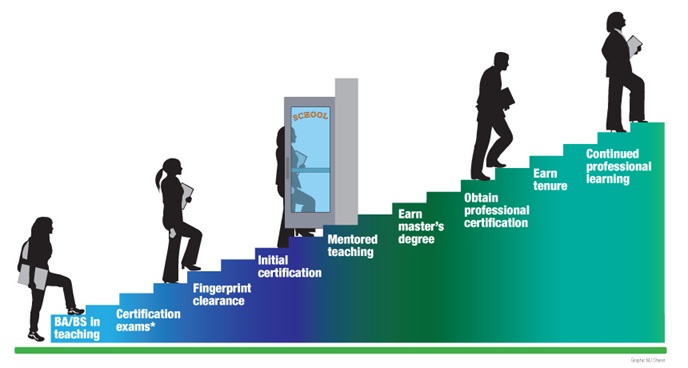
It’s an ongoing debate, with proponents of higher barriers to entry arguing they’re necessary to ensure quality candidates—and skeptics saying they unfairly shut out prospective educators who could be effective in the classroom. The research on certification requirements, licensing exams, and other professional screening mechanisms generally points to tradeoffs, rather than clear-cut answers. Education Week in this morning’s edition reviewed the issue.
When the pandemic began five years ago, it presented a natural experiment to study the question in more depth. Many states relaxed their teacher licensure rules and created emergency certification processes, removing requirements for prospective educators to take the exams that they would have otherwise had to pass.
Studies of this time period out of several states, including Massachusetts and New Jersey, showed that, in the wake of these policies, teachers’ performance held steady, and a more racially diverse group of candidates entered the profession.
But two newpapers from the Center for Analysis of Longitudinal Data in Education Research, or CALDER, at the American Institutes for Research present a more complicated picture.
Nationwide, there’s no definitive evidence that emergency waivers resulted in large numbers of new teachers entering the profession. And in one state, Massachusetts, where the emergency licensing process remained in place past 2022, teacher performance of newly hired teachers declined over time.
Taken together, the research provides more evidence of how the pandemic period affected the composition of the teaching profession, and offers clues about how permanent changes to licensure requirements could play out for student achievement.
It’s possible that the comparable performance that some states initially saw between traditionally licensed and emergency licensed teachers wouldn’t last if those changes were to become permanent, said Dan Goldhaber, the director of CALDER and an author on both papers.
“That is what we saw initially, but it isn’t what we saw downstream,” he said.
Mixed teacher effectiveness outcomes
To determine the overall change in teachers entering the profession, the researchers analyzed federal teacher workforce data from all 50 states and the District of Columbia, comparing measures of teacher supply—such as initial licenses awarded, and graduates from teacher-preparation programs—between states that offered flexibility in licensure test requirements in 2020 and states that did not. They controlled for a series of demographic and economic factors.
“We do not find definitive evidence that states that put in place waivers of licensure tests saw increases in teacher supply,” Goldhaber said.
That finding comes with a caution, though, he added. Because of statistical limitations, the research can only determine there weren’t large effects. It’s possible there were smaller increases in the teacher workforce that the analysis doesn’t capture, he said.
It’s also possible that the temporary nature of the waivers influenced the findings. “People are not that likely to make career decisions based on a short-term regulatory change,” Goldhaber said.
The other CALDER paper, a research brief, examined who received emergency teaching licenses in five states that instated pandemic-era policies: Maryland, Massachusetts, New Jersey, Ohio, and Washington state.
They found that teachers who entered the profession under these licenses were, on average, more racially diverse than their peers who went through a traditional certification process from 2017 onward. These emergency-licensed teachers were also more likely, in all but one state, to work in schools serving larger shares of Black and Hispanic students, and students from low-income families.
In the school year immediately after these policies were put in place, teachers who had emergency certification and those who had regular certification performed about the same—they scored similarly on measures of teacher effectiveness, and received similar performance ratings.
But in Massachusetts, which did not reinstate its testing requirements until 2023, teachers who went through emergency certification in later years were less effective in math and science.
The study, the researchers write, “underscores the idea that loosening licensure rules alone is an incomplete—and, in some cases, potentially counterproductive—strategy for reshaping the composition and quality of the teacher workforce.”
Some argue for widening pathways to the profession
Still, some experts say there’s still not enough evidence to suggest that testing requirements need to continue in their current form.
“It’s not a slam dunk that the licensure requirements are definitely boosting teacher quality, but they are definitely limiting supply, especially for teachers of color,” said education analyst Chad Aldeman.
Aspiring teachers of color fail these tests at higher rates than their white peers, and some researchers have argued that they don’t capture important components of success in the profession, like the ability to build healthy relationships with students.
Research on licensure tests shows that, in most cases, scoring higher on the test means teachers will be more effective in the classroom. But there’s still a “reasonable argument to be made” for widening pathways into the profession, Alderman said.
“I’m willing to tolerate some risk of lower performance, for the benefit of greater supply and greater diversity,” he said.
The reports cited above from theCenter for Analysis of Longitudinal Data in Education Research contain interesting data and are available as free downloads.
Tony
Need help with the Commons?
Email us at [email protected] so we can respond to your questions and requests. Please email from your CUNY email address if possible. Or visit our help site for more information: