Empire AI seeking proposals to support research and development, including the advancement of the ethical and public-interest uses of artificial intelligence (AI) and high-performance computing technologies in New York. 


Dear Commons Community,

Empire AI, a consortium of nine universities, has sent out a request for proposals to promote responsible research and development, including the advancement of the ethical and public-interest uses of artificial intelligence (AI) and high-performance computing (HPC) technologies in New York. Below is a call letter sent by Josh Brumberg, President of the CUNY Graduate Center.

Tony

———————————————————–

Dear CUNY Faculty and Researchers:

Empire AI is a consortium of nine New York State institutions that, with support from New York State and private philanthropy, oversees a shared computing facility to promote responsible research and development, including the advancement of the ethical and public-interest uses of artificial intelligence (AI) and high-performance computing (HPC) technologies in New York. 

We are now soliciting proposals to use the second instance of Empire AI, called Beta, described here, which includes an upgrade of the original Alpha capability.  Beta will be up to ∼7x faster than Alpha on machine learning training and up to ∼20x on inference. Its DGX GB200 NVL72 SuperPOD technology tightly integrates the GPUs, for example enabling efficient training of multi-trillion parameter models.  We anticipate that Beta will be operational by December 2025 and we are encouraging users to take advantage of it.

Project proposal submissions are open from August 1 to September 17, 2025 (midnight ET).

To apply, please complete this form, which contains additional information about Alpha and Beta hardware and about resource allocation expressed in terms of service units.  Be sure to click “Submit” at the bottom of the form to complete your application.

This solicitation is exclusively open only to faculty and faculty-led research groups in the following academic institutions as systems and campuses located in New York State: City University of New York, Columbia University, Cornell University, Icahn School of Medicine at Mount Sinai, New York University, Rensselaer Polytechnic Institute, Rochester Institute of Technology, The State University of New York, and University of Rochester.  Allocations made as a result of this solicitation will commence in December 2025 and expire at the end of November 2026.  

Questions concerning this application, the Alpha/Beta resources, allocations, etc., should be directed to Josh Brumberg ([email protected]) until an Empire AI technical point of contact for CUNY is identified.  Additional assistance can be obtained by submitting a ticket with your issue via email to [email protected]

Good luck with your submissions!

Joshua C. Brumberg, Ph.D.,

President, CUNY Graduate Center

The New England Commission of Higher Education to Nix DEI Standards

Dear Commons Community,

The New England Commission of Higher Education — which accredits more than 200 colleges, primarily in the Northeast — is one of several major institutional accreditors that are reconsidering if and how members should demonstrate how they’re meeting diversity goals.

The commission’s members were concerned about potential conflicts between the accreditor’s standards and declarations from the federal government that DEI measures are illegal, said Lawrence M. Schall, president of the commission.

The Trump administration has put intense pressure on both accreditors and their member colleges, including the New England commission in particular. In a June letter, the Departments of Health and Human Services and Education told the accreditor that it had found Harvard in violation of civil-rights law, and that action may be required because the university “may no longer meet” accreditation standards. (The commission has acknowledged to the departments that it received that notice, Schall said, and explained its process for responding to the issue.)  As reported by ,2

On Wednesday, the Department of Justice directed federally funded institutions to abandon any effort to rectify racial disparities in academic outcomes. The new guidance also suggested that efforts to target student recruitment in historically underserved communities could be using geography as an illegal proxy for race.

“What we heard from institutions is that they felt they would be put in an untenable position,” Schall said, especially the U.S. military academies that are accredited by the commission and bound by law to follow the president’s executive orders.

The commission’s members include the U.S. Coast Guard Academy and the U.S. Naval War College, as well as the Ivy League’s Yale University, which is facing heightened scrutiny over allegations that it is violating civil-rights laws.

The Details

The New England commission’s current standards include references to diversity, equity, and inclusion under five of the nine major areas it measures, including organization and governance, students, and institutional resources.

Under the guidelines for serving students, for example, the standard states: “The institution addresses its own goals for the achievement of diversity, equity, and inclusion among its students and provides a safe environment that fosters the intellectual and personal development of its students.”

The suggested changes would require the college to respond to “the needs of its student population,” provide “support services,” and make “provisions for responding to them including strategies for having all students feel welcomed, supported, and included in the community.”

In the current framework, the commission doesn’t actually require its members to pursue diversity, equity, and inclusion, Schall emphasized. But if colleges do have that goal, the standard frames how they should present it during the accreditation process.

“If you have goals around diversity, equity, inclusion, we would like to know what they are and be updated on the progress you’re making to meet them,” Schall said in an interview, “but we don’t require any school to have a DEI plan.”

Overall, the draft changes articulate a more streamlined approach, Schall said, that provides colleges more flexibility in meeting the accreditor’s requirements. For example, the updated standard for “students” incorporates requirements for academic and co-curricular programs, as it relates to the student experience.

The commission’s leadership will now give its members several weeks to provide feedback on the changes, which will be considered for approval at the commission’s December meeting.

If approved, the new standards would go into effect in July 2026.

The Backdrop

Accreditors — which gatekeep colleges’ access to federal financial aid — have been in President Trump’s crosshairs since the 2024 presidential campaign, when then-candidate Trump vowed to “fire the radical left accreditors that have allowed our colleges to become dominated by Marxist maniacs and lunatics.”

In April, Trump signed an executive order that aimed to force accreditors to remove any requirements related to DEI, as well as to make it easier for new such organizations to be approved by the federal government and for colleges to switch accreditors.

More recently, as was the case for the New England commission, the Education Department has sought to use accreditation as a tool to force some colleges to comply with the administration’s conservative goals and definitions of civil-rights laws.

In June, the department sent notice to the Middle States Commission on Higher Education that Columbia University had violated accreditation standards because it had not adequately responded to antisemitic behavior during protests against the war in Gaza. As a result, the department argued, Columbia was in violation of Title VI, which bars discrimination based on race, color, or national origin, including shared Jewish ancestry.

The Stakes

Two other major accrediting agencies have also sought to minimize potential conflicts over standards that include DEI.

Late last year, the Higher Learning Commission, which accredits some 950 colleges across 19 states, approved new standards that excised the terms “diversity,” “equity,” and “inclusion” from its standards.

In May, the WASC Senior College and University Commission, which accredits colleges mostly in California and Hawaii, announced that it was enacting a temporary “stay” on requirements that reference diversity efforts.

The moves are, in part, meant to assure state lawmakers that accreditors are not compelling members to break state laws that bar DEI programs. The Higher Learning Commission, for example, is working with potential new member institutions in Florida and North Carolina, which have such laws.

Conflicts with state laws aren’t an issue for colleges from the New England Commission’s historical region. But colleges from anywhere in the country can now apply to be members, Schall said. The commission now has member colleges from the Republican-controlled states of Florida, Georgia, and Missouri.

Schall said the removal of DEI language could also shield the commission from punitive action by the Trump administration.

The commission is scheduled to go before a federal advisory committee in October that will issue a recommendation to the Education Secretary on whether it is meeting federal regulations to remain in its gatekeeping role.

“Would a secondary consequence of this be, somehow to avoid some attack on us?” he said. “Based on what we’ve seen, they seem quite free to come after the accreditors with a lot of information that’s not quite accurate.”

Tony


New Book by Dennis and Sandra Fox Upends the Story of Sacagawea:  Tribal historians say she lived to an old age and wasn’t kidnapped as a child

New Book Turns Sacagawea's Story on Its Head
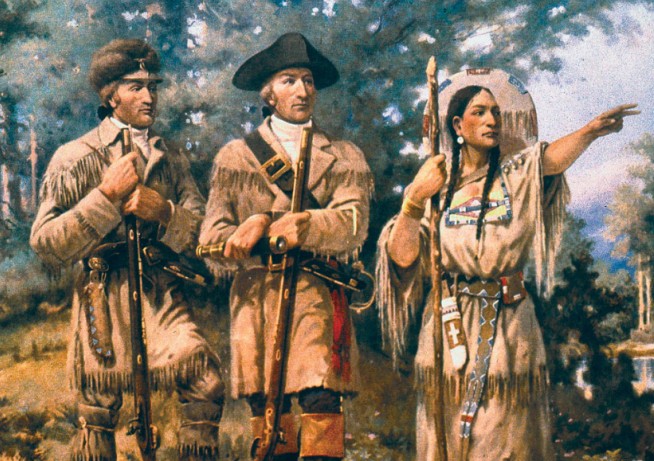
A view of the “Lewis & Clark at Three Forks” mural with Sacagawea on the right.  (Edgar Samuel Paxson)


Dear Commons Community,

New York Times Magazine story on one of the most famous Native Americans in the history books raises a provocative question:  “What if everything we know about Sacagawea was wrong?” reads the headline on the piece by Christopher Cox. For members of the Mandan, Hidatsa, and Arikara tribes, the familiar tale—Shoshone girl, kidnapped by the Hidatsa, guide to Lewis and Clark, dead in her 20s—was a distortion. In their telling, Sacagawea was Hidatsa all along, lived well into her 80s, and was ultimately shot to death. To them, the epic journey to the Pacific was just a small part of her life.

This revisionist push, led by Dennis and Sandra Fox (whose family claims direct descent), culminates in a book, Our Story of Eagle Woman: Sacagawea: They Got It Wrong, aiming to set the record straight through oral history, family testimony, and even DNA analysis. Their evidence includes tribal memories of Sacagawea’s later years, a detailed family tree, and genetic links between her reported descendants and Toussaint Charbonneau, her husband. But the story notes that challenging the standard Lewis and Clark narrative isn’t easy. Historians remain wedded to expedition journals and fur traders’ notes, which record Sacagawea’s death at Fort Manuel Lisa in 1812.

The Hidatsa project’s authors conclude it was Charbonneau’s other wife who died at Fort Manuel Lisa while Sacagawea continued living with her husband for decades. They note the source for much of the information we have about Sacagawea, including on her kidnapping, comes from Charbonneau, whose command of the Hidatsa and English languages was poor. Most intriguing is a firsthand account of Sacagawea’s apparent 1869 death by a man named Bulls Eye, who claimed to be her grandson. Speaking in 1923, he said she was among several people shot by a Sioux raiding party at a trader’s post in Montana Territory when he was only 4. “I have never forgotten.” 

Interesting revision of American history.

Tony

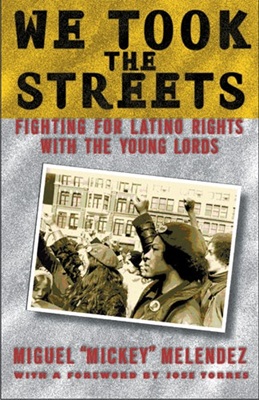
Book: “We Took the Streets” by Miguel “Mickey” Melendez

Dear Commons Community,

I have just finished reading We Took the Streets: Fighting for Latino Rights with the Young Lords by Miguel “Mickey” Melendez. It is an account of the formation of the Young Lords, an activist group that focused on the rights of Latinos in New York City. Published originally in 2003, it has been republished several times since. Melendez was one of the founders of the Young Lords in the 1970s.  His account of growing up in New York City and the conditions of Latinos in East Harlem and the South Bronx are telling.  The Young Lords during their relatively brief existence tried to force New York City and specifically the John Lindsay administration to pay more attention to the needs of the growing Puerto Rican population. It is an interesting read and those of us who were living in New York City during the period will have memories of the importance of the group’s contributions.  All of the major players in the Young Lords are mentioned and their work recognized.  Paul Guzman, who was their main PR person, figures prominently.  He attended the same South Bronx Catholic grammar school, Our Lady of Pity on 151st and Morris Avenue, as I did.  In fact, I taught Paul the Latin prayers recited by altar boys during mass and other services. All in all, I found it a worthwhile read.

Below is a brief review that appeared in Goodreads.

Tony

—————————————————————————————————-

Goodreads

We Took the Streets: Fighting for Latino Rights with the Young Lords

Rutgers University Press

“A thoughtful and historically insightful book…the Young Lords challenged the system as no one else had done before them….Their philosophy served as an inspiration for many of us.” –Representative Jose Serrano (Democrat, New York)“This account of the formation of the Young Lords is fascinating. Back in the 1960s, a group of Puerto Rican college students learned about revolution from the bottom up—from their deeds—upon which they built newer, more daring, and more advanced deeds that developed into still further successes and failures. The young men and women grew in stature until the complexities of their developing situation brought more problems than solutions and, by the end, the movement fell apart.Yet in the time they were active, they changed the history of New York, and for the better. So this account grows as one reads until one is experiencing elements of the epic, the surprising, and the tragic. The book will also have its considerable impact on anyone who is interested in the history of New York during that great period of ferment we call the Sixties.” –Norman Mailer

“The Young Lords were a socialist street gang. They produced more wonderful writers than most costly journalism schools, including Juan Gonzalez, Pablo Guzman, and Felipe Luciano. In part, this book preserves the memory of this astonishing cadre that changed history, spread ethnic pride, and mobilized East Harlem with its audacious activism. I was there, as both a supporter and a reporter, getting a close-up look at these berets in the barrio. They were fearless. When the bombing of Vieques is finally over for good, when New York finally elects a Latino mayor,we will look back and see the Young Lords for the historical turning point they are.” –Jack Newfield

On Saturday, July 26, 1969, at a public demonstration in Tompkins Square Park, a fistful of young men and women took the stage and announced that they would “serve and protect the best interest of the Puerto Rican community.” The Young Lords had officially arrived in New York City.

Miguel “Mickey” Melendez was there, and for the next three years dedicated his life to the Young Lords, one of the most controversial and misunderstood radical activist groups to emerge from the ferment of the 1960s. In We Took the Streets, Melendez shares what it was
cf0like on the streets of El Barrio, alive with the sounds of Tito Puente and Eddie Palmieri but also teeming with the drugs, poverty and injustice that inspired him to become a revolutionary. Advocating social justice for all and independence for Puerto Rico, the Young Lords took on the establishment—and won.

Maureen Dowd:  Men Who Read Books Are Sexy!

Dennis Stock/Magnum Photos

Dear Commons Community,

Maureen Dowd had a column yesterday entitled, “Attention, Men: Books Are Sexy!” in which she laments about the reading habits of men as:  “A man with a book has become so rare that there’s a popular Instagram account called Hot Dudes Reading. ”

She adds:

“Men are reading less. Women make up 80 per cent of fiction sales….Young men have regressed educationally, emotionally and culturally…The fiction gap makes me sad. A man staring into a phone is not sexy.” She also refers to David J. Morris who wrote an essay for the New York Times titled The Disappearance of Literary Men Should Worry Everyone.

Dowd has an insightful take on this topic.  I never thought about it but then again I am someone who reads books, mostly non-fiction and am presently reading the novel, My Brilliant Friend, by Elena Ferrante.

Below is Dowd’s entire column.

Tony

———————————————————————-

The New York Times

“Attention, Men: Books Are Sexy!”

Maureen Dowd

Sun Aug 03 2025 – 19:00

It was one of the most erotic things I ever heard: a man I know said he was reading all the novels of Jane Austen in one summer.

At first, I figured he was pretending to like things that women like to seem simpatico, a feminist hustle. But, no, this guy really wanted to read Northanger Abbey.

Men are reading less. Women make up 80 per cent of fiction sales. “Young men have regressed educationally, emotionally and culturally,” David J Morris wrote in a New York Times essay titled The Disappearance of Literary Men Should Worry Everyone.

The fiction gap makes me sad. A man staring into a phone is not sexy. But a man with a book has become so rare, such an object of fantasy, that there’s a popular Instagram account called Hot Dudes Reading.

Some of the most charming encounters I’ve had with men were about books.

The film director and comedian Mike Nichols once turned to me at a dinner in Los Angeles and told me his favourite novel was Edith Wharton’s The House of Mirth.

I was startled because I have read that book over and over, finding it a great portrait of a phenomenon that is common in politics: someone makes a wrong move and is unable to recover, slipping into a shame spiral. (This does not apply to Donald Trump.)

I went to interview the playwright Tom Stoppard in Dorset, southern England, a few years ago. The playwright has no computer and is not on social media. He writes with a Caran d’Ache fountain pen with a six-sided barrel.

Stoppard had a romantic-looking bookcase full of first editions of Jane Austen and Charles Dickens. He complained that his book collection was regularly raided by “American burglars”.

It was fascinating. I felt the same when I interviewed the actor Ralph Fiennes, and it turned out that he loves Shakespeare and reciting Beckett at 3am under the stars.

He recalled that his mother, a novelist named Jennifer Lash, read him bedtime stories from Shakespeare, including Henry V and Hamlet.

“My mother said, ‘I’ll tell you a story. There was this young man and his father’s died, and he’s a young prince’. And she told it to me in her own words.”

The US president projects a crude, bombastic image of masculinity. I can always escape by rereading Dickens’s Our Mutual Friend and falling back in love with Eugene Wrayburn, an indolent, upper-crust barrister who turns out to have every quality a man should have.

I asked my friend Richard Babcock, a former magazine editor and novelist who taught writing at Northwestern University in Illinois, about the male aversion to reading. His new novel is called A Small Disturbance on the Far Horizon, set in the Nevada desert in 1954 under the shadow of nuclear bomb testing.

It follows three people whose lives are entwined. “The book is about guilt, adultery, murder, a chase through the mountains – you know, the usual day-to-day stuff,” Babcock said wryly.

“Not to blame the current cultural landscape on Ronald Reagan,” he said, “but I think the obsession with money and wealth that arrived in the 1980s may have encouraged the false idea in men that there was little to learn from a novel. If you want tips on how to crush your rival, better to read nonfiction.

“Similarly, with the education focus turning to math and science, gateways to good-paying jobs, the value of the humanities has been degraded. And we don’t hear enough about how novels, sweeping over landscapes, personalities, ideas, events can open perspectives and discipline the mind.”

The writer Susan Sontag once said novels can “enlarge your sympathies”, preventing you from “shrivelling and becoming narrower”. That’s more essential as everyone is hunching over fiendish little personal devices.

She called fiction an axe that “kind of splits you open”, shakes you out of your crusty habits and preferences “and gives you a model for caring about things that you might otherwise not care about”.

As Babcock pointed out, the decline of literary fiction with everyone has left romance and historical fiction, traditionally favoured by women, the dominant genres.

Still, he said, he was “a bit distrustful of the men-don’t-read-novels lament”, noting that “my friends eagerly read novels, even returning to the classics such as Anna Karenina and Middlemarch. Some wonderful male writers are turning out thoughtful, dramatic books such as Daniel Mason’s North Woods and Ben Shattuck’s The History of Sound”.

A couple of years ago, I wrote about how getting my master’s degree in English literature from Columbia University underscored for me that we needed the humanities even more when technology was stripping us of our humanity.

Works such as Frankenstein and Paradise Lost shed light on the narcissism of the powerful, male tech geniuses birthing a world-shattering new species: artificial intelligence.

After that, a New Yorker named Paul Bergman emailed me an invitation to his book club – all men, lawyers and a judge who had got to know one another from the Brooklyn US attorney’s office.

“For the last 45 years,” Bergman said in his email, “we’ve been sharing our thoughts on books we’ve read.” Would I join a few sessions on Middlemarch?

Dear reader, I did.


Tariffs, alarming job numbers, and a high-profile firing: A terrible week for the economy!

Pope Leo thrills hundreds of thousands of young Catholics at Holy Year youth festival!

Pope Leo took to the stage carrying a large wood cross.

Dear Commons Community,

Hundreds of thousands of young faithful feted Pope Leo XIV like a rock star yesterday at an open-air prayer vigil outside Rome, after the head of the Catholic Church made a dramatic entrance by helicopter.

Pilgrims began crying and cheering when the white military helicopter descended over the sprawling, open-air site in Rome’s eastern outskirts.  As reported by The Associated Press.

“We’re too happy to be here! Seeing the pope, that’s a once-in-a-lifetime opportunity!” she asserted happily to Agence France-Presse (AFP). 

Event organizers said people had continued to arrive during the vigil and that it was possible that attendance numbers had reached one million. 

Most pilgrims said they would camp overnight for a Sunday morning mass at the site led by Leo. That will mark the culmination of the week-long youth pilgrimage, a key event in the Catholic Church’s Jubilee holy year.

Some in the crowd were so far away, they could not see the massive stage with a golden arch and towering cross that dominated the vast open area — which at over 500,000 square meters was the size of around 70 football fields.

“I’m so happy to be here, even if I’m a bit far from the pope. I knew what to expect!” British student Andy Hewellyn told AFP.

“The main thing is that we’re all together,” he said ahead of the pope’s appearance, as other young people nearby played guitars, sang, or snoozed in the sun.

“Pope Francis told us to ‘get off your couches,’ and that really gave me a boost,” he said. 

Throughout the week, attendees have participated in Church-planned events, such as confession at Circus Maximus, one of Rome’s top tourist spots.

On Friday, approximately 1,000 priests were on hand, with 200 white gazebos serving as makeshift confessionals lining the hippodrome where chariot races were once held in Ancient Rome.

The pilgrimage unfolds as under-30s navigate economic uncertainty, climate change, and ongoing international conflict, with some pilgrims travelling from war-torn areas like Syria and Ukraine. 

Samarei Semos, 29, who said she had travelled three days from her native Belize to get to Rome, said she hoped Leo would have something strong to say about “third world countries”. 

The Vatican said that before the vigil the pope had met and prayed with travelers accompanying an 18-year-old Egyptian pilgrim who died Friday night. 

Rai News reported that the young woman had died of a heart attack on a bus while returning to her lodging from an event in Rome.

Amid tight security, more than 4,300 volunteers and over 1,000 police were watching over the vigil, organizers said. 

A spectacular event for Pope Leo!

Tony

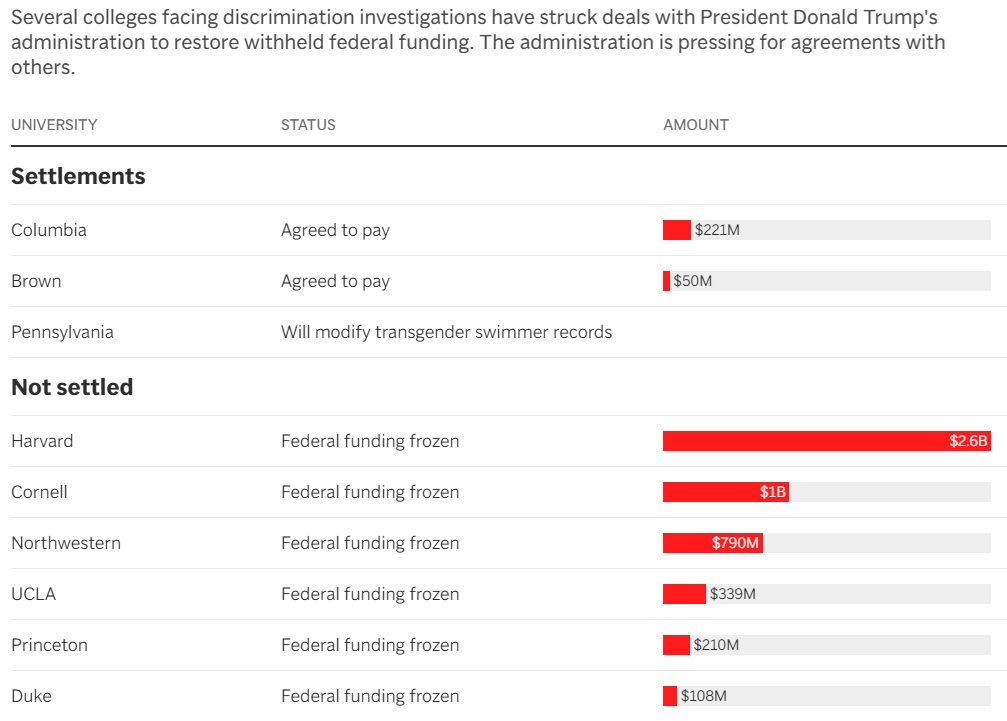
Trump administration is freezing $339 million in research grants to the University of California, Los Angeles

Tracking Trump’s college funding freezes

Dear Commons Community,

The Trump administration is freezing $339 million in research grants to the University of California, Los Angeles, accusing the school of civil rights violations related to antisemitism, affirmative action and women’s sports, according to a person familiar with the matter.

The federal government has frozen or paused federal funding over similar allegations against several private colleges (see table above) but this is one of the rare cases it has targeted a public university.

Several federal agencies notified UCLA this week that they were suspending grants over civil rights concerns, including $240 million from the Department of Health and Human Services and the National Institutes of Health, according to the person, who spoke about internal deliberations on the condition of anonymity.

The Trump administration recently announced the U.S. Department of Justice’s Civil Rights Division found UCLA violated the Equal Protection Clause of the Fourteenth Amendment and Title VI of the Civil Rights Act of 1964, “by acting with deliberate indifference in creating a hostile educational environment for Jewish and Israeli students.”

Last week, Columbia agreed to pay $200 million as part of a settlement to resolve investigations into the government’s allegations that the school violated federal antidiscrimination laws. The agreement also restores more than $400 million in research grants.

The Trump administration plans to use its deal with Columbia as a template for other universities, with financial penalties that are now seen as an expectation.

The National Science Foundation said in a statement it informed UCLA that it was suspending funding awards because the school isn’t in line with the agency’s priorities.

UCLA’s chancellor Julio Frenk called the government’s decision “deeply disappointing.”

“With this decision, hundreds of grants may be lost, adversely affecting the lives and life-changing work of UCLA researchers, faculty and staff,” he said in a statement.

The Department of Energy said in its letter it found several “examples of noncompliance” and faulted UCLA for inviting applicants to disclose their race in personal statements and for considering factors including family income and ZIP code. Affirmative action in college admissions was outlawed in California in 1996 and struck down by the Supreme Court in 2023.

The letter said the school has taken steps that amount to “a transparent attempt to engage in race-based admissions in all but name,” disadvantaging white, Jewish and Asian American applicants.

It also said UCLA fails to promote an environment free from antisemitism and discriminates against women by allowing transgender women to compete on women’s teams.

Frenk said that in its letter the federal government “claims antisemitism and bias as the reasons” to freeze the funding but “this far-reaching penalty of defunding life-saving research does nothing to address any alleged discrimination.”

Earlier this week, UCLA reached a $6 million settlement with three Jewish students and a Jewish professor who sued the university arguing it violated their civil rights by allowing pro-Palestinian protesters in 2024 to block their access to classes and other areas on campus.

UCLA initially had argued that it had no legal responsibility over the issue because protesters, not the university, blocked Jewish students’ access to some areas. The university also worked with law enforcement to thwart attempts to set up new protest camps.

The university has said that it’s committed to campus safety and inclusivity and will continue to implement recommendations.

Tony

Videos: South Africa starts injecting rhino horns with radioactive material to curb poaching


(AP Video: Alfonso Nqunjana)

Dear Commons Community,

A South African university launched an anti-poaching campaign on Thursday to inject the horns of rhinos with radioactive isotopes that it said were harmless for the animals but which can be detected by customs agents.  If you are interested in learning more about this approach, a longer explanation is available in the video below.

Interesting approach.

Tony


New Statue (Moai) Found on Easter Island!

  Easter Island Moai. Pablo Cozzaglio – Getty Images

Dear Commons Community,

Just when experts thought they knew every moai (monolithic human statues) on Rapa Nui, otherwise known as Easter Island, a dried-up lakebed kept them on their toes. These statues—largely made of a stone formed from volcanic ash and dust called tuff—pepper the island, with more than 1,000 already found and logged.

Finding a new one came as a surprise. And a bit of a mystery.  As reported by Popular Mechanics and Good Morning America.

“We think we know all the moai, but then a new one turns up, a new discovery, and in this case, in the lake, at the statue quarry,” Terry Hunt, professor of archeology at the University of Arizona, told Good Morning America. “There have been no moai found in the dry bed or in what was previously a lake, so this is a first.”

And it may not be the last.

As the area undergoes drying, the lakebed in question has given up its moai. And this opportunity may occur again. “Under the dry conditions that we have now, we may find more,” Hunt said. “They’ve been hidden by the tall reeds that grow in the lakebed and prospecting with something that can detect what’s under the ground surface may tell us that there are in fact more moai in the lakebed sediments. When there’s one moai in the lake, there’s probably more.”

The newly discovered moai is also one of the smallest found, leading experts to believe that hidden within these reeds is the potential for a bounty of new moai.

Created by the Rapu Nui people, moai have a mythical legend attached to them and have gained worldwide renown for their appearances. Some believe these moai were given special powers to walk across land and end up in their resting place. Whether or not the legend has legs, there are many theories regarding how these statues moved from building sites to various locations.

While the largest of the statues weighs 86 tons and rises 32 feet tall, most of the moai average about half that size. About 95 percent are carved from the volcanic tuff, but a few are made from basalt. Each one is unique, created by carvers to represent the characteristics of the person it resembled, often a chieftain or key leader.

The finishing touch on moai was the inclusion of special stones for the eyes, not carved or placed until the statue found its home.

Even though experts thought they knew the locations of all of these moai homes, finding this new, small one in the lakebed proves some had remained a complete mystery.

“It’s here in the lake and nobody knows this exists,” Salvador Atan Hito, vice president of Ma’u Henua, the group that oversees the island’s national park, told Good Morning America, “even the ancestors, our grandparents don’t know [about] that one.”

We learn something new every day.

Tony