Trump booed during national anthem at New York Knicks playoff game!


Mr Trump watched the match from behind glass Trump watched the match from behind glass – Getty Images

Dear Commons Community,

Trump was loudly booed by basketball fans during our national anthem as he appeared at Madison Square Garden in New York last night.

Deafening jeers greeted him as he was shown on screens inside the stadium during the pre-game singing of The Star-Spangled Banner.

In clips that quickly went viral on social media, Trump was seen smiling as boos shattered the respectful silence for the anthem, echoing around the packed arena before the screens hastily cut away.

New York Knicks fans had made it clear on social media that the president should expect a hostile atmosphere before the game against San Antonio Spurs in the NBA Finals.

Trump, a long-time Knicks fan, took his seat for Game 3 of the best-of-seven series after a security operation that had thrown Manhattan into chaos.

The Secret Service had swarmed the arena, erecting a 10ft fence around it and shutting down a dozen streets in the surrounding area.

The US president was always likely to be an unpopular visitor in the heavily Democratic city, but adding to New Yorkers’ anger was the logistical burden the president’s visit has placed on fans and the local community.

“During one of the best moments NYC has enjoyed in decades, [Trump] makes it all about himself. Trump should LEAVE US ALONE! He’s not wanted here,” Senator Chuck Schumer, the Democratic minority leader, wrote on X.

Knicks fever has gripped New York with the team on a 14-game winning run that has put them within three victories of ending a 53-year wait for an NBA championship. This is also the first time in 27 years that Madison Square Garden has hosted a NBA Finals game.

Fans’ moods would not have improved: the Knicks’ winning streak ended in a 115-111 defeat, though they still lead the Spurs 2-1 in the series. 

The 20,000 ticket holders – many of whom had paid thousands of dollars to attend – had been encouraged to arrive at least two hours early, with no bags, to clear airport-style security screening in time for the game.

Clips shared on social media showed long queues of fans waiting to get into Madison Square Garden.

Authorities had barred fans without tickets from coming within several blocks of the venue, and banned watch parties directly outside – a break from the previous two games, which drew excited crowds.

“The message is simple: celebrate the Knicks, but avoid the MSG area tonight if you do not have tickets for the game,” NYPD Commissioner Jessica Tisch told a news conference on Monday morning.

The Secret Service said it would deploy counter-drone technology as part of its operation to protect Trump.

The larger-than-usual security plan comes after multiple recent threats to Trump, including a gunman outside the White House last month and an assassination attempt at a White House correspondents’ dinner in April.

Trump, a native New Yorker, is a self-described long-time Knicks fan and is the first sitting president to attend an NBA Finals game.

He was a guest of James Doland, the basketball team’s owner, a Trump donor widely disliked by Knicks fans.

Trump knows well that he is not welcome here in New York.

Tony

Report: Has the Left Ruined the Humanities?


Photo-based illustration of the top of a bust of Aristotle with a blue and a red flag planted in the top.

Illustration by The Chronicle of Higher Education.

Dear Commons Community,

The Chronicle of Higher Education had an opinion piece yesterday commenting on a Report on the State of Scholarship in the Humanities and the Humanistic Social Sciences The report focuses on the issue of whether the humanities and social sciences have been corrupted by political aims, and whether their disciplines have tossed out rigorous research standards in favor of advancing social-justice causes favored by the political left. Here is an excerpt from The Chronicle article.

Over the past several months, a group of high-profile scholars convened privately to study whether this criticism holds water across several fields within the humanities and social sciences. “The first thing to say,” they concluded in a report published Friday, “is that we reject the complaint in this bald form.”

However, the group found reason for concern — a “mixed picture” that validates portions of the criticism. “Every field we have studied,” the group wrote, exhibits warning signs pointing to “a deterioration in scholarly standards fueled by the substitution of political criteria for properly scholarly criteria in the assessment of research and a more general repudiation of longstanding ideals of rigor and objectivity.”

That conclusion is sure to spur debate, not least because it comes on the heels of another prominent attempt to investigate the causes of widespread distrust in higher education. In April, Yale University released a report that struck similar self-flagellating notes, arguing that academics need to “admit where we have been wrong.”

What’s unique about this latest effort is who convened the group: Daniel Diermeier, chancellor of Vanderbilt University, and Andrew D. Martin, chancellor of Washington University in St. Louis, outspoken proponents of the view that colleges have become too political. Martin told The Chronicle that he and Diermeier have heard many faculty members and others express concern about the humanities and the qualitative social sciences. “So we thought a reasonable thing to do would be to pull together a group of scholarly experts to look at the issue,” he said, “to produce a report not meant to end conversation, but actually to begin conversations on campuses around the country.” Their findings, he said, did not surprise him.

In August, the two chancellors charged a group, selected and led by the New York University philosopher Paul Boghossian, with determining whether “the steady drumbeat of complaints about the deterioration of scholarly standards” within the humanities and social sciences “are justified.” For its work, the group — which included Kwame Anthony Appiah, another NYU philosophy professor, and the Princeton University historian Sean Wilentz, among others — wrote field-specific internal reports about philosophy, anthropology, sociology, history, literary studies, and music studies, relying on “extensive research” in consultation with other experts. The summary report drew on those reports for its conclusions.

That report is front-loaded with caveats. The humanities are essential, for one, and contain serious scholarship. Administrators should also be cautious about taking action in response to its findings, the scholars wrote, and instead consult disciplinary experts for deeper study.

The report presents three sources of politicized distortion: when research must be constrained by an “accepted political goal,” when the disinterested pursuit of knowledge is “displaced by” the goal of serving “a pragmatic purpose,” and rejecting the very idea that one is capable of assessing evidence on a claim “independently of our political commitments.”

The scholars cite anthropology as a potent example of the first source, quoting a 2021 speech from the president of the American Anthropological Association then who said the field’s “political project is to challenge the culturally dominant commonsense of capitalist consumerism.” These sorts of definitions — and the subtler ways that they manifest — result in the sometimes-unconscious censorship of scholarship that doesn’t serve the political goal, the report says.

More broadly, the report condemns what it calls the widespread embrace of postmodernism and relativism among scholars as antithetical to their very project. And it traces postmodernism’s appeal, in part, to the permission it grants scholars to discard evidence they don’t find personally palatable.

The authors of the report are careful to distinguish themselves from those who think the primary problem with academe is political imbalance. The fact that academics “are significantly more liberal or progressive than the general public” is “not by itself a problem for scholarship.” In an email, Boghossian added that “the solution is to restore a conception of scholarship in the humanities that is as free of ideological distortion as possible.”

Universities exist to support disinterested inquiry, the report concludes, and the obstacles it names in fulfilling that mission are serious. “They are not mere problems in the administration or operation of a university,” the scholars write, “but strike at the very heart and soul of what a university should be for.”

In an interview, Diermeier said he has also been concerned about universities suppressing the free speech of speakers and making public statements about political issues. “What the report has indicated is that there’s growing evidence that the problem of polarization in higher education is real, that it affects scholarship, that it affects teaching, that it affects publications and publication practices,” he said. “These are serious concerns, and they need to be addressed.”

Diermeier said Boghossian was chosen to lead the effort after he read and was “extremely impressed” by Boghossian’s 2006 book Fear of Knowledge: Against Relativism and Constructivism. Boghossian did not answer questions about how he in turn selected the participating scholars and the disciplines analyzed. The field-specific reports that undergird the summary report were not released Friday but may be soon, Diermeier said.

The scholars were compensated for their work, according to Martin, though he declined to comment on how much they were paid or where the funding came from.

Martin said he’d received a mix of praise and criticism in the first hours after the report went live. “I deeply value my colleagues in the humanities and in the qualitative social sciences and the great value that they bring to our students and bring to our institutions and to the country more generally,” he said. “I think at this moment of self-reflection, I’m hopeful that this document will be a catalyst to get those important conversations to take place.”

The report touches on important issues and is worth a read.

Tony


Trump can’t take the heat – Walks away from ‘Meet the Press’ interview with Kristen Welker

Trump and ‘Meet the Press’ moderator Welker spar over California elections

Dear Commons Community,

Trump abruptly ended an interview with NBC’s “Meet the Press” and walked away after moderator Kristen Welker challenged him about unsubstantiated claims of “cheating” in the California primary elections.

The dustup between Trump and Welker arrived amid the president’s pre-midterms visit to Wisconsin, a crucial swing state for both parties that he won in 2024. As reported by USA Today.

After Welker noted that “Republicans are doing well in California” following the June 2 primary contests, Trump said “they’re dropping fast because it’s a rigged election,” which led to a tense back-and-forth (video)  in the interview that aired yesterday.

Republicans have criticized the dayslong, ongoing counting process in California’s primary races.

Los Angeles mayoral candidate Spencer Pratt, a conservative, and Trump-endorsed gubernatorial candidate Steve Hilton are both in second place standings in their respective contests, but Democratic foes have gained ground. California has what’s known as “jungle primaries,” in which all candidates regardless of party compete against each other, and the top two hopefuls advance to the general election.

As Welker and Trump discussed the California races, including the vote-tallying process, Welker noted “that’s how they count the votes in California.” Trump responded, asking, “Do you know why they’re doing that? Because they’re cheating on the election.”

Welker then asked Trump if he had evidence to support his claims, and the president responded that “all I have to do is look” and “I listen to people.” The NBC anchor again asked for evidence of election fraud and repeated that the typical dayslong process is “how they count the votes in California.”

Trump then questioned if it’s appropriate to count votes five days after Election Day, and Welker said California officials are urging a quick vote count but have pointed out that the process is slow.

Trump told Welker that “they’re crooked just like you’re crooked, your press is crooked and ‘Meet the Press’ is crooked.” Welker denied the accusations, and Trump said her questions played into “their hands.”

Welker urged Trump to continue the interview as he called her “either stupid or crooked.” The president also criticized other news outlets, including ABC, CBS and CNN.

Trump then looked to end the interview, appearing to remove his microphone to throw it.

“Sorry. Let’s call it quits because I’ve had enough,” Trump said. “Thank you, darling. Have a good time.”

When Welker told Trump she traveled to Wisconsin for the interview, as “MTP” is typically filmed on set in Washington, he responded that “I sat in the rain with you for an hour.” As Welker tried to continue the conversation, Trump said he sat “on and off in the rain, and I’ve given you enough time. You ought to straighten out your press.”

The interview ended, and Welker said from the show’s Washington studio that she spoke with Trump on June 6 and they both noted the weather complications. The “MTP” host also revealed that Trump agreed to speak with her for another interview.

Tony

Maureeen Dowd on Marilyn Monroe – “Norma Jeane’s Still Got It”

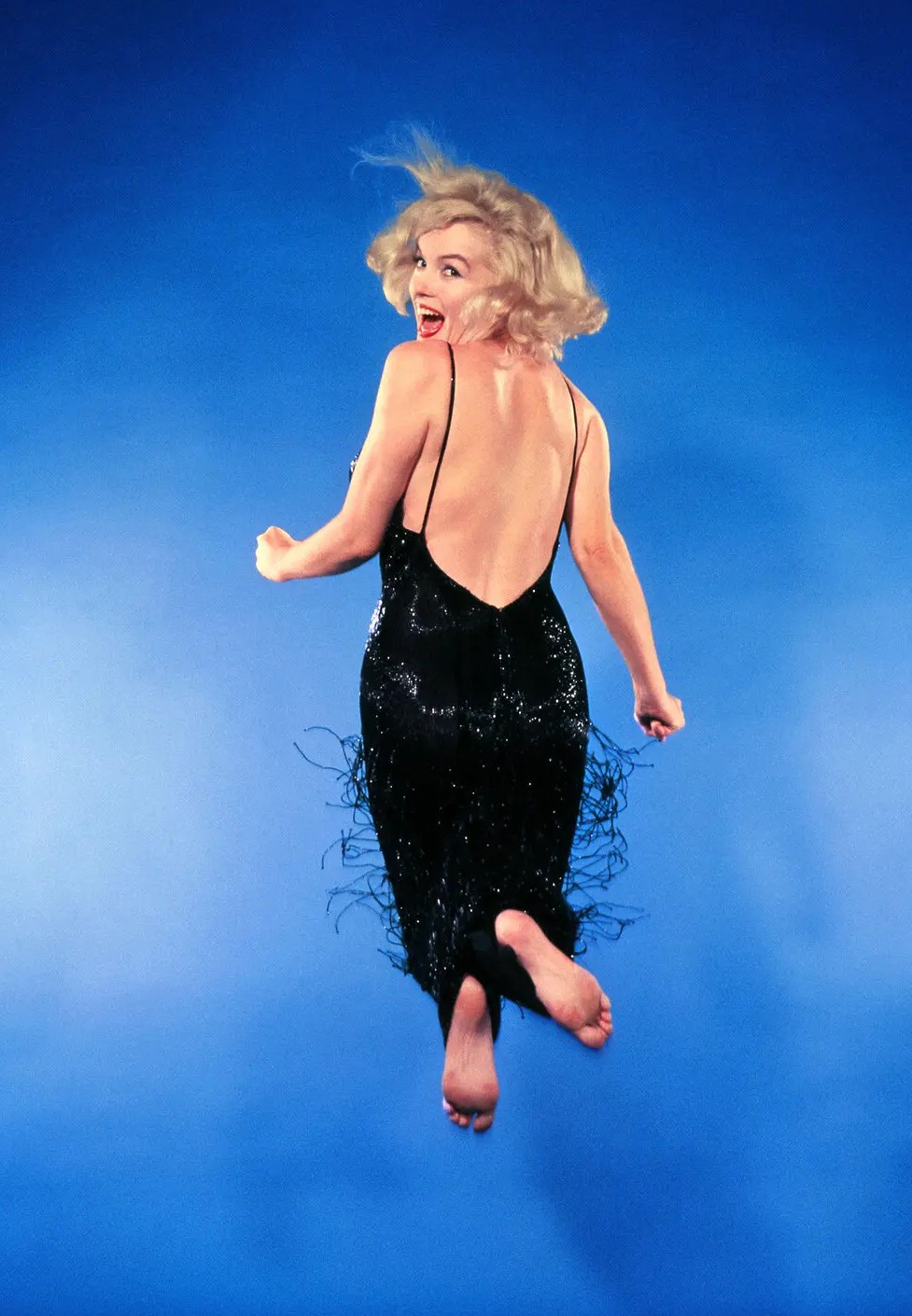
Credit…Philippe Halsman/Magnum Photos

Dear Commons Community,

New York Times columnist, Maureen Dowd, had a tribute yesterday to Marilyn Monroe on the occasion of Ms. Monroe’s 100 birthday.  Dowd provides interesting insights into Monroe that should resonate with her readers.  For instance, regarding Monroe’s relationship with the playwriter, Arthur Miller.

“Arthur Miller described the voluptuous yet fragile woman he wed as “a poet on a street corner trying to recite to a crowd pulling at her clothes.”

When Miller left out his journal open to a page saying that she had embarrassed him in front of his intellectual peers and Marilyn read it, she wrote, “I guess I have always been deeply terrified to really be someone’s wife since I know from life one cannot love another, ever, really.”

Like everyone else, Miller was mesmerized by his wife’s power of enchantment. “Glamour is a bird that for dark and largely unknowable reasons decides to light on this branch rather than another,” he once wrote.

I found Dowd’s piece a good read that would be of interest to anyone who remembers the glamorous star of the 1950s and 60s.

Below is Dowd’s entire column.

Tony

———————————————————-

The New York Times

Norma Jeane’s Still Got It!

June 6, 2026

By Maureen Dowd

Opinion Columnist, reporting from Washington

I’m excited about the big birthday celebration.

Not the crass party that President Trump is having for America’s 250th, with a hulking metal contraption on the South Lawn for the U.F.C. cage fights next weekend, and a solipsistic rally starring Trump, now that most of the “celebrities” have dropped out. (The president says that’s fine because he’s bigger than Elvis.)

For his 80th birthday, he has funneled millions meant for a bipartisan celebration of this remarkable country to a partisan celebration of his contemptible self.

L’Etat, c’est moi!

No, I’m excited about Marilyn Monroe’s centennial bash, which has been playing out across the globe, from a prestigious exhibition at a Paris film museum — “Cent Ans de Fascination” — to a show at the National Portrait Gallery in London, to a concert in Japan, to a display of costumes and personal artifacts at the Academy Museum of Motion Pictures in L.A., to a joyous look-alike contest with straights, gays, young, old and even bearded Marilyns in Palm Springs, home to “Forever Marilyn,” the 26-foot-tall, 34,000-pound statue of America’s icon of icons in her white-halter pleated, blowy dress from “The Seven Year Itch.”

The smart dumb blonde who sang the most notorious “Happy Birthday” of all time to President Jack Kennedy — the only public erotic event in American presidential history — is getting a very happy birthday, indeed. Norma Jeane Mortenson, who survived a mentally ill mother, a father who deserted her, 12 foster homes and some sexually abusive foster parents, a mudslide of sexual predation in Hollywood, very famous husbands who were peevish and jealous of her fame, and insensitive Kennedy brothers, is getting the love she always craved.

Starting as the 1948 Castroville, Calif., Artichoke Queen, Norma Jeane created Marilyn, putting a high gloss over deep wounds. “Marilyn’s like a veil I wear over Norma Jeane,” the actress once said. Some of her foster parents sent her to the movies to get her out of the house, and the little kid sat in front of the big screen and dreamed about a life where she was wanted.

Like her character in “Some Like It Hot,” Sugar “Kane” Kowalczyk, Marilyn often got the fuzzy end of the lollipop.

She loved the camera and was scared of it. (Hence the bouts of lateness.) She loved the public and was scared of it. Mike Nichols, who went to Lee Strasberg’s acting class in New York with Marilyn, once explained her astonishing staying power to me by saying, “She had the greatest need.” And while there were greater beauties, he noted, Marilyn was “superhumanly sexual.”

Her friend Saul Bellow observed: “She was connected with a very powerful current, but she couldn’t disconnect herself from it,” adding, “She had a kind of curious incandescence under the skin.”

Her strange combination of luminosity and vulnerability made her immortal.

Unlike today’s sex symbols, Marilyn thought it was cool to be smart. She collected over 400 classic books — from Thomas Mann to the works of Freud — and befriended intellectuals, even marrying one.

Arthur Miller described the voluptuous yet fragile woman he wed as “a poet on a street corner trying to recite to a crowd pulling at her clothes.”

When Miller left out his journal open to a page saying that she had embarrassed him in front of his intellectual peers and Marilyn read it, she wrote, “I guess I have always been deeply terrified to really be someone’s wife since I know from life one cannot love another, ever, really.”

Like everyone else, Miller was mesmerized by his wife’s power of enchantment. “Glamour is a bird that for dark and largely unknowable reasons decides to light on this branch rather than another,” he once wrote.

In a world that increasingly lacks artists — and politicians — who burn through the screen, and with younger generations less interested in offscreen lust, Marilyn remains as fulgent and seductive as ever. The company that manages her estate reported making $80 million from merchandising her name and image in a year. TJ Maxx sells Marilyn Monroe underwear.

Marilyn earned a small fraction of what peers like Elizabeth Taylor and Jane Russell did. She got only $500 a week when she was the blonde in “Gentlemen Prefer Blondes” with Russell. She bought her first house, a small hacienda in Brentwood, with furnishings from Mexico, the year she died.

So why has she persisted as the most shimmery sex symbol all around the world?

In one of the poems she scribbled in her notebook, Marilyn described herself as “strong as a cobweb in the Wind.”

Hollywood has always had a perch for curvy, sultry blondes — from Jean Harlow to Kim Novak to Jayne Mansfield to Pamela Anderson to Sydney Sweeney.

But Marilyn was one of a kind, embodying our deepest fantasies, ensnared in a film-noir triangle with President Kennedy and his brother, the attorney general. The woman was more interesting than the myth.

As Sam Wasson, the author of several best-selling books about Hollywood, put it: “She can be anything to anyone. She is the American dream in darkness and in light — her rise story comforts us to think dreams can come true and her decline story comforts us to think maybe we’re better off if our dreams don’t come true. From the feminist angle, she is equally versatile: She can be seen as defiant or a victim of exploitation, an artist or an object. Also, you can’t underestimate what dying young does for your longevity!”

Leon Wieseltier, the editor of the journal “Liberties,” said Marilyn cast her spell by radiating “happy carnality, which is why her harsh treatment by men seems especially mean. She tried and tried to be ‘serious,’ but there was no point. She was doomed to be a fantasy. That’s what Billy Wilder saw: that she was both incendiary and naïve. She brought the news that desire is just as exciting when it is sunny as when it is dark.”

Wilder, who directed Marilyn in “The Seven Year Itch” and “Some Like It Hot,” was also bewildered by Marilyn’s ability to bewitch, calling her surprising and intuitive in every scene. Even when she made him wait while she cowered in her dressing room, or blew a line — like “Where’s the bourbon?” — 80 straight takes, he forgave her, savoring her “elegant vulgarity.”

“As I’ve said before, I’ve got an old aunt in Vienna who would say every line perfectly,” Wilder told Cameron Crowe, laughing. “But who would see such a picture?”

As Marilyn herself noted, “Glamour cannot be manufactured.” It’s magic.

“Fame isn’t everything,” she told the LIFE editor Richard Meryman in her last interview, in 1962. “It warms you a bit. But that warming is temporary. It’s like caviar. It’s good to have caviar, but if you had it every damn day, you know?” She laughed. “Too much caviar.”

Xavier Becerra wins California governor primary, advances to November general election

Dear Commons Community,

It is official, Democrat Xavier Becerra has won the California Governor primary election and will advance to the general election in November. The top two vote-getters in the primary will advance to the general election regardless of political party. Becerra’s victory was called by the Associated Press on Friday night.

With 68% of the votes counted, Becerra, the former HHS Secretary under President Biden, has a slight lead over Republican Steve Hilton, 26.8% to 26.4%. Democrat Tom Steyer remains in third place with 21.1%. MAGA favorite Chad Bianco and former Democratic Congresswoman Katie Porter appear to be out of the race, coming in 4th and 5th respectively.

Hilton spoke out against delays in the vote counting at a rally outside a Bay Area elections office on Friday.

Offering what he calls a short-term plan to speed up the vote count, Hilton said, “The ‘election count accelerator plan’ that I’m laying out today is focused on an election count accelerator ‘core’, which is using existing administrative workers from our state government in non-essential roles to surge them to the election centers so we can get this done quickly.”

State leaders also criticized President Donald Trump Friday after he again claimed without evidence in a post on Truth Social that Democrats are cheating through the use of mail-in ballots, though he himself voted by mail in the Presidential election in 2024.

Good luck to Mr. Becerra!

Tony


James Murdoch (Rupert Murdoch’s Son) Builds His Own Media Empire

James Murdoch. Credit…Photo illustration by Chantal Jahchan

Dear Commons Community,

The New York Times reported yesterday that James Murdoch, Rupert Murdoch’s son, would be buying New York magazine, Vox.com and the Vox Media podcasting network for an estimated $300 million.  As reported.

It is an enduring feature of our nation’s leading (for now) media dynasty, the Murdochs, that they continually generate news — as a force in politics and culture, as a bellwether of their industry and as a family whose fights have been soapy enough to inspire four seasons of “Succession.”

The family’s story arc, though, appeared to reach its zenith last September. That was when Rupert Murdoch ended a wrenching family legal battle over future control of his conservative media empire with three of his four oldest offspring — James, Liz and Prue — and made their more right-leaning brother, Lachlan, his undisputed business heir.

Driving the drama was Rupert’s fear that upon his death, James would swoop in with his sisters to pull the Murdoch news outlets, including Fox News and The New York Post, to the left. Rupert’s liberal critics hoped for — pined for — the same outcome. But Rupert and Lachlan, who now runs the companies, came to an accommodation with the wayward children in which they would cede their claims in return for more than $1 billion each. That seemed to be that.

Then came news last month that James would buy New York magazine, Vox.com and the Vox Media podcasting network for an estimated $300 million.

Small by the standards of today’s media deals, the purchase nonetheless grabbed attention because of what it represented: the most visible move by James to leave his father’s gargantuan shadow. It signaled a break from a legacy that James has publicly associated with climate change denialism and the “insidious and uncontrollable forces” that caused the Jan. 6 riots. He holds that his father’s empire has spread toxic political content in pursuit of ratings and revenue, degrading civic health and its own corporate standing.

Coverage of the deal has portrayed James as acquiring “an ideological competitor” to the outlets run by his brother. Though it would be the equivalent of fighting a destroyer with a speedboat, the notion made sense. The family fight had always taken place within the family media business. Now it would play out through rival media businesses.

James disclaims any connection between his acquisition and his family’s travails. When The Times asked him if he wanted to differentiate himself from his father, he said flatly no: “I’m just trying to build a great business,’’ he said.

But when I spoke with James last week, it was clear that he was setting out with an editorial philosophy that carries at least an implicit rebuke of his father’s populist, winner-take-all philosophy. That outlook, and many keen insights about what viewers really desire, built the Fox empire. It also turbocharged a practice of partisan combat that raced far beyond Murdoch’s control and shaped a worldwide ecosystem of misinformation. James is looking toward independent media as a higher-minded, if less lucrative, antidote to those forces. In their business choices, the two men — and the gulf between their visions — capture the divergent paths of American media in the industry’s roiling 2020s.

Good luck to James!

Tony

Stock market slumps in worst day since last October – S & P down 2.6%

Dear Commons Community,

The U.S. stock market had its worst day since October yesterday as a sell-off in big technology companies weighed down the broader market and a strong jobs report boosted expectations that the Federal Reserve will be forced to hike interest rates at some point this year.

The S&P 500 sank 2.6%, its biggest one-day drop since October 10, when the Trump administration threatened to impose a 100% tariff on imported goods from China. The losses helped push the benchmark index to its first losing week in the last 10.

The Dow Jones Industrial Average fell 1.4%, while the Nasdaq composite slumped 4.2%.  As reported by The Associated Press

Tech stocks dragged the broader market lower as companies that had powered the S&P 500 to a series of records the past two months saw losses. Nvidia fell 6.2%, Broadcom dropped 7.9% and Micron Technology slid 13.3% for the biggest loss among stocks in the S&P 500.

Shares in Meta fell 5.5% following a published report that the social media giant may seek to do a new stock offering to raise funds for spending on AI infrastructure.

Stocks within the S&P 500 were not far from being evenly split between gainers and losers. But, many of the bigger tech stocks have pricey values that tend to give them outsized influence on the broader market.

Meanwhile, bond yields jumped after a report showed the U.S. added a surprising 172,000 jobs in May, according to the Labor Department. It is the latest report showing that employment remains solid, despite the squeeze inflation is putting on businesses and consumers.

The latest reading on employment comes two weeks before Kevin Warsh heads his first policy meeting as chair of the Fed. Policymakers are widely expected to keep rates steady at the June 16-17 meeting despite pressure from President Donald Trump to lower borrowing costs. Longer-term, the market sees a better than 60% chance the Fed will push rates higher by the end of the year, according to CME FedWatch, and little to no chance of a cut.

“Any hopes of a Fed rate cut have effectively been eliminated with this morning’s strong jobs report,” said Ronald Temple, chief market strategist at Lazard, in a research note.

The yield on the 10-year Treasury rose to 4.54% from 4.50% just before the report was released. The yield on the 2-year Treasury, which more closely tracks the Fed’s actions, jumped to 4.16% from 4.04% just prior to the report.

The Fed has been holding interest rates steady as it tries to gauge the ongoing impact from rising inflation. Prices were already ticking higher from the impact of tariffs. The U.S. war with Iran has essentially blocked crude oil shipments from moving through the Strait of Hormuz.

The price of Brent crude, the international standard, fell 2% to settle at $93.09. It was about $70 per barrel before the war. The surge in oil prices prompted a jump in fuel prices. That has fueled a broader rise in inflation as prices for anything being shipped move higher and threaten to slow economic growth.

A measure of inflation preferred by the Fed showed that prices rose 3.8% overall in April. That marked the biggest increase in two years.

Wall Street has been anticipating that negotiations to end the war will eventually be successful. American and Iranian negotiators reached a tentative deal last week to extend their ceasefire, but the agreement has not been finalized.

The latest round of corporate earnings is coming to a close. Lululemon slumped 8.6% after trimming its revenue and profit forecasts.

Most reports from companies have been surprisingly good and helped Wall Street on its record run. Encouraging profits and forecasts helped overshadow lingering worries about the direction of the economy amid tariffs and high energy costs because of the U.S. war with Iran.

With earnings now in the background, analysts have been warning that the tech companies benefiting from interest in artificial intelligence may have become too expensive. That could result in a slowdown for a market that has posted a solid gain in 2026, with the S&P 500 up 7.9% for the year.

All told, the S&P 500 fell 200.57 points to 7,383.74 on Friday. The Dow dropped 695.15 points to 50,866.78, and the Nasdaq lost 1,121.53 points to close at 25,709.43.

Ouch!

Tony

Seven U.S Republican senators who may defy Trump!

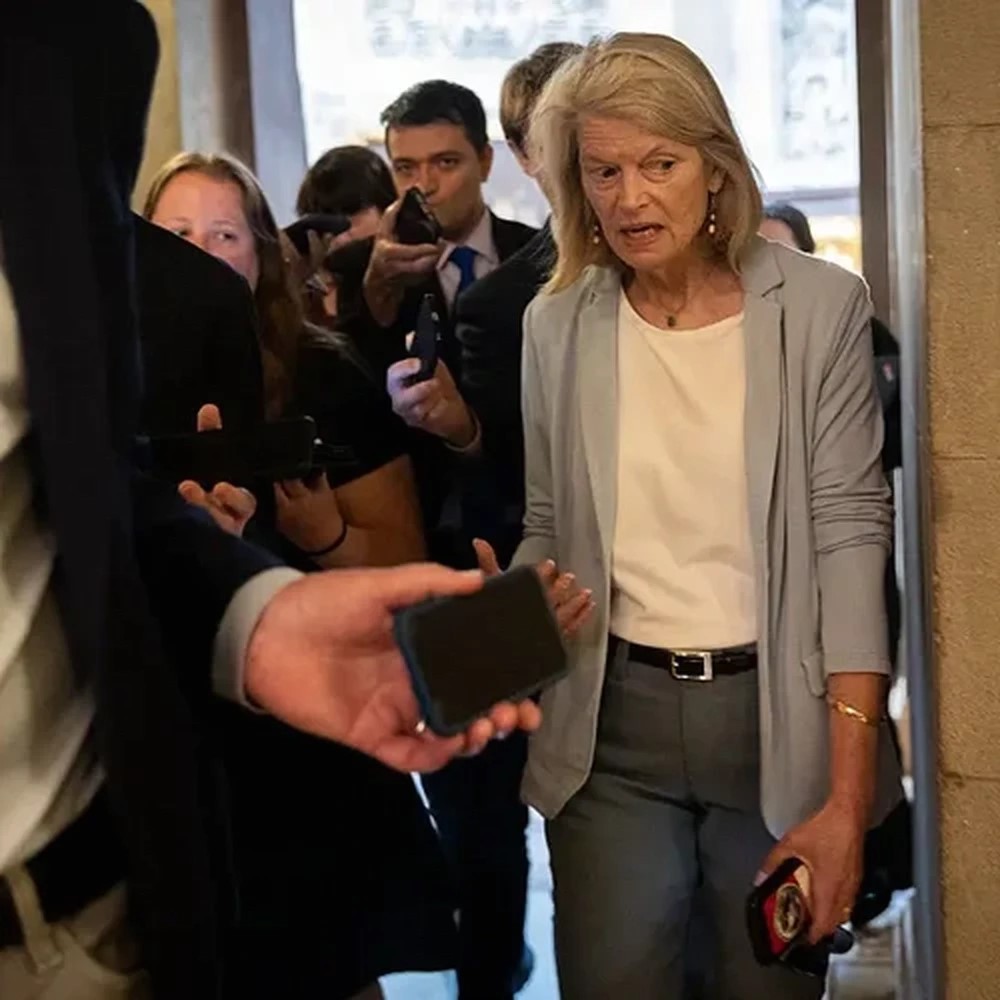
Lisa Murkowski

Dear Commons Community,

Lisa Murkowski, Susan Collins, Thom Tillis, Bill Cassidy, Mitch McConnell, John Cornyn, and Dan Sullivan are seen as the most likely to oppose Trump in upcoming votes. Murkowski and Collins have long records of breaking with their party on war powers and executive authority, while retirees like Tillis and McConnell can act without electoral repercussions. Cassidy and Cornyn have personal grievances tied to Trump-backed primary defeats, and Sullivan faces a strong Democratic challenger in Alaska, giving each senator distinct incentives to distance themselves.   As reported by Newsweek.

Senator Opposition History Electoral Status Key Issues/Comments
Lisa Murkowski (Alaska) Voted to convict Trump after Jan 6; consistently opposed Trump on war powers and executive authority Not up for reelection until 2028 Open to caucusing with Democrats if they gain seats in 2026
Susan Collins (Maine) Voted against Trump’s tax bill; broke with leadership on Iran war powers Faces competitive reelection in a state Trump lost by 7 points Moderate Republican with consistent dissent on executive power, trade, and national security
Thom Tillis (North Carolina) Voted against Trump’s tax legislation; blocked DOJ nomination; criticized anti-weaponization fund Retiring, in office until Jan 3, 2027 Most outspoken critic among retiring Republicans; challenged Trump on Medicaid, NATO, and personnel decisions
Bill Cassidy (Louisiana) Voted to convict Trump after Jan 6; lost Trump-backed primary Final months of Senate career Calls for permanent elimination of anti-weaponization fund; increasingly outspoken post-primary defeat
Mitch McConnell (Kentucky) Broke with Trump on tariffs; criticizes foreign policy and national security Retiring at end of term Focuses on institutional concerns; less public confrontation but carries weight due to experience
John Cornyn (Texas) Driven out by Trump-backed challenger; called for legislation to kill anti-weaponization fund No electoral incentive remaining Personal grievance against Trump; less frequent critic but potential problem for GOP vote counting
Dan Sullivan (Alaska) Occasionally broke with administration on foreign policy and Alaska-specific issues Faces competitive reelection against Democrat Mary Peltola Incentive to distance from Trump due to state economic impacts and low presidential approval

Why these defections could cost the GOP the Senate

Republican leaders face a tension between advancing Trump’s priorities and protecting vulnerable seats. Murkowski and Collins can leverage their independence to appeal to swing voters, while retiring senators like Tillis and McConnell have more freedom to oppose controversial measures. Even targeted dissent from Cassidy or Sullivan could complicate confirmation votes, funding battles, and foreign policy measures, especially with Trump’s influence waning among some GOP lawmakers.

Tony


Opening salvo: Republicans propose major spending cuts to the US Department of Education!

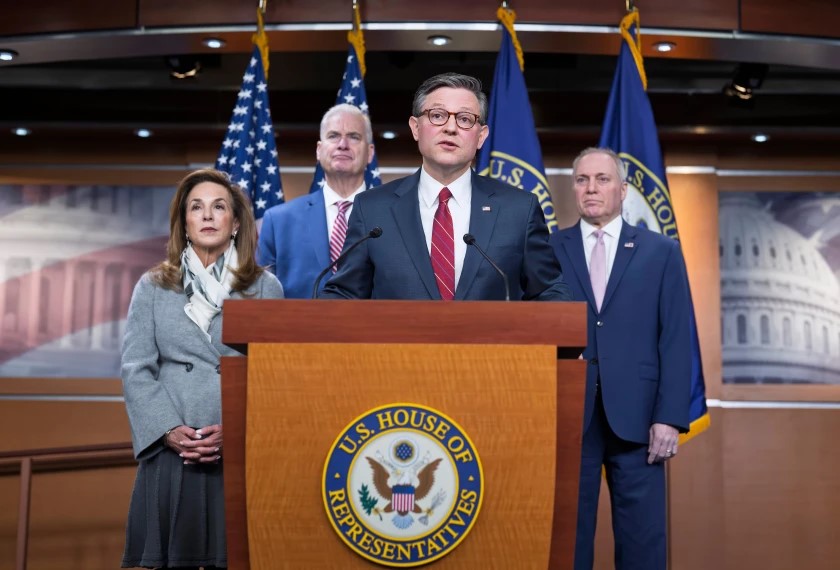
House Speaker Mike Johnson, R-La., and fellow House Republican leaders.  AP Photo/J. Scott Applewhite

Dear Commons Community,

Republicans in the U.S. House of Representatives launched their opening salvo in the monthslong federal budget process, releasing an Education Department spending bill yesterday that incorporates some of President Donald Trump’s proposed cuts and ignores others.

The bill proposes to eliminate more than $3 billion combined for teacher professional development and English-learner services, and would end dedicated funding streams for civics education, gifted and talented programs, magnet schools, and other longstanding initiatives.  As reported by Education Week.

In some cases, the House GOP’s reductions aren’t as steep as Trump’s: House members are pitching a 38% cut to spending for the Education Department’s research arm instead of the two-thirds reduction the president is seeking. But in one notable case, House Republicans have proposed a cut where Trump hasn’t: Their spending plan would cut $1.6 billion from Title I, whereas Trump maintained level, year-over-year funding for the Education Department’s largest K-12 program.

This House spending bill is far from the final word in the budget process. It still has to make its way through the appropriations committee and the full House. And Senate appropriators have yet to come out with their own spending bill (last year, they rejected all of Trump’s proposed cuts). Then, the two chambers will have to negotiate any differences. If all goes according to schedule (and it often doesn’t), a new budget will be in place in time for the Oct. 1 start of the federal fiscal year.

Any changes to federal education programs would hit schools in 2027-28.

Tony

The last astronomers – Amid a flood of AI advances, astrophysicists are questioning the soul of their field

ILLUSTRATION: CHIARA VERCESI

Dear Commons Community,

Science has a featured article this morning entitled, “The Last Astronomers.”  It speculates on the future of astrophysics as a field of study in light of advances in artificial intelligence. It offers stark insights from major scientists.  Below is the entire article.

Tony

—————————————–

Science

The last astronomers

In Section Feature

Amid a flood of AI advances, astrophysicists are questioning the soul of their field

JOSHUA SOKOL

Featured

One afternoon in April, Cecilia Garraffo settled down at the head of a conference room table in Cambridge, Massachusetts, and gazed out at what might be the last astrophysicists of their kind.

The walls of this room had, in the past, reverberated with the din of thousands of other groups of scientists. Now, as streaks of sunlight poured in, the discussions turned to nonhuman collaborators. One by one, the gathered researchers discussed how they planned to apply machine learning to problems in astronomy. Observing an interstellar comet. Discerning wispy filaments of galaxies at the universe’s largest scales. Developing a new “tokenizer” that can translate astrophysical images into a form more readable by artificial intelligence (AI). “Sometimes models will be overconfident,” Garraffo warned a junior team member.

Afterward, as everyone filed out, black hole researcher Daniel Palumbo made a brief announcement. Representatives from AI chipmaker NVIDIA were on campus in search of scientists who wanted to solve problems using their hardware. To anyone who might need extra processing power, “today’s the day,” he said.

The Center for Astrophysics | Harvard & Smithsonian employs more than 600 astronomers and other staff, making it one of the world’s largest concentrations of professional stargazers. Garraffo heads its AstroAI group, which is charged with leading the center’s approach to applying machine learning to various problems. In just 4 years since they first proposed this specialized team, Garraffo and her colleagues have forged collaborations throughout the building and with industry teams such as Google DeepMind and Anthropic.

Originally, their goal was to use machine learning and AI to remove the technical barriers of math and computation while preserving what Garraffo considers the fun part of physics: honing scientific questions. Their toolbox did not include chatbots. Despite the buzz around ChatGPT, which was released within months of AstroAI’s first proposal, Garraffo had thought her group would steer clear of the headline-grabbing tool and other large language models (LLMs).

At least, until recently.

Now, stories of miraculous progress were starting to spread across the institution. As her MacBook Air pinwheeled to a crawl thanks to an AI agent running software locally, Garraffo’s colleague Alyssa Goodman showed me a data-fitting problem. She wanted to understand how the spiral arms of a distant galaxy were moving. But isolating just that motion from other patterns imparted into her data by the spin and the geometry of our own Galaxy had thwarted her group for years. She asked ChatGPT, which resolved the problem in a few minutes. Now, her research group was planning to write several papers on the resulting data set, “the single best map of spiral arm kinematics ever—like, by a factor of 100.”

Conversations comparing these tools with human researchers, once an underground whisper, have grown into a deep rumble in astrophysics departments around the world. Many are turning over aspects of their research practice—searching the literature, developing code, writing proposals to use telescopes, doing first-pass “reads” of their peers’ submitted proposals, and actually solving problems—to agentic AI systems such as Anthropic’s Claude or OpenAI’s Codex. Major institutions such as the Space Telescope Science Institute and the Institute for Advanced Study have rushed to hold meetings on LLMs and AI agents in science. In March, Anthropic published a blog post from Harvard University physicist Matthew Schwartz about his experiments in “vibe physics.” After supervising Anthropic’s Claude model closely enough to catch its many fabrications and bluffs, he forced it to generate in 2 weeks a real, publishable physics paper that he claimed would normally take a year. Schwartz’s sense was that the “AI grad student” approximated a second-year grad student at Harvard. Give AI 12 more months, Schwartz extrapolated, and LLMs’ capabilities may rival those of postdocs.

Representatives of the AI companies, who seem to view astrophysics problems as public relations boons that offer compelling showcases of their models, boast that their technologies will soon achieve supremacy over actual theoretical physicists, astrophysicists, and cosmologists. Some even make mechanizing the study of the night sky a selling point. In February, as Elon Musk began seeking to take SpaceX public to raise cash for orbiting data centers, his company explained its true goal as “scaling to make a sentient Sun to understand the Universe.”

Already, by making it faster and easier to produce professional-seeming papers, AIs threaten both to overwhelm journals and peer reviewers and to take opportunities away from junior scientists. But far upstream of that, many scientists interviewed by Science sense a phase change underway. Many fear that if unleashed in all parts of the scientific process, AI tools could lead to nothing less than the death of astrophysics as a human endeavor. “A lot of people think that it’s too late to intervene—we’re done,” says David Hogg, a computational astrophysicist at New York University (NYU).

ALTHOUGH FEARS OF A ROBOT takeover are inspiring soul-searching across society in general, astrophysics is a strange, special case. It relies on reservoirs of prestige, deep public appeal, and invocations of wonder: Human beings and funding agencies alike just seem to like studying the stars, and astronomical progress has long been thought of as a synecdoche for human progress in general. Yet because astrophysics is already mostly data science and math, many of its juiciest problems may be low-hanging fruit for LLMs.

At the same time, understanding the night sky promises little in the way of economic applications or human lives saved, so progress at all costs doesn’t seem as imperative as it might for fields such as drug discovery. If any scientific discipline could stake out a nuanced, human-centric relationship with powerful new AI tools, it would be astrophysics. So how is that going so far?

Early signs are, in a word, mixed. In September 2025, a guest speaker at the NYU physics department ran an AI agent in real time in the background. As he spoke, the system—called Denario and built by a group at the Flatiron Institute, a privately funded research center dedicated to advancing science using computational methods—generated entire scientific projects. It scoured journals, spun out ideas, carried out analyses, and extruded professional-seeming scientific papers—some obviously goofy, some plausible—that popped up on the screen behind him. With tools like this and beyond, he said to an audience of mostly grad students, you no longer need grad students. Why wait months for a young human scientist to do a project when an AI can give you the answer within an hour?

“What I love is to chase the truth.” said Cecilia Garraffo Center for Astrophysics Harvard & Smithsonian

“It was a very bizarre talk,” says Matthew Daunt, a seventh-year grad student at NYU, because even Denario’s most impressive outputs didn’t look all that scientifically useful. “And yeah, the comment of ‘You don’t need grad students anymore’ kind of pissed me off.”

Hogg, who also works at the Flatiron, had a one-on-one meeting with Daunt right after the lecture. “He was like, ‘I’m not cattle,’” Hogg says.

The incident inspired Hogg to think about the moral value of AI systems studying the universe—and the value of the humans that such systems may replace. Simply banning the use of AI models would require an impossible amount of policing, he felt. But if astrophysicists simply sit back and let these models “cook,” their hundred-thousand–fold advantage in speed would mean scientists would be quickly buried under an unreadable avalanche of machine-only studies.

It seemed to him that finding a middle path between these extremes, in which LLMs help science and scientists alike, involved first wrestling with a question that seems less in the realm of physics and more like metaphysics. In February, he posted his paper to a preprint server. Its title: “Why do we do astrophysics?”

Hogg offered an answer. It wasn’t to solve the cosmos but to grapple with it: a journey, not a destination. Graduate students aren’t supposed to be only the means of the science—doing work for senior scientists—but an end in themselves, molded into competent scientists by doing that work. In so doing, today’s students would become the latest link in an unbroken chain of practice, going all the way back to the first among us who looked up agog at a sky full of stars. “Anyone working in astrophysics,” Hogg wrote, “is someone who wants to do astrophysics, not someone who wants to learn the answers.”

There are only a few thousand astrophysicists worldwide. Perhaps 100 email responses came in within a few days after Hogg posted the paper. Some correspondents disagreed. Many thanked him for dragging the conversation from coffee shops into the literature. “Flatiron fell apart,” Hogg says. In frenzied conversations, many of his own colleagues were compressing their internal timelines for when AI might bring major changes to their science from years to weeks—and fretting about the consequences.

Hogg had suggested I could visit the Flatiron to hear some of these conversations in person. But after weeks of emailing, a member of the Flatiron’s communications team turned me down. The institutional politics around AI and systems such as Denario, they told me on background, had become so fraught that my request stirred up a hornet’s nest of internal conflicts.

ASTRONOMY IS NO STRANGER to advances in quantitative methods, having arguably given birth to them in the first place. Thousands of years ago, scholarly orders from Mesopotamia to Mesoamerica to China and beyond served as intermediaries between their societies and the cosmos by combining extensive bookkeeping with clever mathematical algorithms—what might now be called data science. In the second century B.C.E., Hipparchus accessed and reprocessed centuries of Babylonian records to develop theories of solar and lunar motions. At the beginning of the 1600s C.E., Johannes Kepler used Tycho Brahe’s observational data to fit mathematical laws to the motions of the planets.

As the supply of astronomical data exponentially increased, astronomers and mathematicians pioneered many of the first “computers” human beings scribbling on paper. One early program employed teams of hairdressers put out of work by the execution of the aristocracy in the French Revolution to calculate logarithms. By the 1820s, mathematician Charles Babbage, dreaming of automating mental work the way the steam engine had automated physical labor, designed the first programmable computing engine to make astronomical calculations.

By the end of the 19th century, photography had began to be applied to the study of the night sky, leading to another explosion in data and computing needs and rendering a human eye on a telescope eyepiece irrelevant. Photonegatives of distant galaxies piled up in basements in places such as the Harvard Observatory. More scientific data could be extracted, astronomers understood, if only these images could be studied in detail.

In the Harvard Plate Stacks, three levels of hulking black cabinets store some 600,000 thin glass plates from this era. To process all these data from the cosmos, curator Thomas Burns explained, Harvard astronomers brought in a new workforce of woman computers. The women got a chance to make heroic contributions to a field that would otherwise have excluded them. But they were also exploited. Some, from working-class backgrounds, needed a paycheck too much to negotiate. Others, from wealthy families, didn’t need the paycheck at all.

Burns descended a narrow spiral staircase and fetched a glass negative from 1934. Photons from thousands of galaxies around the Coma Cluster had traveled 300 million light-years to Earth, where a chemical reaction in the film had trapped their energy like fossils in amber. The glass, illuminated against a white backlight, was covered in tiny markings in different colors. First a “computer” named Muriel Mussells Seyfert had labeled countless galaxies. Then others had revisited the same frame in other passes, leaving lasting traces of a layered dialog.

Burns explained that Seyfert, uncredited, had helped calculate the mass enclosed within a red circle around the center of the cluster. The result corroborated an odd contemporary proposal that the galaxy cluster harbored some extra, unaccounted-for “dark matter.” Another astronomer, Vera Rubin, came across these same underappreciated data in the early 1950s. Perhaps inspired by this hint, she would later go on to find even firmer evidence for the existence of dark matter.

Another three-quarters of a century later, in March, NVIDIA announced its new Space-1 Vera Rubin Module, designed for use in swarms of orbiting data centers. Their proliferation could pollute astronomical images—and the AI models they enable could render astrophysics itself unrecognizable. I asked Garraffo about the scenario in which her field produces fewer human stories like the one captured in this annotated glass plate. What if people—such as Seyfert, or Rubin—no longer make these kinds of discoveries themselves?

“What I love is to chase the truth,” Garraffo replied, considering. Perhaps the moment of human insight frozen on the plate was romantic, but the work had clearly also been tedious—and to her, an elegant truth of the universe such as general relativity was more romantic. If tools exist that would lead to such truths faster and better, she argued, astronomers should use them. “Pretending, ‘Let’s cover the truth so people feel like they can discover it’—it’s very narcissistic, in a way.”

Garraffo isn’t sure when AIs might surpass human capabilities, but a recent experience convinced her they haven’t yet. In her early career, as a pen-and-paper theoretical physicist, she had worked on alternate versions of Albert Einstein’s theory of gravity, general relativity, which is known to be incomplete. Garraffo wanted to solve the equations for one alternative, called Einstein-Gauss-Bonnet, and find an exact description within the theory of the shape of spacetime around a rotating black hole. It was a practice case, she thought: If you could figure out how to do that, the same conceptual tools might work across other alternate theories of gravity, giving scientists a new way to probe and evaluate new theories that aim to usurp Einstein’s. She trained a neural network to intuit its way to an approximate, numerical solution. But this kind of network was not an LLM, and it couldn’t rewrite its inner workings out into a neat, concise mathematical answer.

Then she asked the best publicly available versions of both Claude and ChatGPT to solve the Einstein-Gauss-Bonnet equations for a rotating black hole analytically and produce the kind of crisp answer she sought. It was a very hard but well-posed mathematical problem, and she was optimistic it could work. “The models I tried failed miserably. Miserably,” she said. Claude, in back-and-forth exchanges, claimed it could find an interesting result for the problem, then wrote up an entire impressive-looking paper. But as she read the paper, she realized it was just stating existing ideas in byzantine ways.

If the LLMs had been able to make progress on the problem, and if AI systems stopped improving right at that level, “that to me, maybe selfishly, would be ideal,” Garraffo said. With tools of that strength, humans like her would still need to identify the relevant questions, ask them, interpret the answers, and have the fun of making sense of what that meant for physics. “Then we have to press the brakes.”

But the power of the models may soon surpass that level. “We all collectively came to the realization that these tools are about to take over,” postdoc Rodrigo Córdova Rosado told me in his office earlier this spring, flanked by a LEGO X-Wing on top of a shelf of physics textbooks. In about 2 hours, he told me, he had used Claude to interpolate between the best existing general relativity textbooks and write a new one, complete with sample problems and figures generated by scripts it wrote in the math software Mathematica. He was now checking the book for errors. (On the side, as a student of the Osage language and a member of the Osage nation, he had been experimenting to see whether AI might be able to create an Osage-English dictionary.)

“This is a wave,” he said. “If you do not surf it, it feels like you’re gonna get drowned by it.”

DURING MY VISIT, Garraffo invited team members who wanted to talk more philosophically about AI to come to her office. Seven scientists packed in, two more joined remotely, and they began an impromptu roundtable discussion.

The conversation grew loud. Do AI agents lack good “taste” in scientific problems? Were these tools democratizing, helping non-English speakers participate in science—or were they antidemocratic, by making science dependent on subscriptions to some of the wealthiest corporations in the world? Were astronomers now free to care less about computer science and more about the universe? Would the fact that LLMs are inherently probabilistic—and not unerring engines of mathematical logic—make the math and statistical analyses they spit out untrustworthy? “Is it insane,” one grad student exclaimed, “if I don’t see this as such a big issue?”

Both in that room and outside it, many of astrophysicists’ concerns lump into two families. First, many researchers fear LLMs’ ability to effortlessly conjure text, code, and highly technical analyses threatens the current metrics, incentives, and trust networks that knit “astrophysics” into a cohesive, reliable body of knowledge.

For example, in a publish-or-perish world, publishing papers at a fast rate and racking up citations has been treated as a proxy for the quality of a scientist’s output, which in turn determines who gets resources to do research at all. But now publishing an incremental but impressive-looking paper seems cheaper and easier than ever. “LLMs are forcing us to face the fact that, as a field, we do not do well at assessing ourselves and our peers,” Natalie Hogg, a cosmologist at the University of Cambridge, wrote in a February blog post.

Ethan Vishniac, editor-in-chief of journals published by the American Astronomical Society (AAS), is already dealing with this issue. Since LLMs first became popular, he says, paper submissions have surged, making it harder to find reviewers. Much of the increase from established astronomers has since leveled off, but paper submissions from outside the known community have continued to increase. In April, for example, a “20-year-old working alone from Chennai,” India, claimed in a blog post that an endto-end science pipeline of his own creation had conceived of, executed, and written a study on a distant source of radio signals. That paper was accepted in March by an AAS journal but was later rejected for not disclosing the nature of its AI use, his post said.

Traditionally, AAS editors have responded to every submitter with personal feedback. But now, Vishniac says, the correspondence sometimes gets so “weird” that he suspects he’s talking to agents, not people. Rather than democratizing science, these tools may soon force journals in the opposite direction. “The quantity of things of low quality can strangle the system,” Vishniac says. “And the only solution to that is to do pretty much arbitrary gatekeeping.”

The second cluster of worries involves what researchers outside of astronomy have termed “deskilling” or, more bleakly, “cognitive surrender.” What if AI-dependent astrophysicists, especially young ones, lose or never build their own math, coding, and reasoning skills? “At that point, we’ve just completely selected for the disappearance of science in 50 years, because nobody will know how to do anything,” Córdova Rosado said.

What AI enthusiasts dismiss as now-optional “grunt work” is exactly where graduate students develop the skills and intuition to do high-level science, Minas Karamanis, a cosmology postdoc at the University of California, Berkeley, argued in a March blog post. “Every hour you spend confused is an hour you spend building the infrastructure inside your own head that will eventually let you do original work,” Karamanis wrote. Once a student crosses the hard-to-see line where the machine lets them skip thinking for themselves, “you haven’t saved time. You’ve forfeited the experience that the time was supposed to give you.”

NONE OF THE SCIENTISTS interviewed for this piece seemed confident projecting whether, in a few months or a year, their concerns will seem embarrassingly overblown or already painfully out of date. But in a field already threatened in the United States by sharp cuts to science funding and threats to the visas of foreign-born students, the situation for young scientists is “nightmarish,” Vishniac told me. “Why is this happening in 2026?” Hogg said, rhetorically. “Can we postpone the AI revolution in astronomy?”

The issues are closest to home for the supposedly replaceable grad students. Poking my head into offices at the Center for Astrophysics, I offered to anonymize any grad student who wanted to participate in this article. Just one, a physicist, came forward. The student said their peers talk about these issues all the time. They’re aware of Schwartz’s “AI grad student” post, which, the student said, “implies that everyone sitting in that office is obsolete until they become a third-year grad student.” But they were skeptical they could be so easily replaced.

And of course they, too, were using LLMs and agents. The grad student said their peers “are trying to [be] realistic: ‘This is about to be our future, this is what our careers are going to be.’”

During the discussion in Garraffo’s office, one of the most humanist, tech-skeptical voices had been Rafael Martínez-Galarza, AstroAI’s deputy director. The next day, in his office, he showed me how he was using Claude to contribute to a code repository and to build a machine learning model tailored to solar physics. He had learned how to code and supervise students before AI arrived, he said, putting him in a “sweet spot” to profit from these tools without blindly trusting them.

“I didn’t want to say this yesterday in the room because there were students there,” he volunteered, “but I can see how a lot of things that I sit here to discuss with the students, I can just transform into a prompt and get the results much faster. But do I want that?”

“I see value in the process of matter turning into neurons trying to understand itself. I think it’s beautiful—it’s almost poetic.”

External pressures to be more productive might push him toward an LLM, he admitted. And he did share some of the stated goals of AI engineers who want their models applied to astrophysics. He, too, deeply wanted to understand the universe and see humans exploring the Solar System. “I suspect a lot of why astronomy and cosmology are so catchy is because at the very end, it is really about meaning, right?” he said. “I see value in the process of matter turning into neurons trying to understand itself. I think it’s beautiful—it’s almost poetic.”

But he conceives of that process, science, as a social activity, by and for humans. It would be more rewarding, he thought, to spend months solving a problem with a human than minutes with even the most brilliant chatbot. Even if answers to the cosmos could spill out in a sudden, oracular revelation, why not delight in getting to ask the universe our own questions and working through them together?

“I don’t see why we would rush colonizing the Galaxy or even understanding the universe, if that means a step back in the human experience,” he added. “I don’t see the point.”

Skip to toolbar