Dear Commons Community,
Pope Leo XIV yesterday presented his vision for how to preserve human dignity in the era of artificial intelligence.
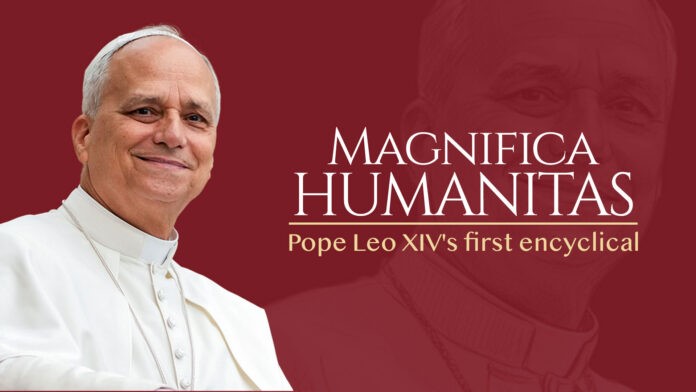
He offered his ideas by issuing a document known as an encyclical, a nearly 400-year-old papal tradition of teaching the Roman Catholic faithful. The document issued on Monday, is Leo’s first encyclical since he became pope last year.
Written by the pope and generally addressed to the whole church, encyclicals impart authoritative teachings about moral or social challenges. They lack the legal status of a papal bull, which is a formal declaration of an article of faith or moral law. But Catholics are still encouraged to use encyclicals to guide their lifestyles and choices.
Popes do not usually attend the presentation of their encyclicals, but Leo presented his in person at the Vatican alongside Christopher Olah, a founder of Anthropic, a major A.I. developer, and several Catholic prelates and theologians.
His encyclical, entitled, Magnificat Humanitas: On Safeguarding the Human Person in the Time of Artificial Intelligence (has 245 sections). The title says it all. His message voices concerns that the human race has to be protected from untethered AI. Here are two paragraphs:
“It is not my intention here to offer a comprehensive treatment of artificial intelligence, nor to give an overview of the extensive relevant literature, since authoritative contributions already exist, including within the ecclesial context. I limit myself to recalling a few essential elements for a moral and social discernment that safeguards the primacy of the human person, in order to ensure that it will always be human intelligence, with its conscience and freedom, that guides technical innovations and responsibly determines their use and limits.
It is appropriate to preface this discussion with two considerations. First, any statement regarding AI risks becoming quickly outdated, given the remarkable pace at which these systems are developing. Second, all of us, including those who design them, possess only a limited understanding of their actual functioning. Indeed, current AI systems are more “cultivated” than “built,” for developers do not directly design every detail, but instead create a framework within which the intelligence “grows.” As a result, fundamental scientific aspects — such as the internal representations and computational processes of these systems — remain, at present, unknown. There thus emerges an urgent need for a twofold commitment: on the one hand, a deepening of scientific research; on the other, the exercise of moral and spiritual discernment.”
The entire encyclical is worth a read!
Tony

This entry is licensed under a Creative Commons Attribution-NonCommercial-ShareAlike 4.0 International license.

